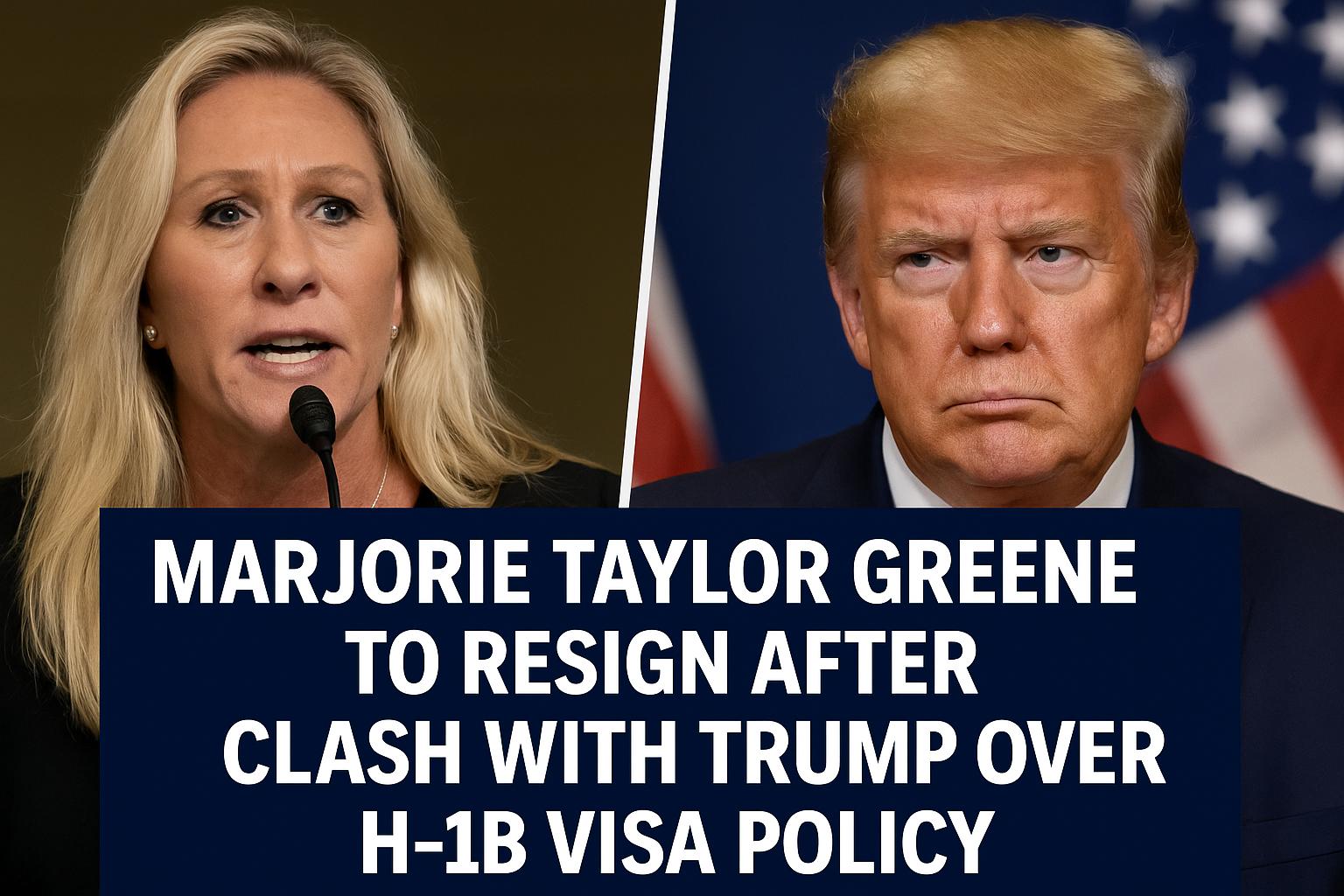
Republican Congresswoman Marjorie Taylor Greene has announced that she will resign from the U.S. House of Representatives in January, bringing an abrupt end to her third term. The decision follows a heated public fallout with President Donald Trump, who recently withdrew his endorsement of the Georgia lawmaker after months of rising tensions. Greene, long known as a vocal Trump ally and one of the most prominent figures associated with the MAGA movement, confirmed her departure late Friday, marking a significant shift within Republican politics.
Greene’s resignation comes just days after she introduced a bill calling for the elimination of the H-1B visa programme, a temporary work visa widely used by American companies to hire foreign professionals. Indians, particularly those in the technology sector, make up the majority of H-1B recipients each year. The proposal placed her at odds with Trump, who only days earlier publicly defended the programme, arguing that the United States needs highly skilled workers from abroad to address labour shortages in several industries. His remarks represented a departure from longstanding criticism of employment-based visa programmes among many MAGA-aligned figures.
Political observers suggest that Greene’s decision to target the H-1B programme may have been an attempt to position herself as the uncompromising defender of an “America First” agenda at a time when Trump’s stance appeared to shift. Reports indicate that Trump had already grown frustrated with Greene’s persistent calls to release the Epstein files, but her aggressive push to end the visa programme intensified their rift. Trump subsequently denounced her in unusually personal terms, describing her as a “lunatic” and accusing her of constant complaints rather than contributing productively to the party’s agenda.
The disagreement escalated further when Greene publicly criticised Trump during interviews, arguing that his support for foreign talent and student visa holders did not align with America First principles. She highlighted concerns over Chinese student enrolment and foreign worker participation in the U.S. job market, asserting that American workers and students were being displaced. Greene also questioned Trump’s international travel schedule, insisting that greater focus should be placed on domestic priorities.
Despite having arrived in Congress in 2021 as one of Trump’s most loyal supporters, Greene has increasingly sought to distinguish herself from the broader MAGA direction. She has taken controversial positions on foreign policy, notably becoming the first Republican lawmaker to describe the situation in Gaza as genocide, and has repeatedly demanded the release of the Epstein files, emphasising her support for survivors.
Trump’s decision to retract his endorsement marked a turning point in their relationship. He accused her of self-serving political theatrics and signalled openness to backing a primary challenger in her Georgia district. Greene, in response, warned that Trump’s public attacks could place her at risk, while continuing to present herself as the steadfast champion of grassroots conservative priorities.
At the centre of the dispute is the changing political landscape surrounding U.S. immigration and skilled-worker programmes. While traditional MAGA voices have long argued that the H-1B visa system allows companies to undercut American wages, Trump recently stated that the United States lacks specific technical skills within the domestic workforce. He argued that the nation cannot simply pull workers “off an unemployment line” to fill advanced manufacturing and defence-related roles. He also expressed support for foreign students, asserting that they are vital contributors to American business competitiveness.
What once appeared to be an enduring political alliance has now fractured into an open feud, reshaping dynamics within the Republican Party. Greene’s resignation underscores the growing ideological divide over immigration, foreign talent, and the future direction of the conservative movement. Her departure from Congress marks the conclusion of a tumultuous chapter defined by contentious policy battles, shifting loyalties, and an increasingly public struggle over the meaning of America First within the GOP.