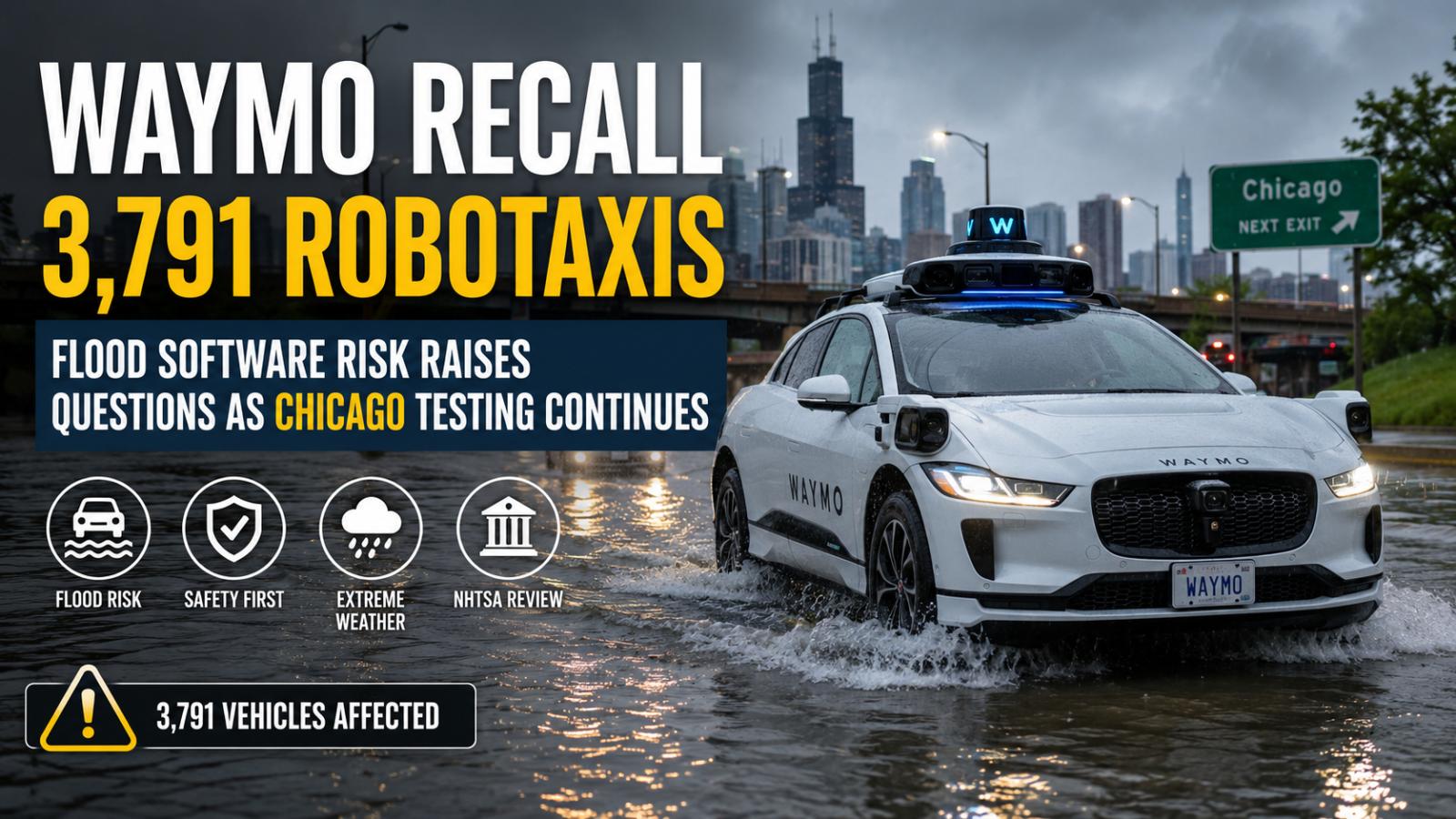
Waymo’s recall of 3,791 robotaxis is putting new attention on self-driving safety as the company continues early-stage testing in Chicago.
Federal safety officials said the issue involves autonomous-driving software that may slow but fail to stop when detecting a flooded lane on higher-speed roads, increasing crash risk.
Why Waymo Issued the Recall
The recall followed a Monday, April 20, 2026, incident in San Antonio, Texas, where an unoccupied Waymo vehicle entered a flooded road during severe weather. No passengers were inside, and no injuries were reported.
Waymo said it found an area for improvement involving flooded lanes on faster roads and filed a voluntary software recall covering fifth- and sixth-generation automated driving systems.
What Changes Are Being Made
NHTSA said Waymo has increased weather-related operating limits and updated vehicle maps while a full remedy is developed. Waymo said it is adding software safeguards and limiting access to areas where flash flooding may occur.
What It Means for Chicago
Waymo began mapping Chicago in late February as an early step toward a possible future robotaxi service. The company says the recall will not affect its Chicago testing.
Still, Chicago’s heavy rain, expressways and urban flooding risks make the recall important for Illinois regulators and riders watching how driverless taxis handle extreme weather before broader approval.
Why Flood Risk Matters
The National Weather Service warns that flooded roads can become dangerous quickly, with one foot of moving water able to carry away many cars and two feet capable of moving larger vehicles.
For Waymo, the recall is not just a software fix. It is a public test of whether autonomous taxis can respond safely when real-world weather changes faster than maps and sensors expect.


 Joyful
0%
Joyful
0%
 Cool
0%
Cool
0%
 Thrilled
0%
Thrilled
0%
 Upset
0%
Upset
0%
 Unhappy
0%
Unhappy
0%