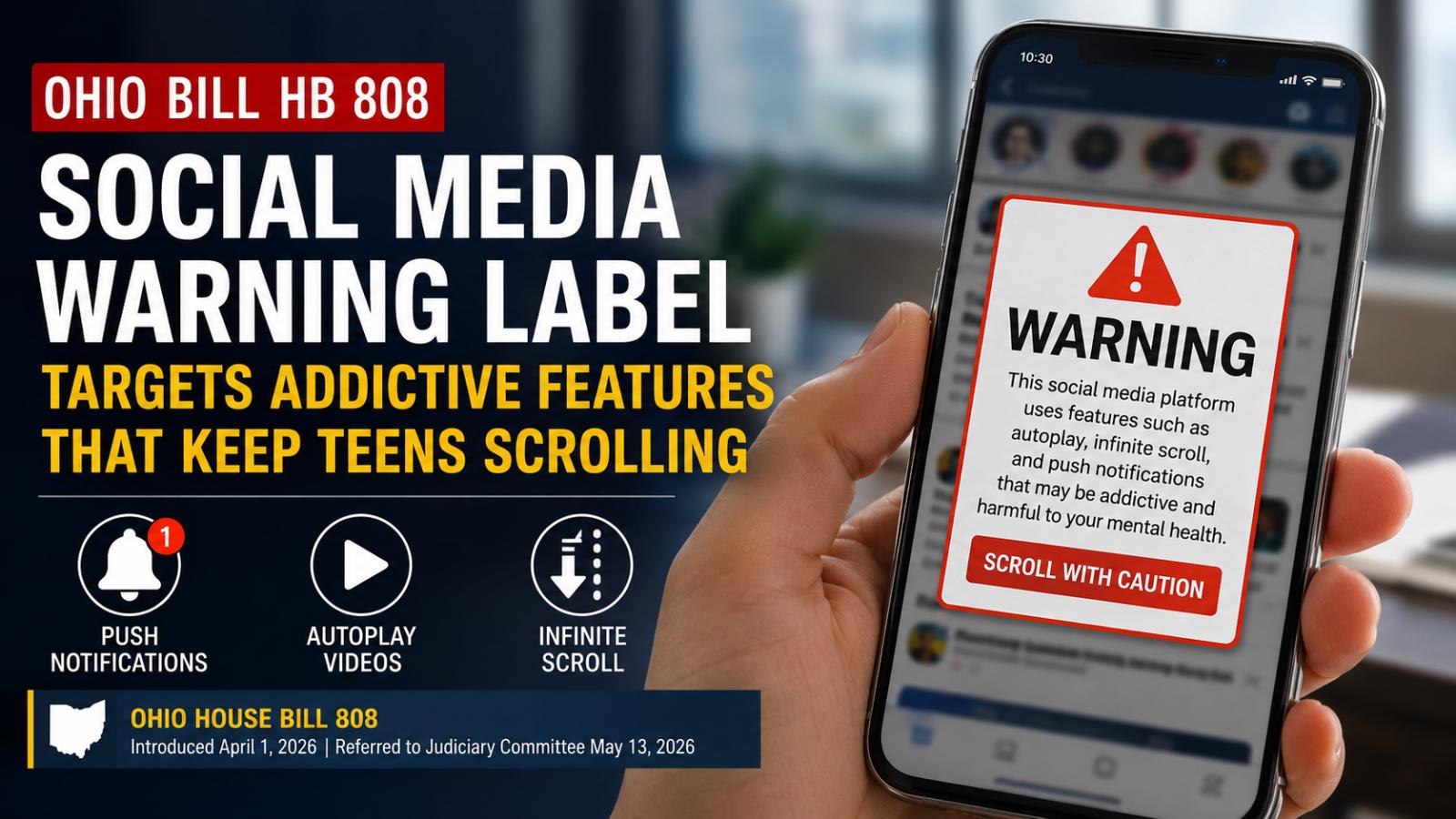
Ohio social media warning label bill HB 808 would require notices on platforms that use addictive features to keep users scrolling for long periods.
The bill was introduced in the Ohio House on Wednesday, April 1, 2026, by state Representatives Christine Cockley of Columbus and Jodi Salvo of Bolivar. Legislative tracking records show the measure was later referred to the House Judiciary Committee on Wednesday, May 13, 2026, with no roll call vote listed so far.
Ohio Social Media Warning Label Bill Targets Addictive App Features
House Bill 808 would require warning labels on “addictive social media platforms.” The official Ohio legislative listing identifies the bill’s title as “Require warning labels on addictive social media platforms,” while the bill summary says it would create new sections of the Ohio Revised Code dealing with social media warning labels.
The proposal targets platforms that use engagement tools such as push notifications, autoplay, infinite scroll and similar design features that can keep users active for extended periods. Supporters say the warnings would alert users, especially teens and parents, when an app is designed to encourage prolonged use.
Why Ohio Lawmakers Are Focusing On Teens
Cockley said constant access to social media can push children and teenagers into comparison with peers, celebrities and influencers. She said those pressures may contribute to depression, anxiety, poor sleep and academic struggles.
Supporters argue that a warning label could remind young users to pause, step away from their phones and build confidence outside online comparison.
What The Bill Would Require
According to reporting on the bill text, the warning label would be created by Ohio’s Director of Behavioral Health in consultation with the Department of Health and the Department of Education and Workforce. The label would be based on available medical and sociological research, including government publications and peer-reviewed studies.
The measure would direct officials to consider possible links between extended social media use and anxiety, depression, body dysmorphia, low self-esteem, sleep disruption, educational outcomes, attention span, memory formation and related behavioral patterns. The bill also calls for annual updates to the warning label and an annual report explaining how research shaped the label’s design, timing and duration.
Broader Legal Context
The Ohio proposal comes amid a wider national debate over whether states can regulate social media design without violating First Amendment protections. In 2024, then-U.S. Surgeon General Vivek Murthy called for warning labels on social media platforms as part of the national discussion on youth mental health. The U.S. Department of Health and Human Services has also warned that children and adolescents who spend more than three hours a day on social media face double the risk of mental health problems, including symptoms of depression and anxiety.
Ohio has already faced legal challenges over social media regulation. A federal judge previously struck down an Ohio law requiring parental consent for children under 16 to access social media apps, finding it unconstitutional, according to the Associated Press.
The U.S. Supreme Court’s 2024 decision in Moody v. NetChoice also placed state social media laws under closer constitutional scrutiny, especially when laws affect how platforms manage or present speech.
Expert Says Social Media Risk Varies By User
Dr. Kristen Lindquist, a psychology professor and emotional development expert at Ohio State University, said social media is powerful because it taps into the brain’s natural interest in social connection. She said online platforms are different from face-to-face interaction because they are always available.
Lindquist cautioned that the evidence does not show social media harms every user in the same way. Children who are otherwise doing well and can control their use may not face serious harm, while young people with lower self-esteem, depressive symptoms or certain online habits may be more vulnerable.
The bill’s progress in the House Judiciary Committee will show whether Ohio lawmakers want to move from warning parents and teens about social media risks to legally requiring platforms to display those warnings.