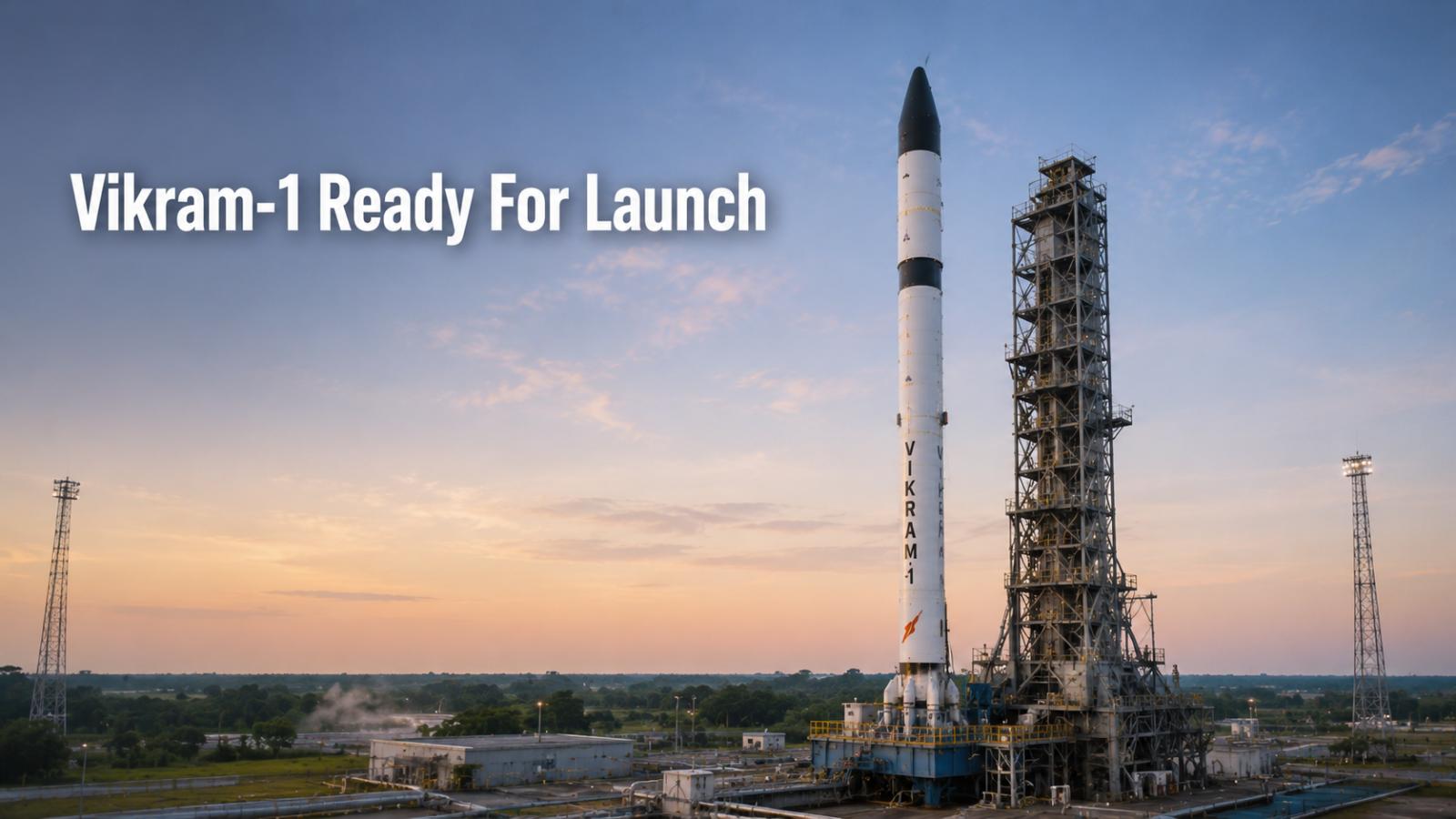
Skyroot Aerospace is preparing Vikram-1 for its maiden orbital mission from Sriharikota. Scheduled for July 18, 2026, the launch could mark India’s first privately developed orbital rocket flight and strengthen the country’s commercial small-satellite launch sector.
The Vikram-1 first orbital launch is scheduled for 11:30 a.m. IST on Saturday, July 18, 2026, from the Satish Dhawan Space Centre in Sriharikota, Andhra Pradesh. Through Mission Aagaman, Skyroot Aerospace will attempt India’s first orbital launch by a privately developed rocket.
Prime Minister Narendra Modi wished the Hyderabad-based company success before liftoff, calling the mission a “historic new frontier” for India’s space journey. He said the flight reflects the talent and entrepreneurial spirit of young Indians and shows how space reforms are creating opportunities for innovation.
Vikram-1 First Orbital Launch: Time and Mission
Mission Aagaman will attempt to place its satellite payloads into a 450-kilometre Low Earth Orbit at a 60-degree inclination. Low Earth Orbit is commonly used for communication, observation and technology-testing satellites.
Vikram-1 is designed to provide dedicated services for small satellites, helping customers reach selected orbits without relying only on spare capacity aboard larger rockets.
What Vikram-1 Will Carry
Among the payloads is Diamond Lotus, described in the report as a laboratory-grown diamond developed by Bengaluru-based Cosmos Diamonds. The item adds a symbolic element to a mission mainly intended to test the rocket and demonstrate launch capability.
The flight will examine propulsion, guidance, stage separation, telemetry and orbital deployment systems. Mission data will support Skyroot’s later development flights and planned commercial services.
Skyroot Aerospace Rocket Features
The four-stage rocket stands about 24 metres tall and uses a lightweight carbon-composite structure. Its first three stages use solid fuel, while a liquid-fuelled orbital adjustment module handles final manoeuvres.
Vikram-1 is designed to carry payloads of up to 350 kilograms to a 450-kilometre orbit. Reaching orbit requires precise stage separation, high speed and accurate payload deployment.
Why Mission Aagaman Matters
India expanded private participation in its space sector through reforms introduced in 2020. Vikram-1’s maiden flight will test whether a private Indian company can operate an orbital-class launch vehicle from an Indian spaceport.
A successful mission could strengthen India’s small-satellite launch market and encourage investment in domestic space technology. The flight should not be described as successful until Skyroot Aerospace, ISRO, IN-SPACe or another authorised source confirms the result.
Skyroot previously launched the Vikram-S suborbital demonstrator from Sriharikota on Friday, November 18, 2022. Vikram-1 is more complex because it is intended to enter orbit and deploy satellite payloads.