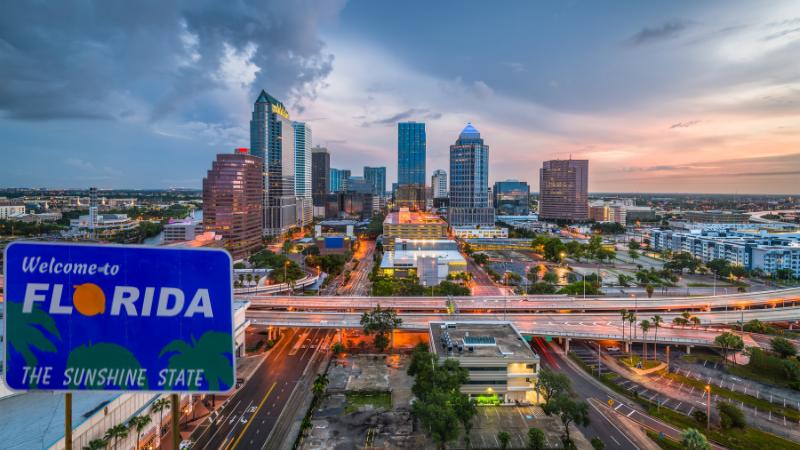
When drivers enter a new state in the U.S., they’re often met with a cheerful "Welcome to…" sign, a longstanding gesture symbolizing hospitality and openness. However, for undocumented immigrants carrying certain types of out-of-state driver's licenses, the message is becoming increasingly unwelcoming. A growing number of Republican-led states are now invalidating driver’s licenses issued to undocumented immigrants by other states, reflecting a widening divide over immigration policy and enforcement.
Florida led the charge in 2023 by passing a law that invalidates certain driver’s licenses issued by other states to immigrants in the country without legal status. Signed into law by Governor Ron DeSantis, the measure makes it a misdemeanor to drive in Florida using a license issued “exclusively to undocumented immigrants” or marked to indicate the holder did not provide proof of lawful presence. The law currently targets only a narrow category of licenses—specifically those from Connecticut and Delaware that use special markings to denote undocumented status. Connecticut has issued nearly 60,700 such licenses, while Delaware has not publicly released similar data.
Though narrow in scope, Florida’s law sends a strong political message and has inspired other Republican-majority states to follow suit. Tennessee and Wyoming have already passed or proposed similar legislation, while Alabama, Montana, New Hampshire, North Dakota, Oklahoma, and South Carolina have introduced bills or seen movement on related efforts. In Alabama, lawmakers are considering a requirement that all state highway welcome signs include a warning about the invalidation of certain out-of-state licenses, to inform drivers before they’re potentially subject to penalties.
These actions form part of a broader trend of states asserting themselves in immigration enforcement, a domain traditionally managed by the federal government. While states cannot enforce deportation or regulate entry, they are increasingly crafting laws that influence the everyday lives of undocumented immigrants. By invalidating driver’s licenses, these states aim to deter undocumented immigrants from living, working, or even traveling through their jurisdictions.
Meanwhile, 19 other states and Washington, D.C., take a very different approach, issuing driver’s licenses to undocumented immigrants as a matter of safety and integration. In these states, licenses are granted based on requirements like passing a driving test, regardless of legal status. Many of these licenses do not visibly differentiate the holder’s immigration status, though Connecticut and Delaware use distinct markings.
This split exists despite a federal push for uniformity. On May 7, the REAL ID Act will be enforced nationwide. It requires a standardized form of identification for activities such as boarding domestic flights and entering federal buildings. REAL ID-compliant licenses include a star and are only issued to individuals who can provide proof of lawful presence, such as U.S. citizens or permanent residents. Yet, states remain free to issue non-compliant licenses, which creates a two-tier system—one that’s further complicated by politically motivated laws like Florida’s.
Connecticut Governor Ned Lamont attempted to respond by proposing legislation that would remove the special designation from licenses given to undocumented immigrants. This move would effectively make them indistinguishable from other non-REAL ID licenses, potentially allowing them to remain valid in Florida. However, the bill did not come to a vote.
Supporters of these restrictive laws argue they help deter illegal immigration and maintain law and order. In Alabama, state Senator Chris Elliott openly stated that the goal is to discourage undocumented immigrants from entering or remaining in the state. He believes that if undocumented individuals know their licenses won’t be valid, they’ll avoid driving into or through Alabama altogether.
Critics say the laws are not only mean-spirited but also counterproductive and potentially harmful to tourism and business. Alabama state Senator Linda Coleman-Madison noted that these laws might entrap unsuspecting tourists and legal visitors. She proposed amending legislation to include warnings on road signs, ensuring that people are aware of the risk before they cross state lines.
Beyond the legal technicalities, the effect of these policies is deeply personal for those impacted. For many undocumented immigrants, a driver’s license is essential to daily life—used to commute, transport family members, and access basic services. According to advocates in Florida, while actual enforcement of the license ban remains rare, fear among undocumented communities has increased. Some immigrants deliberately travel to other states to obtain a legal license, only to be denied the ability to use it elsewhere.
Even in states like California, where undocumented immigrants can legally obtain licenses, there’s growing concern about interstate travel. Immigrants with valid California licenses are increasingly hesitant to drive into states like Florida or Tennessee, fearing their licenses will be rejected, and they may be arrested or penalized.
This legal patchwork places undocumented individuals in an increasingly precarious situation. The disparities between state policies have introduced a form of geographic inequality in access to mobility. As more states take independent action, it becomes harder to maintain any form of consistent national standard.
The clash over driver's licenses underscores a deeper tension between state sovereignty and federal immigration authority. While the federal government struggles to implement comprehensive reform, states are moving in opposite directions—some toward inclusion, others toward restriction. For the individuals caught in between, every state line represents not just a new jurisdiction, but a new set of risks and rights.
What was once a routine form of identification has now become a flashpoint in America’s immigration debate. As these laws proliferate, the act of driving across a state border becomes an uncertain journey for undocumented immigrants, many of whom are just trying to live and work in peace. For them, the once-friendly roadside greeting may now serve more as a warning than a welcome.