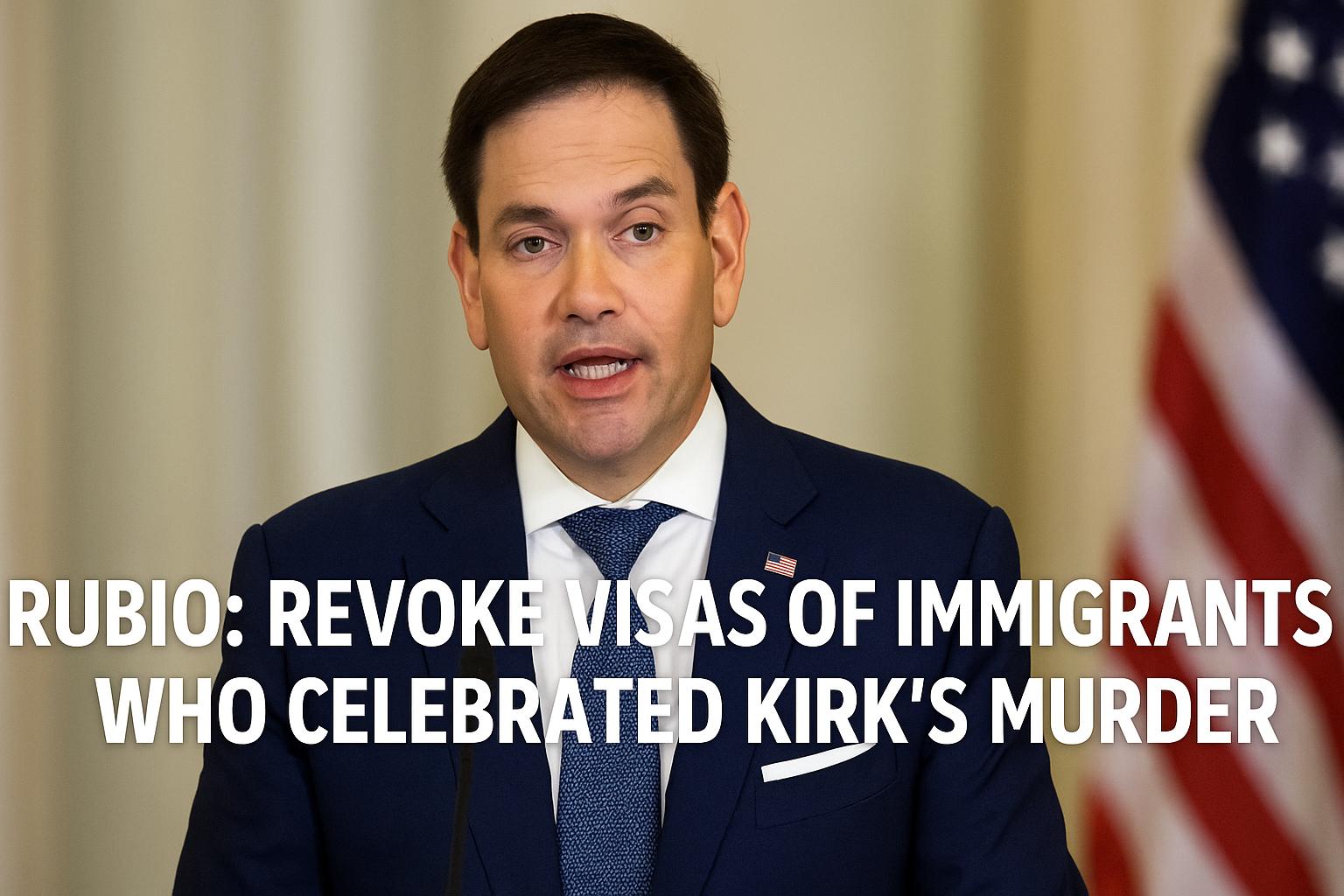
The United States was left shaken in the wake of the murder of right-wing activist Charlie Kirk, a close ally of President Donald Trump. His death, following a shooting at Utah Valley University, has stirred a heated political storm and brought renewed debate over gun violence, political extremism, and immigration policy. United States Secretary of State Marco Rubio responded firmly, declaring that immigrants found celebrating Kirk’s killing would face visa revocations and possible deportation.
Rubio, addressing the nation through a video message, stressed that the United States does not welcome individuals who endorse or celebrate political assassinations. He said the country holds high standards for granting visas to students, tourists, and workers, and emphasized that those who applaud the murder of political figures undermine the safety and values of America. According to Rubio, those who were celebrating Kirk’s death on social media or in public while holding visas should expect immediate action from federal authorities. Visa cancellations, he warned, are already underway. The strong words reflect a determination to ensure that individuals who cheer on political violence have no place in the United States.
Kirk’s killing has intensified the already tense political climate. The activist, known for his outspoken support of conservative causes and alignment with Trump, was shot while attending an event at Utah Valley University on September 10. He succumbed to his injuries later that day. The tragedy was swiftly labeled an act of political violence, with Trump himself calling Kirk a martyr and ordering American flags to be flown at half-mast in his honor. Supporters hailed him as a patriot whose work embodied the fight for conservative values, while critics revisited his controversial stances on issues like gun rights, accusing him of fueling the very atmosphere of division that has worsened violence across the nation.
Authorities arrested a suspect, Tyler Robinson, who was quickly taken into custody by the Federal Bureau of Investigation. Early reports indicate that Robinson had a complex personal life, including ties to an alleged transgender partner named Lance Twiggs. The investigation has sparked discussions not only about Robinson’s motives but also about the broader radicalization and instability leading to political violence in the United States. Federal agents are now piecing together evidence to understand whether Robinson acted alone or with encouragement from wider networks of ideological extremism.
The atmosphere following Kirk’s murder has been one of sharp polarization. On one hand, tens of thousands of his supporters are demanding justice and stricter action against those who commit acts of political violence. On the other, his critics argue that Kirk himself contributed to the volatile climate through his uncompromising rhetoric, particularly on topics like gun rights and immigration. This divide highlights the broader struggle within American politics, where ideological battles frequently spill into the realm of personal safety and community security.
Rubio’s statement underscores the government’s intent to draw a line between free expression and destructive behavior. He pointed out that while freedom of speech remains central to American values, actively celebrating the assassination of a political figure crosses a line that cannot be tolerated. For those holding visas, the consequences are immediate and non-negotiable: visa revocation and deportation. By targeting this specific group, the administration aims to send a strong message that residency and visitation privileges in the United States are not compatible with celebrating violence.
Observers note that this approach highlights the intersection of immigration policy and national security. In an era when social media amplifies reactions to political events in real time, the government is under pressure to monitor not only threats but also the public discourse around them. By linking visa eligibility with public conduct, officials hope to prevent individuals who support violence from using American soil as a platform. At the same time, critics argue that such measures risk blurring the line between personal opinion and actionable threats, raising questions about enforcement and due process.
Despite the debates, Kirk’s murder remains a painful reminder of the fragility of political life in the United States. His death has prompted both mourning and criticism, reflecting the polarized nation he worked in and spoke to. While investigations into Robinson’s motives continue, the broader impact is already clear. The incident has intensified the clash between advocates for stricter gun control and defenders of gun rights, while simultaneously bringing immigration and deportation policy into the spotlight.
As the tour of his memory continues in political speeches and rallies, Kirk is being remembered by his supporters as a man who stood unapologetically for conservative ideals. For opponents, his death serves as a tragic example of how divisive rhetoric can escalate into real-world violence. Meanwhile, Marco Rubio’s stance ensures that the case will not only remain a central issue in the political landscape but also shape policy on who gets to enter and remain in the United States. His firm words make clear that celebrating acts of violence will not only be condemned but will also come with consequences for those whose status in the country depends on a visa.
The murder of Charlie Kirk, the arrest of Tyler Robinson, and the administration’s response have combined to create one of the most controversial episodes of recent political history. It underscores the dangers of rising hostility, the influence of online communities, and the pressure on leaders to respond quickly and decisively. As the story continues to unfold, one thing remains certain: the legacy of Charlie Kirk’s life and the government’s firm reaction to his death will leave a lasting imprint on both the political climate and immigration enforcement in the United States.