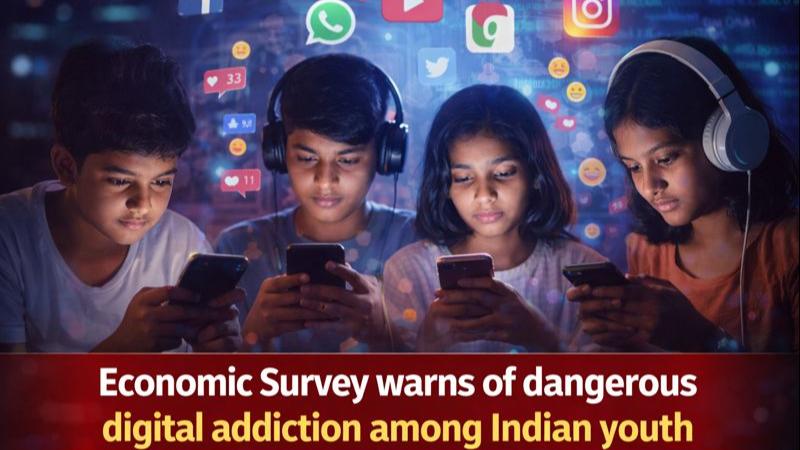
India’s Economic Survey 2025–26 has raised a serious warning over the rapid rise of digital addiction among children and adolescents, calling it a growing public health and economic risk. Tabled in Parliament on Thursday, the report highlights how excessive use of smartphones, social media, gaming platforms, and online entertainment is increasingly affecting mental wellbeing, academic performance, and long-term productivity among the country’s youth. The survey defines digital addiction as persistent and compulsive digital use that results in psychological distress and disrupts daily functioning, a pattern that is becoming alarmingly common in younger age groups.
According to the survey, prolonged screen exposure is linked to reduced concentration, sleep deprivation, anxiety, and declining learning outcomes. These effects extend beyond individuals, weakening social connections by reducing face-to-face interactions, community participation, and essential interpersonal skills. The report also flags broader economic implications, noting that compulsive digital behaviour leads to impulsive online spending, gaming-related losses, cyber fraud exposure, and long-term costs in the form of lower employability, reduced workplace productivity, and diminished lifetime earnings.
The survey expresses particular concern over social media addiction, which it links to anxiety, depression, low self-esteem, cyberbullying stress, and higher suicide risks among young people. Studies cited in the report indicate that individuals aged 15 to 24 are especially vulnerable, as constant exposure to high-stimulation content amplifies stress and emotional instability. The issue is compounded by academic pressure and digital peer comparison, making adolescents more susceptible to mental health disorders and sleep-related problems.
Digital engagement continues to expand rapidly across India. In 2024, nearly half of Indian internet users consumed online video content, while over 40 percent actively used social media platforms. Millions more relied on digital payments, music streaming, food delivery apps, and email services. This widespread usage means India’s youth are growing up in an environment where constant digital interaction is the norm rather than the exception. The survey stresses that while digital access has opened doors to education, employment, and civic engagement, access itself is no longer the challenge, especially among people aged 15 to 29 where internet penetration is nearly universal.
The Economic Survey argues that policy priorities must now shift from expanding access to managing digital wellbeing. It recommends structured interventions such as cyber-safety education, parental guidance on screen-time management, peer mentoring programmes, mandatory physical activity in schools, and age-appropriate digital access policies. The report also calls for stronger accountability from online platforms hosting harmful or addictive content and encourages families to adopt screen limits, device-free hours, and shared offline activities.
Drawing from international examples, the survey highlights measures adopted by countries such as Australia, China, South Korea, and Singapore to curb youth digital addiction through age restrictions, gaming limits, parental controls, and community-based cyber wellness programmes. Several nations have also restricted smartphone use in classrooms to protect student focus and mental health. For India, the report suggests additional steps including offline youth engagement hubs, voluntary digital detox initiatives, education-only digital devices for children, and expanded mental health support services like the Tele-MANAS helpline. The survey concludes that safeguarding youth mental health is essential to ensuring India’s digital growth does not undermine its social and economic future.