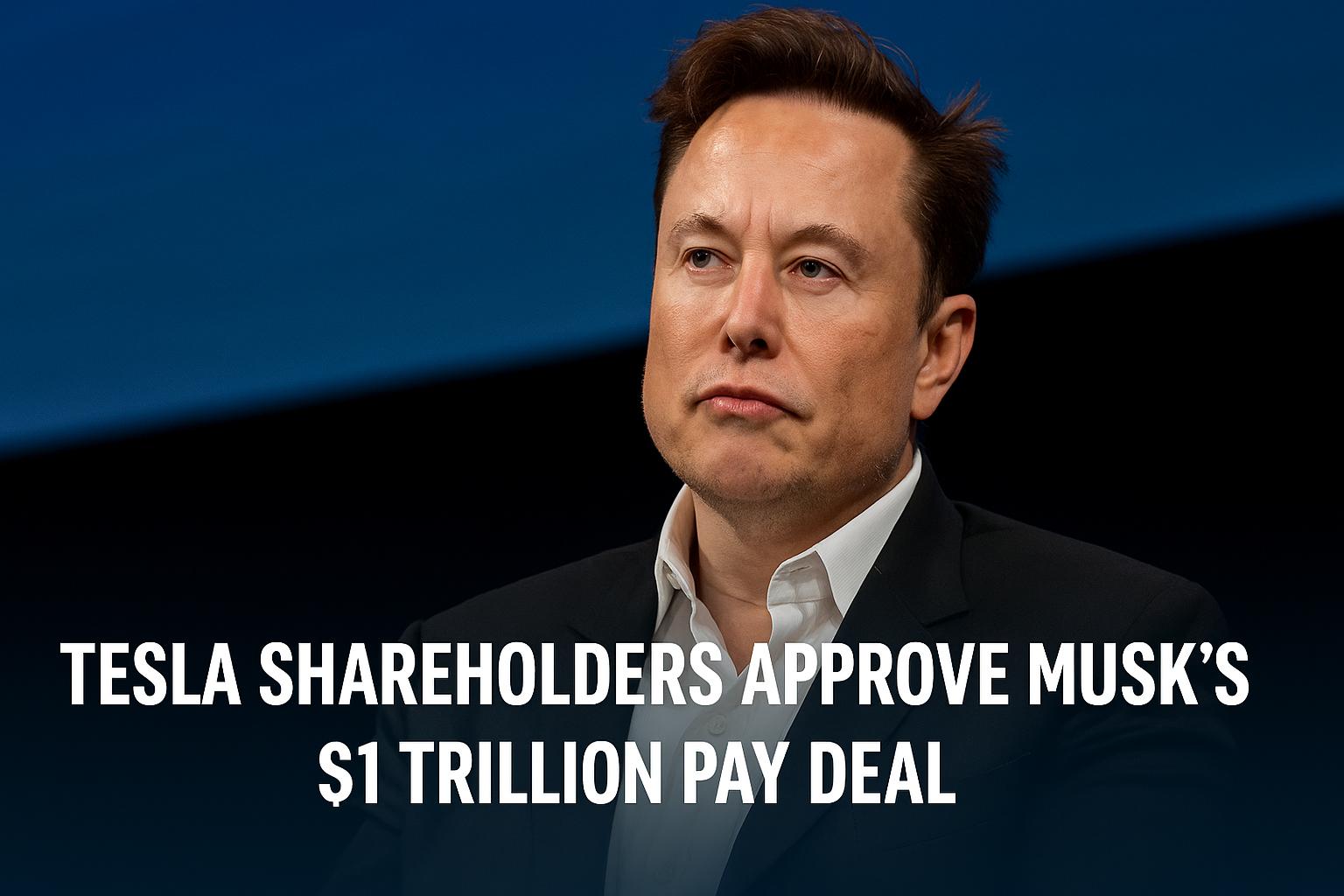
Elon Musk has once again redefined corporate ambition. At Tesla’s annual shareholder meeting in Austin, the company’s investors voted to approve an unprecedented $1 trillion compensation plan for its CEO. The package, designed to stretch over a decade, is tied to a series of extraordinary performance goals that could transform Tesla into one of the most valuable and diversified technology companies in the world.
Unlike conventional executive pay structures, Musk’s plan contains no guaranteed salary or cash bonuses. His earnings depend entirely on Tesla achieving what the company calls “Mars-shot milestones,” referring to goals that push the limits of both innovation and scale. The structure reflects Tesla’s intent to link compensation to extraordinary long-term performance rather than short-term financial metrics.
The compensation plan is divided into 12 segments, each triggered by a combination of market capitalization milestones and operational benchmarks. The first tranche activates only when Tesla’s valuation hits $2 trillion, nearly $500 billion above its current level. From there, the targets escalate through a mix of $500 billion and $1 trillion increments, culminating in an almost unimaginable $8.5 trillion market capitalization goal. Achieving that would make Tesla nearly twice as valuable as today’s most valuable company.
For context, Tesla’s current market value stands at around $1.5 trillion, a figure that already places it among the largest corporations in history. Yet Musk’s targets go far beyond share price performance. The agreement demands substantial progress in production, technology, and profitability, making it one of the most ambitious pay frameworks ever established.
One of the central pillars of Musk’s plan is the company’s goal to deliver 20 million vehicles by 2035. This is a daunting challenge, considering Tesla has produced only around 8 million vehicles to date. Meeting this target requires expanding production capacity, constructing new factories worldwide, and securing access to raw materials needed for battery and chip manufacturing. It also means maintaining leadership in an industry where competition from Chinese and European manufacturers is intensifying rapidly.
Beyond cars, Tesla’s vision extends to technologies that once existed only in science fiction. The company aims to operate one million robotaxis commercially for at least three months. Its current pilot program in Austin remains small, with only hundreds of vehicles, though plans are underway to expand to multiple U.S. cities. These autonomous fleets are expected to serve as both a revenue driver and a demonstration of Tesla’s self-driving software maturity, which remains under regulatory scrutiny.
Another crucial component is the production and deployment of one million humanoid robots, known as Optimus. These robots are expected to cost around $20,000 each and could transform industries from logistics to personal assistance. However, they are still in the prototype stage, and mass production presents immense engineering and manufacturing challenges.
Tesla’s software ambitions are equally bold. One milestone requires achieving 10 million active Full Self-Driving subscriptions within a three-month window. Reaching this goal demands dramatic improvements in Tesla’s driver-assistance technology, safety systems, and customer trust.
Financially, Tesla must also achieve a staggering $400 billion in adjusted EBITDA (earnings before interest, taxes, depreciation, and amortization) over four consecutive quarters. This would be approximately 25 times higher than its 2024 results. Analysts suggest this level of profitability is only possible if Tesla succeeds in diversifying revenue streams toward AI services, autonomous transportation, and software-based subscriptions rather than relying solely on car sales.
The final stages of Musk’s pay plan include a requirement that Tesla’s board put a formal succession plan in place, ensuring long-term stability and leadership continuity. Musk must also maintain an approved leadership position through at least 2035 to qualify for all tranches. Should he step down earlier, the remaining rewards would be forfeited.
Even if Tesla achieves only a portion of its objectives, the payout potential remains immense. For example, if the company reaches a $3.5 trillion valuation, manufactures 15 million cars, and deploys half a million robotaxis, Musk could still unlock several tranches worth tens of billions of dollars.
At the shareholder meeting, Musk’s confident presentation — and even a brief dance with a humanoid robot — reflected his characteristic mix of showmanship and determination. Yet behind the spectacle lies an extraordinary wager: that Tesla can simultaneously dominate electric vehicles, robotics, and artificial intelligence within the next decade.
If Musk succeeds, it will mark the largest personal payday in corporate history — and potentially a new era for industrial and technological innovation. But if the company falls short, this trillion-dollar promise may stand as one of the boldest yet riskiest compensation experiments ever attempted. The next decade will determine whether Musk’s vision becomes a triumph of ambition or a cautionary tale in corporate history.