The number of reported sightings of rogue drones operating near military installations in the United Kingdom has more than doubled over the past year, raising fresh concerns over national security and prompting the government to consider significant changes to military powers. Official figures show that incidents increased from 126 in 2024 to 266 in 2025, representing a rise of more than 100 per cent and highlighting what ministers describe as an evolving and increasingly complex threat environment.
Government sources have indicated that while not all incidents can be attributed to hostile intent, the involvement of foreign state actors cannot be ruled out in some cases. Defence Secretary John Healey said the sharp increase in drone activity near sensitive locations underscores the changing nature of modern security challenges and the need for faster and more robust responses. He noted that drones, once largely recreational devices, are now capable of surveillance, disruption and potential attack, particularly when used in coordinated operations.
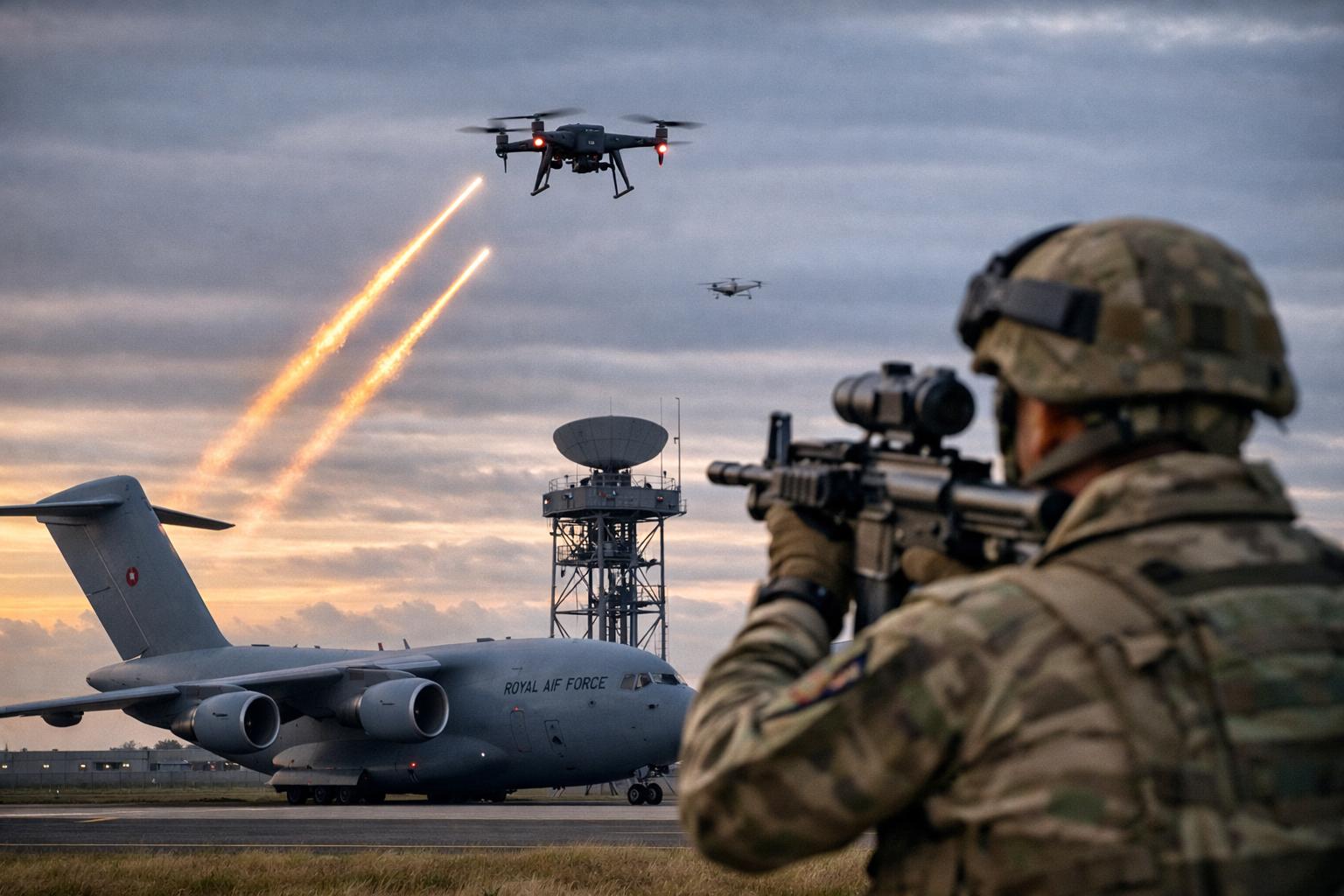
Under current law, UK military personnel do not have the authority to shoot down drones, even when they are detected close to bases or training facilities. Responsibility for kinetic action rests primarily with the police, while soldiers rely on non-lethal counter-drone measures such as diverting aircraft or disrupting navigation systems through GPS interference. The government now plans to address this gap by introducing new legislation through the Armed Forces Bill, which would grant the military direct powers to neutralise threatening drones operating in restricted zones around defence sites.
Healey said the proposed changes would allow armed forces to act more swiftly to protect key installations and personnel, while also increasing investment in advanced counter-drone technologies. Although the initial focus is on military locations, officials have acknowledged that similar measures could eventually be extended to civilian infrastructure, including airports, if the threat level continues to rise.
Heightened concern follows several high-profile incidents last year in which drones were spotted over four UK air bases used by the United States Air Force. These included RAF Lakenheath and RAF Mildenhall in Suffolk, RAF Feltwell in Norfolk and RAF Fairford in Gloucestershire. While no direct damage was reported, the incursions highlighted vulnerabilities and led to temporary security alerts.
The issue is not confined to the United Kingdom. Across Europe, authorities have reported an increase in unidentified drone activity near airports, power stations and military facilities. Some governments have linked the pattern to suspected hybrid warfare tactics connected to Russia’s ongoing conflict with Ukraine, though Moscow has denied any involvement and dismissed such claims.
In response to the growing threat, the UK has already tightened rules governing drone use. New regulations introduced at the start of the year require operators of drones and model aircraft to hold valid flier identification, aimed at improving accountability and enforcement.
Alongside legislative changes, British defence officials have pointed to technological advances as a key part of the response. Last year, the government confirmed the successful field testing of a directed energy weapon designed to counter drone swarm attacks. The system, known as RapidDestroyer, uses radio frequency energy to track, target and disable multiple drones simultaneously and was developed by a consortium led by the British arm of defence company Thales. Officials say such capabilities will play an increasingly important role as drones become more accessible and more sophisticated in both civilian and military contexts.