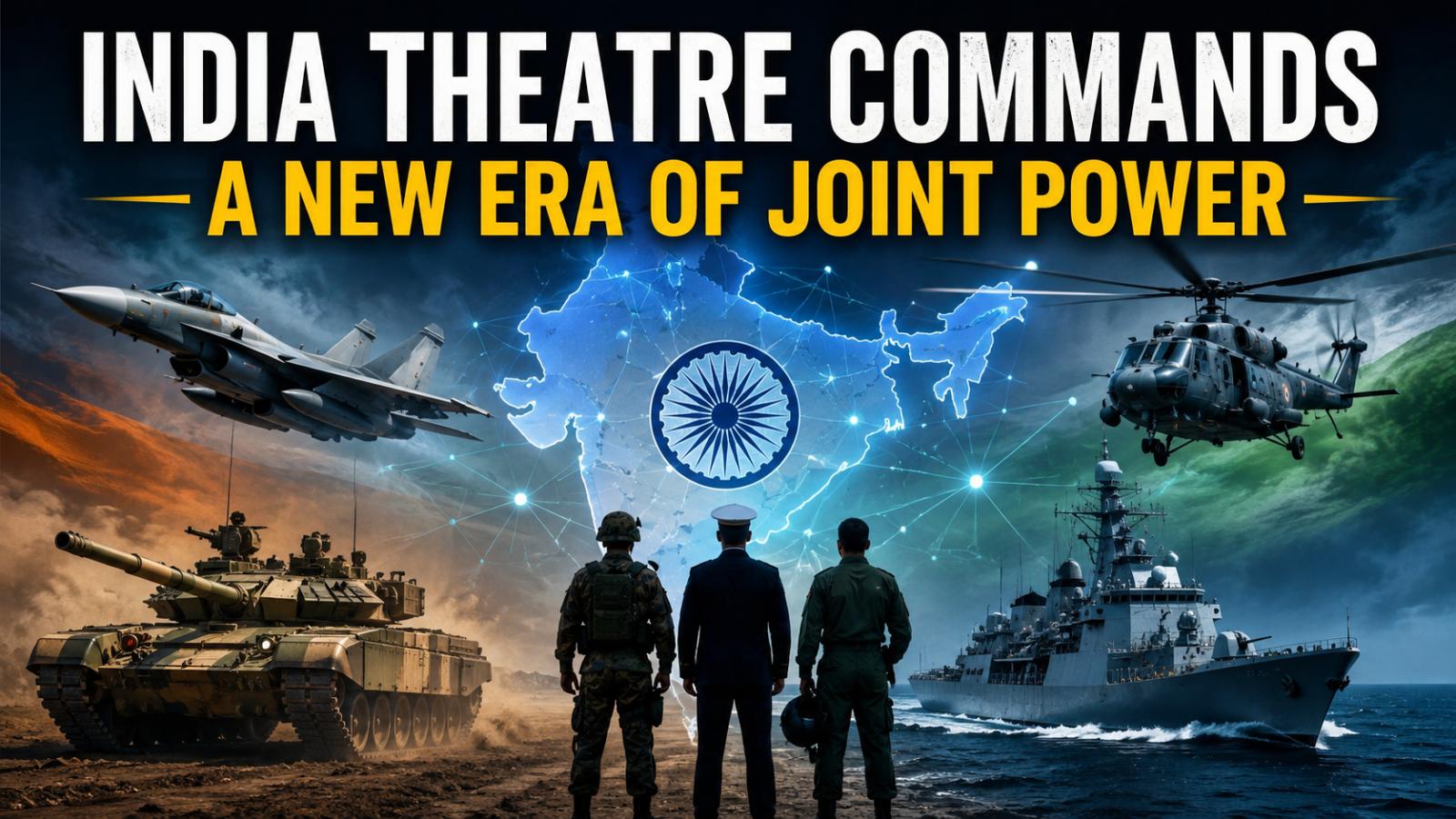
India Theatre Commands are intended to bring the Army, Navy and Air Force under unified operational leadership. The theatreisation proposal seeks stronger jointness, faster decisions, coordinated logistics and an integrated response to land, air and maritime threats.
Theatreisation could replace separate operational planning
India is considering one of the biggest structural changes in the history of its armed forces: the creation of Integrated Theatre Commands. The proposed system would place military resources assigned to a geographical theatre under a single operational commander instead of relying mainly on separate Army, Navy and Air Force command structures.
The objective is not simply to reduce the number of commands. Theatreisation is designed to improve joint planning, intelligence-sharing, logistics and the coordinated use of combat power. A theatre commander could plan land, maritime and air operations as parts of one campaign, allowing the military to respond more quickly to multi-domain threats.
The Ministry of Defence has described the reorganisation of existing commands into joint or integrated theatre commands as an important part of military modernisation. However, the government has not publicly announced the final command boundaries, headquarters or implementation schedule.
Tri-service reform remains under government consideration
Former Chief of Defence Staff General Anil Chauhan led extensive consultations on the proposed structure before completing his tenure in May 2026. Current reports identify General N. S. Raja Subramani as his successor, placing the responsibility for advancing the reform under new military leadership.
The broad plan has been associated with three geographical commands covering the northern, western and maritime theatres. Lucknow, Jaipur and Thiruvananthapuram have been discussed in public reporting as possible headquarters, but these locations should not be presented as final because the Ministry of Defence has not officially confirmed them.
Final implementation would require approval at the highest level of government. Until an official notification is issued, the number of commands, leadership ranks, allocation of forces and transition timetable remain proposals rather than an operational structure.
Air assets remain a central command concern
India currently has seven Army commands, seven Air Force commands and three Naval commands. It also operates the tri-service Andaman and Nicobar Command and the Strategic Forces Command. Converting this arrangement into integrated theatres would require a major redistribution of authority, personnel and operational responsibilities.
One important issue is the management of limited air power. Aircraft can move rapidly between theatres, and specialised resources such as aerial refuellers, surveillance platforms and electronic-warfare systems may be needed across several fronts. The final model must therefore balance theatre commanders’ operational requirements with the need to retain flexible central control over scarce air assets.
Jointness is already advancing through legal and logistics reforms
The Inter-Services Organisations (Command, Control and Discipline) Act, 2023 provides a legal foundation for commanders of notified joint organisations to exercise administrative and disciplinary authority over personnel from different services. The government has presented the law as an important step towards deeper integration among the armed forces.
Joint Logistics Nodes in Mumbai, Guwahati and Port Blair have also been operational since 2021. They provide shared support for supplies, fuel, ammunition, transport, stores and engineering requirements, reducing duplication among the three services.
These measures show that military jointness is progressing even before the Theatre Commands receive final approval. The real test will be whether the completed structure gives commanders clear authority, protects the flexibility of specialised assets and improves combat readiness without creating another layer of bureaucracy.