NASA Accelerates Lunar Base Development Strategy
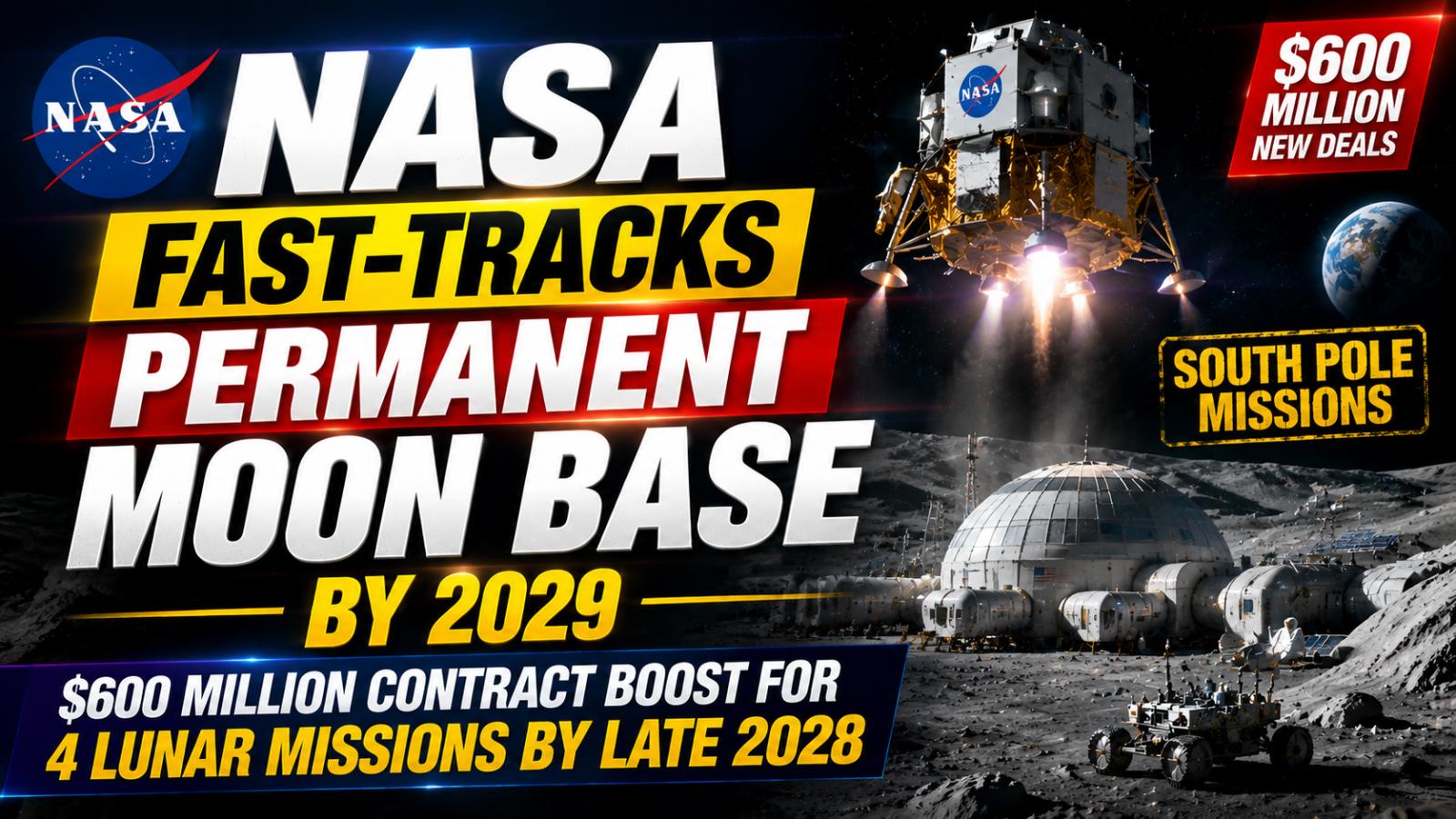
NASA has moved forward with an accelerated timeline for establishing a permanent human presence on the Moon, marking a significant step in its long-term lunar exploration strategy. The US space agency has awarded nearly $600 million in new contracts to three commercial partners to support upcoming lunar missions aimed at the Moon’s south pole.
Commercial Partnerships Drive Lunar Logistics Missions
Under the latest funding allocation, four automated logistics missions are scheduled to launch by late 2028. These missions are designed to transport scientific equipment, navigation systems, and infrastructure components essential for early lunar development. NASA’s approach emphasizes collaboration with private aerospace companies to reduce costs and increase mission frequency while maintaining technical reliability.
The selected partners include Astrobotic, Intuitive Machines, and Firefly Aerospace. Each company will be responsible for delivering payloads using upgraded lunar lander systems, supporting early-stage infrastructure mapping and resource analysis on the lunar surface.
Focus on Moon’s South Pole and Water Resources
NASA’s long-term interest in the Moon’s south pole is driven by the presence of permanently shadowed regions believed to contain water ice. This resource is considered critical for sustained lunar exploration, as it could potentially be converted into drinking water, oxygen, and even rocket fuel. The agency views this as a key foundation for future deep space missions.
The current program represents a strategic shift away from earlier orbital-focused projects, such as the Gateway space station, toward direct surface operations. Officials have indicated that surface-based infrastructure offers more immediate opportunities for long-term exploration and resource utilization.
Industry Challenges and Recent Setbacks
The announcement comes at a time of volatility in the commercial space sector. Recent technical setbacks, including a high-profile failure involving a private heavy-lift rocket during testing, have raised concerns about launch reliability and schedule delays. Despite this, NASA continues to rely on private-sector innovation to advance its lunar ambitions.
Future Outlook for Lunar Construction
NASA is targeting 2029 as the beginning of actual lunar base construction, with earlier missions laying the groundwork through mapping, resource identification, and infrastructure testing. The program reflects a broader shift in space exploration strategy, prioritizing sustainable presence rather than short-term missions.
As commercial space capabilities expand, NASA’s lunar program is expected to evolve into a multi-partner ecosystem, combining government oversight with private-sector execution to achieve long-term human settlement on the Moon.