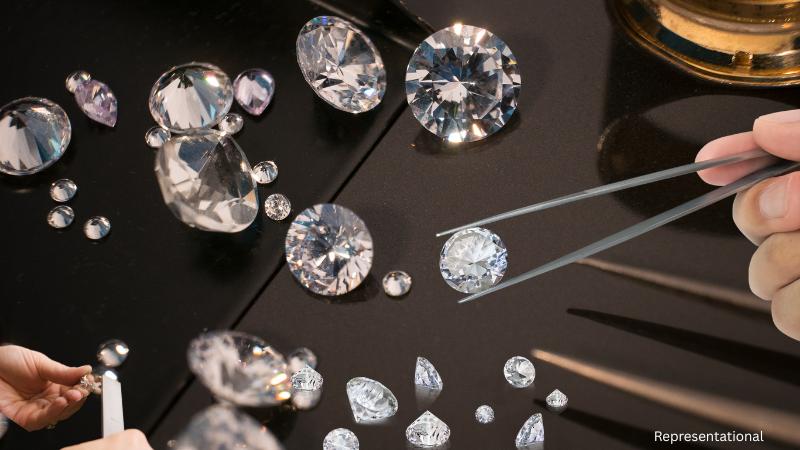
The diamond cutting and polishing industry in Gujarat’s Saurashtra region is facing one of its worst crises in recent history, with nearly one lakh workers losing their jobs since April. The downturn began after the United States imposed a 10 percent base tariff on Indian goods, and the situation has worsened dramatically following a tariff increase to 25 percent. Industry experts warn that an even steeper 50 percent rate is expected to take effect from August 27, further threatening the survival of this labour-intensive sector.
Small-scale diamond processing units in Bhavnagar, Amreli, and Junagadh have been the hardest hit, as many orders from the United States have either been paused or cancelled. The US, which has long been India’s largest diamond market, plays a critical role in sustaining these businesses. In 2024, India supplied 68 percent of the US’s diamond imports by volume and 42 percent by value, amounting to $5.79 billion worth of trade. This dependency means that even minor disruptions in US demand have a disproportionate impact on Indian exporters and workers.
The latest data from the Gems and Jewellery Export Promotion Council reveals the scale of the decline. Exports of cut and polished diamonds fell by 22.72 percent in the first quarter of the 2025-26 financial year compared to the same period last year, dropping to $2.83 billion from $3.67 billion. This steep fall has led to widespread unemployment among skilled artisans, most of whom earn between ₹15,000 and ₹20,000 per month. While there is some potential for a shift towards the lab-grown diamond sector, such opportunities remain limited and cannot absorb the sheer number of displaced workers.
Industry representatives have expressed deep concern over the impact of these tariff hikes. They argue that the US market, which accounts for over $10 billion in diamond exports annually, is too significant to lose. A prolonged downturn or market closure could cripple the industry, affecting not only exporters but also thousands of families dependent on this trade. Many small workshop owners in Saurashtra are already struggling to pay wages, and some have shut down operations entirely in the absence of new orders.
The looming additional 25 percent penalty tariff set for August 27 has intensified fears of a complete collapse. If implemented, most Indian goods entering the US would face a total 50 percent tariff, making them uncompetitive in the American market. The diamond industry, being a high-value yet labour-driven sector, is particularly vulnerable. Experts note that unlike large corporations, small and medium-scale units cannot easily diversify into alternative markets or absorb such steep cost increases.
For workers, the crisis is not only an economic setback but also a social challenge. Many have been employed in diamond cutting for decades, with skills specific to the trade and limited alternatives for income. The sudden loss of employment has created uncertainty for entire households, especially in rural areas where job options are scarce. Families are now grappling with loan repayments, daily expenses, and the risk of long-term unemployment.
The government and industry bodies are under pressure to find solutions, ranging from diplomatic negotiations with the United States to exploring new export destinations. However, such measures take time, and the immediate challenge remains to support workers who have already lost their livelihoods. Without urgent intervention, the Saurashtra diamond belt could face a prolonged recession that might take years to recover from, leaving a lasting impact on both the local economy and the global positioning of India’s diamond trade.