Tanzania’s President Samia Suluhu Hassan has been officially declared the winner of the country’s presidential election, securing another term in office after a landslide victory that has sparked widespread unrest and international concern. The electoral commission announced on Saturday that the incumbent leader, representing the ruling Chama Cha Mapinduzi (CCM) party, won 98% of the votes cast during Wednesday’s election, solidifying the party’s decades-long hold on Tanzanian politics.
According to the electoral chief Jacobs Mwambegele, nearly 32 million votes were cast, and Samia received approximately 31.9 million, representing 97.66% of the total. Voter turnout reached nearly 87% of the 37.6 million registered voters, marking one of the highest participation rates in recent elections. In his statement, Mwambegele proclaimed, “I hereby announce Samia Suluhu Hassan as the winner of the presidential election under the Chama Cha Mapinduzi (CCM) party.” The ruling party and its predecessor, Tanu, have maintained control since Tanzania’s independence, never having lost a national election.
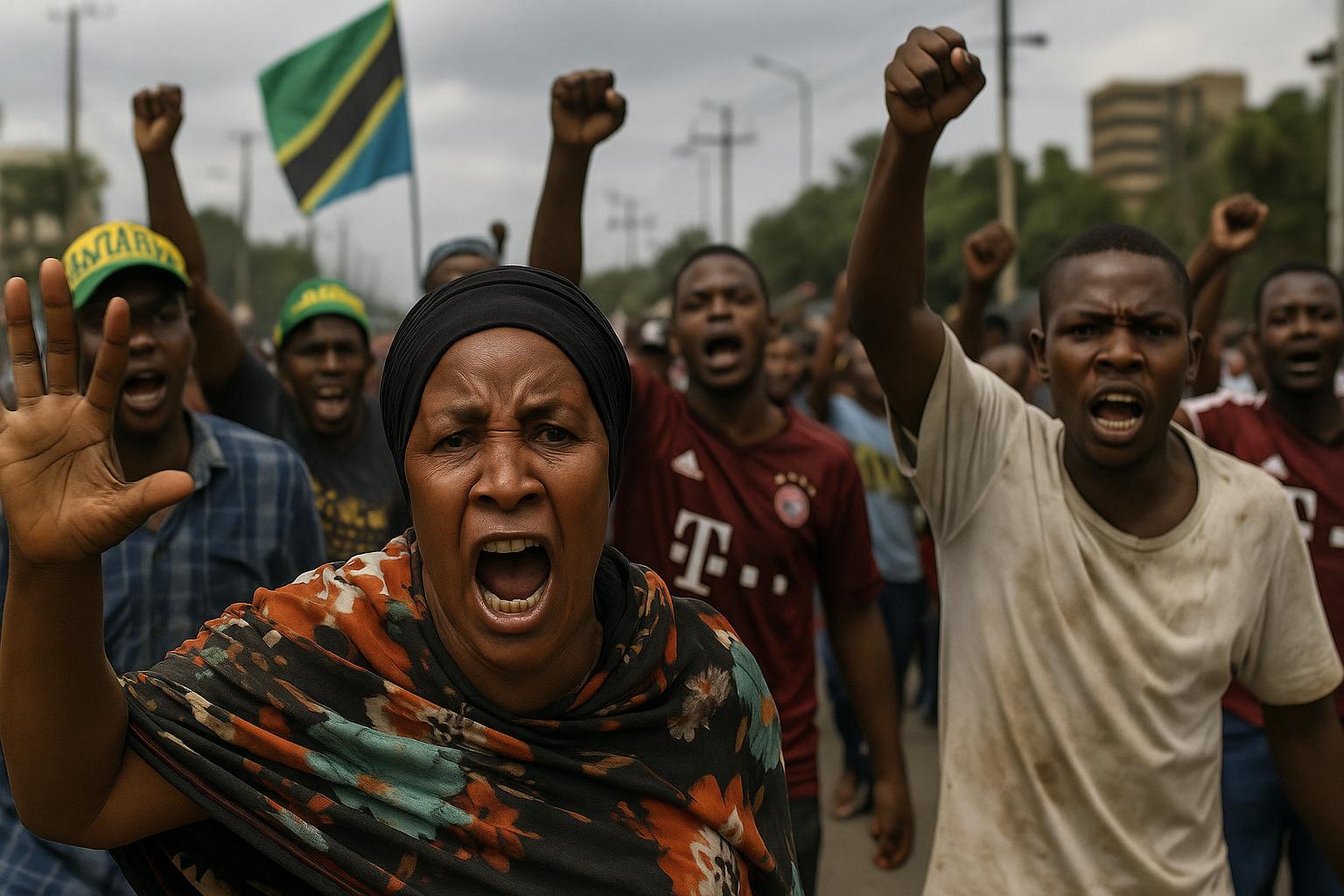
However, the outcome has been overshadowed by allegations of fraud, violent protests, and accusations of human rights abuses. Reports from rights groups and eyewitnesses describe days of chaos, particularly in major cities such as Dar es Salaam and Mwanza, where clashes between protesters and security forces have resulted in numerous deaths and injuries. Internet access across the country has been heavily restricted, complicating independent verification of casualty figures and on-the-ground developments.
International reaction has been swift. United Nations Secretary-General Antonio Guterres expressed deep concern over “reports of deaths and injuries during demonstrations,” urging all parties to avoid further escalation. Governments from the United Kingdom, Canada, and Norway echoed similar concerns, citing credible reports of widespread fatalities and excessive use of force by security forces. In response, Foreign Minister Mahmoud Kombo Thabit characterized the unrest as “isolated pockets of incidents” and praised the swift action of police and military personnel to restore order.
The opposition, however, paints a starkly different picture. Two of the main opposition figures—Tundu Lissu, currently detained on treason charges he denies, and Luhaga Mpina of the ACT-Wazalendo party—were effectively sidelined before the election. Sixteen minor candidates, none with significant public backing, were permitted to run, prompting accusations that the race lacked genuine competition. The opposition Chadema party claimed that approximately 700 people had been killed in clashes since election day, though the government dismissed that number as “hugely exaggerated.”
Human rights organizations had warned for months about shrinking political freedoms in Tanzania. Amnesty International condemned what it called a “wave of terror,” alleging enforced disappearances, torture, and extrajudicial killings of opposition supporters in the lead-up to the polls. Despite these concerns, the government has consistently rejected allegations of systematic abuse, framing its actions as necessary to maintain national stability.
Protests intensified in Dar es Salaam on Friday, where demonstrators tore down posters of President Samia and set fire to polling stations. Young people have been at the forefront of these demonstrations, accusing the government of eroding democratic principles and silencing dissent. Several eyewitnesses reported that riot police used live ammunition and tear gas to disperse crowds, leading to further casualties and arrests.
In Zanzibar, the semi-autonomous region with its own president and legislature, the CCM’s Hussein Mwinyi retained his position with nearly 80% of the vote. The opposition in Zanzibar described the local poll as “massively fraudulent,” alleging ballot stuffing and voter intimidation. Despite these claims, officials there declared the elections peaceful and legitimate.
Samia Suluhu Hassan, who became Tanzania’s first female president following the death of her predecessor John Magufuli in 2021, now faces the challenge of restoring credibility both at home and abroad. While her government emphasizes continuity and national unity, critics argue that the overwhelming margin of victory points to deeper democratic erosion. With the curfew extended and the internet still partially restricted, communication and movement across several cities remain limited.
As Tanzania grapples with the aftermath of a contentious vote, uncertainty looms over its political and economic future. The ruling party’s continued dominance, the exclusion of major opposition figures, and reports of excessive force have raised concerns among observers about the state of democracy in one of East Africa’s largest nations. For many Tanzanians, the immediate question is not only about who governs next but whether political expression and civil rights will survive the turbulence of yet another disputed election.