Vaikuntha Ekadashi is often observed with fasting, temple visits and devotional practices, but traditional sources describe it as far more than a symbolic religious occasion. Ancient Hindu texts and yogic teachings present the observance as a carefully timed alignment of cosmic movements, biological rhythms and human consciousness, established long before the emergence of modern scientific terminology. The day is traditionally observed during Dhanur Masa, in the bright fortnight of Margashirsha, immediately preceding Makara Sankranti, when the Sun begins its northward journey known as Uttarayana.
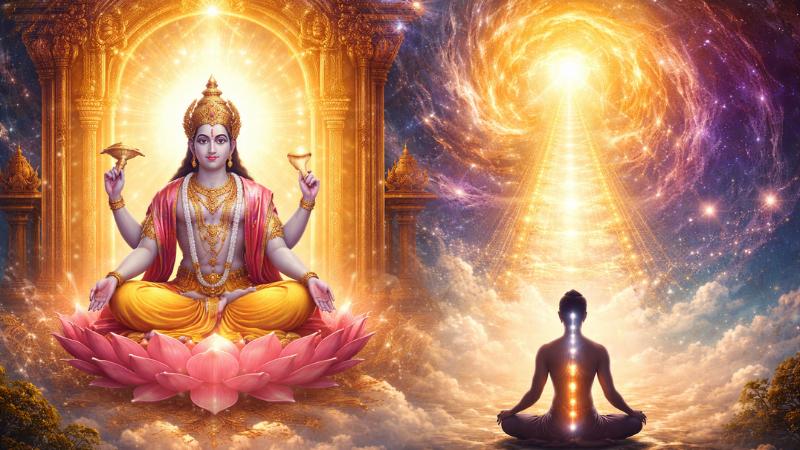
While many temples ceremonially open a northern gate on this day, classical interpretations clarify that the reference is not primarily architectural. Yogic literature describes Vaikuntha as a state beyond limitation and suffering, and Dvara as a gateway. Together, the term points toward an internal transition rather than a physical passage. According to yogic physiology, this gateway corresponds to the Sushumna Nadi, the central energy channel that runs along the spinal axis. Texts such as the Shiva Samhita state that liberation is experienced when prana, or vital energy, flows freely through this central channel without obstruction.
Vaikuntha Ekadashi is observed on Ekadashi tithi, a lunar phase traditionally associated with reduced digestive activity in the human body. Yogic science holds that on this day the digestive system operates at a minimum, making fasting less stressful on the body. Through fasting, the downward-moving energy known as Apana Vayu is restrained, allowing prana to move upward more naturally. This upward movement is believed to balance the Ida and Pingala nadis, often described as the lunar and solar energy channels, creating conditions favorable for the activation of the Sushumna Nadi. Contemporary scientific research into fasting has begun to recognize restorative processes that align with these ancient observations.
Classical yogic texts further explain this mechanism. The Hatha Yoga Pradipika notes that when food intake and sensory distractions are restrained, prana is more likely to enter the central channel. The timing of Vaikuntha Ekadashi coincides with the Sun’s transition toward Uttarayana, symbolically mirroring the upward movement of consciousness described in yogic practices. This phase is traditionally associated with the awakening of higher centers of awareness, moving from the lower chakras toward Ajna and Sahasrara.
Hindu scriptures also describe cosmic time in a distinctive way, defining a single day of the devas as consisting of six months of Uttarayana and six months of Dakshinayana. In this framework, one human year equals one full day and night for celestial beings. Vaikuntha Ekadashi is therefore regarded as marking a cosmic dawn within this larger cycle.
Devotional practices on this day traditionally include the recitation of the Dwadashakshari mantra, Om Namo Narayanaya, as a form of japa. Beyond ritual observance, the day is understood as an opportunity for internal alignment, where seasonal astronomy, lunar dynamics and human physiology converge. Ancient seers embedded this observance into the calendar as a reminder of harmony between the cosmos and the individual.
The invocation Hari Om, often associated with Vaikuntha Ekadashi, reflects this integrated vision. Hari signifies the principle that removes sorrow, ignorance and bondage, while Om represents the primordial sound identified with ultimate reality. Together, they express an aspiration toward clarity and balance within the larger cosmic order.
Viewed through this lens, Vaikuntha Ekadashi stands as a structured convergence of spiritual practice and natural rhythms, emphasizing introspection, restraint and alignment rather than mere ritual formality.


 Joyful
0%
Joyful
0%
 Cool
0%
Cool
0%
 Thrilled
0%
Thrilled
0%
 Upset
0%
Upset
0%
 Unhappy
0%
Unhappy
0%