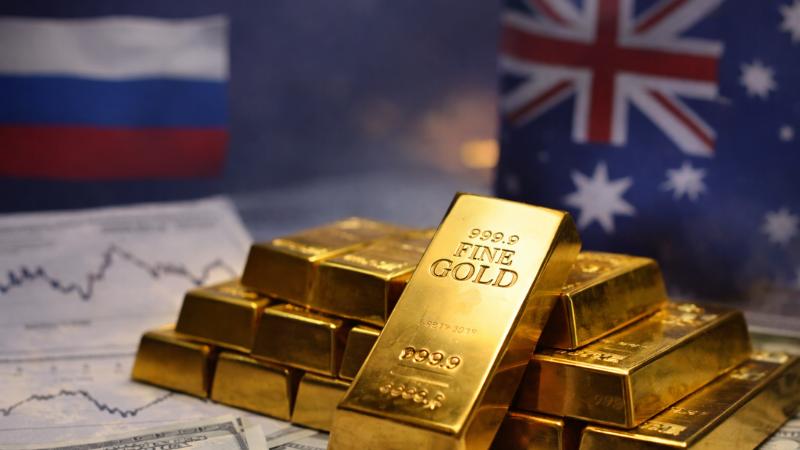
Russia’s reserves are largely concentrated in Siberia and the Far East, including the Krasnoyarsk, Magadan, Amur and Chukotka regions. These areas are known for harsh weather and logistical challenges that slow development, yet they also host some of the largest untapped ore bodies on the planet. Projects such as the Sukhoy Log deposit are expected to significantly expand output in the coming years. With gold valued at nearly $1.7 trillion within its borders, the metal has become an increasingly important pillar of Russia’s broader resource strategy.
Australia matches Russia’s reserve size, with extensive deposits centered in Western Australia’s Yilgarn Craton. The country’s mining industry combines large open-pit operations with deep underground shafts, ensuring consistent production while exploration continues across remote regions. Stable regulations and advanced infrastructure have helped Australia maintain its reputation as one of the world’s most dependable suppliers of precious metals, with reserves similarly valued at about $1.7 trillion.
South Africa, historically synonymous with gold mining, ranks third. Much of its remaining 5,000 tonnes lies in the Witwatersrand Basin, where some of the world’s deepest mines operate. Although rising costs and safety concerns have tempered output, new extraction technologies are reviving interest in the region’s estimated $701 billion stockpile.
Indonesia follows with approximately 3,800 tonnes, supported by large-scale operations such as the Grasberg complex in Papua, one of the world’s largest combined gold and copper mines. Regulatory shifts and community issues occasionally complicate production, yet the country’s $505 billion in reserves continues to attract international investment.
Canada’s 3,200 tonnes are spread across established districts in Ontario and Quebec, as well as northern territories. Strong environmental standards and investor-friendly policies have fostered steady development, supporting an industry valued at roughly $449 billion.
China, with 3,100 tonnes, maintains significant domestic production through state-backed enterprises operating in provinces such as Shandong and Inner Mongolia. Despite tighter environmental controls, the country continues to prioritize strategic gold accumulation, with reserves worth about $435 billion.
The United States rounds out the list with 3,000 tonnes, largely located in Nevada’s Carlin Trend and parts of Alaska. Innovation and exploration have helped offset higher operating costs, keeping output steady. Valued at more than $421 billion, these deposits contribute to domestic supply stability amid global market fluctuations.
As prices remain elevated, gold’s role as both a financial hedge and an industrial resource is expected to grow. The countries holding the largest reserves are likely to shape future supply chains, investment flows and commodity markets, reinforcing gold’s enduring influence on the global economy.