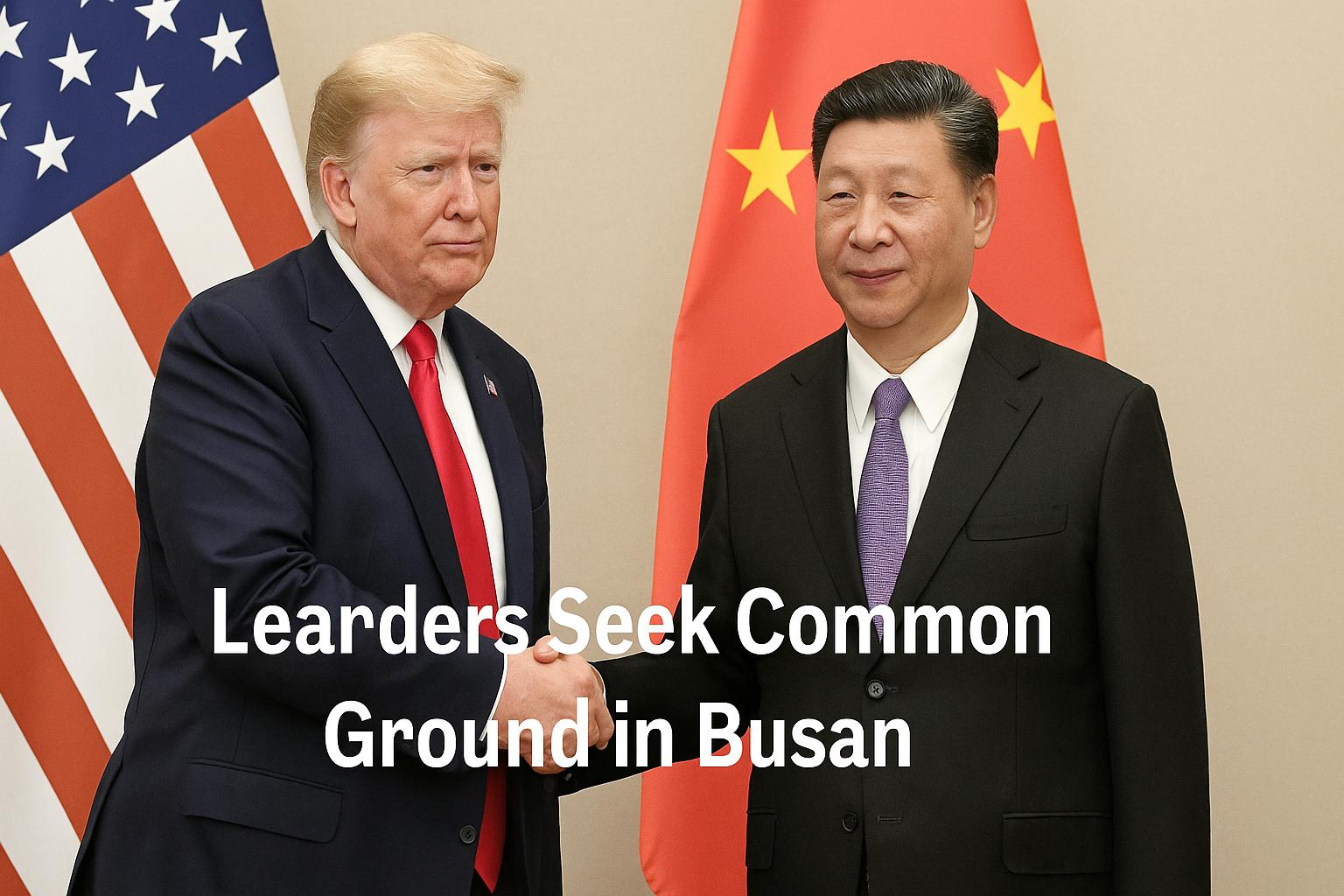
The high-stakes meeting between United States President Donald Trump and Chinese President Xi Jinping in Busan, South Korea, concluded after nearly one hour and forty minutes on Thursday, lasting longer than initially scheduled. The session, held on the sidelines of the Asia-Pacific Economic Cooperation (APEC) summit, was seen as a pivotal effort to reduce escalating tensions that have rattled global markets for months. Both leaders are believed to have sought a pathway to prevent further deterioration in economic ties following renewed tariff threats and export restrictions that reignited the trade conflict between the world’s two largest economies.
According to statements made during and after the discussions, the talks were aimed at rebuilding trust and setting a framework to restore a measure of stability to bilateral trade relations. President Trump told reporters that a trade deal “could be signed today,” and added that both sides “have already agreed to a lot of things.” Although he did not elaborate on specifics, the remark signaled progress toward easing disputes that have disrupted supply chains and slowed investment flows across several sectors.
The meeting comes as Washington and Beijing attempt to de-escalate tensions that have persisted since the collapse of earlier trade talks. Trump, who has frequently used tariffs as leverage in negotiations, had threatened to impose a 100 percent import tax on Chinese goods if no concessions were made. Beijing, meanwhile, responded by curbing rare earth mineral exports, a critical component for global manufacturing, electronics, and renewable energy industries. Both sides now appear to have stepped back from these extremes, opting instead for dialogue and incremental compromise.
In the days leading up to the Busan meeting, US officials indicated that the administration did not intend to move forward with the additional tariffs previously announced. Simultaneously, Chinese representatives expressed openness to loosening export controls on rare earths and resuming large-scale purchases of American soybeans — a key export sector affected by the trade dispute. These mutual gestures have been interpreted by analysts as early signs of a potential thaw in relations.
US Treasury Secretary Scott Bessent stated that both countries were working toward what he described as a “substantial framework” that could temporarily halt China’s export restrictions for up to a year while reviving American agricultural trade. The framework, he added, would also provide both governments with time to negotiate a more comprehensive agreement addressing technology access, manufacturing dependencies, and digital regulation.
During an informal exchange aboard Air Force One before departing South Korea, President Trump suggested that Washington could consider reducing some of the tariffs linked to China’s role in the fentanyl supply chain. “I expect to be lowering that because I believe that they’re going to help us with the fentanyl situation,” he said. The statement hinted at a possible linkage between economic negotiations and public health cooperation, underscoring the broad scope of the US-China dialogue.
Despite the positive tone emerging from Busan, analysts remain cautious. Experts have described the meeting as an attempt to secure short-term stability rather than resolve the underlying structural challenges that continue to divide the two nations. “The proposed deal on the table fits the pattern we’ve seen all year: short-term stabilization dressed up as strategic progress,” said foreign policy expert Craig Singleton. His comments reflect widespread skepticism that either side is prepared to make the concessions necessary for a lasting resolution.
President Trump characterized the meeting as the “G2 summit,” a nod to the global economic weight of both nations. By invoking that term, he underscored the shared responsibility of the United States and China in maintaining economic balance and ensuring that trade competition does not spiral into broader confrontation. The symbolism of the setting—Busan, a major hub for global commerce and logistics—was not lost on observers, who saw it as a fitting backdrop for a conversation about restoring stability to world markets.
While no formal deal or joint statement was issued following the talks, diplomats from both delegations described the atmosphere as pragmatic and constructive. The fact that the discussion extended beyond its scheduled time was viewed as a sign that progress had been made. For now, the meeting appears to have achieved its immediate goal: lowering the temperature of one of the world’s most consequential economic rivalries.
What happens next will depend on whether both capitals can translate these provisional understandings into enforceable agreements. The Busan summit may not have produced a dramatic breakthrough, but it has reopened a diplomatic channel that had been largely silent. As global investors watch for concrete outcomes, the Trump-Xi meeting serves as an important signal that even amid competition and mistrust, dialogue between the United States and China remains both possible and essential to global economic stability.