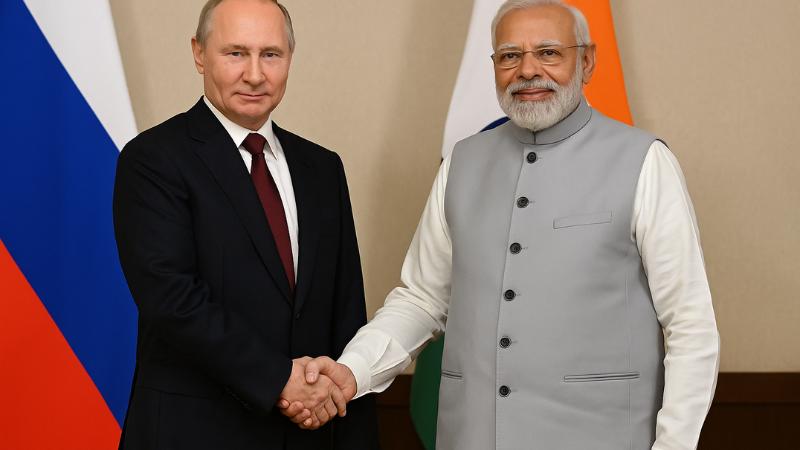
Russian President Vladimir Putin is expected to travel to India on December 4 and 5 for the 23rd Annual Summit, marking his first visit since the start of the Russia-Ukraine conflict and India’s Operation Sindoor. The meeting between Prime Minister Narendra Modi and Putin is expected to place significant emphasis on strengthening defence cooperation, including discussions on a potential new S-400 air defence system contract. The visit comes at a critical time, as both countries reassess their long-standing strategic partnership amid broader geopolitical and military changes.
India and Russia are likely to explore renewed collaboration across several defence platforms. Moscow has offered to supply two to three additional S-400 regiments to the Indian Air Force, a proposal that underscores Russia’s intent to maintain its role as a key defence partner. Although India continues to rely heavily on Russian-origin equipment—historically accounting for 60 to 70 per cent of its arsenal—the share of Russian imports has steadily declined over the past decade. This shift reflects India’s evolving procurement strategy and its increasing interest in diversifying suppliers while nurturing domestic capabilities.
Despite the reduction in imports, the extensive history of operational trust and interoperability between the two militaries continues to shape India’s defence planning. Officials are expected to raise issues related to delivery timelines and maintenance support, particularly in light of previous delays triggered by the Ukraine conflict. Ensuring consistent supply and reliable servicing remains a priority as India monitors the evolving regional security environment along its borders.
India’s procurement policy has undergone a marked transformation under the Aatmanirbhar Bharat initiative, with New Delhi prioritising indigenous manufacturing of critical defence systems. According to data from the Stockholm International Peace Research Institute, Russian imports accounted for 76 per cent of India’s total intake in 2009, but the figure fell to 36 per cent in 2024. Even as India strengthens ties with partners such as France and the United States, joint projects with Russia, including the S-400 system, BrahMos cruise missile, and T-90 tanks, remain central pillars of bilateral cooperation.
The extensive collaboration between the two nations includes co-production of MiG-29 fighter aircraft, Kamov helicopters, T-72 tanks, BMP-2 infantry vehicles and stealth frigates for the Navy. Joint development of systems such as the BrahMos missile and AK-203 assault rifle highlights the continued depth of the partnership, even as India gradually expands its defence network.
Operation Sindoor in May drew renewed attention to the S-400, known domestically as the “Sudarshan Chakra”. An S-400 unit based in Adampur reportedly shot down a Pakistani aircraft at a range of 314 kilometres, and the Indian Air Force confirmed that the system neutralised multiple airborne threats while tracking hundreds of targets simultaneously. Its rapid deployment capability, requiring under five minutes, has been widely cited as a significant operational advantage. The system is now embedded within India’s multi-layered air defence network along both the China and Pakistan frontiers, reinforcing the country’s strategic autonomy.
Sources indicate that Russian defence conglomerate Rostec has begun preliminary discussions on a fresh S-400 contract and has assured India that future deliveries will adhere to agreed schedules, a commitment seen as essential after past delays. India’s original USD 5.43-billion deal for five regiments has resulted in three deliveries so far, with the final two expected between early and mid-2026.
A key feature of the new proposal is Russia’s readiness to provide up to 50 per cent technology transfer for S-400 missiles and associated systems. This could enable Indian manufacturers, including Bharat Dynamics Limited, to undertake local assembly and accelerate production of the 48N6 missile variant approved earlier this year. Nearly half of the S-400 support ecosystem could be indigenised, a step that would reduce long-term costs and support India’s broader goal of building domestic capacity in advanced defence technologies.
Even as cooperation remains strong, Russia’s share in India’s defence imports has continued to decline. The 2025 SIPRI findings show that Russian systems made up 36 per cent of India’s total arms imports during 2020-2024, a significant drop from 55 per cent in 2015-2019 and 72 per cent in 2010-2014. The trend reflects India’s strategy of diversifying suppliers and reducing dependence on any single source while expanding its indigenous manufacturing base.
Negotiations over the expanded S-400 contract and other joint initiatives are expected to accelerate during Putin’s visit, with both sides aiming to reach significant milestones by mid-2026. The summit is poised to reaffirm the enduring nature of India-Russia defence ties, even as the partnership adapts to a changing global landscape.