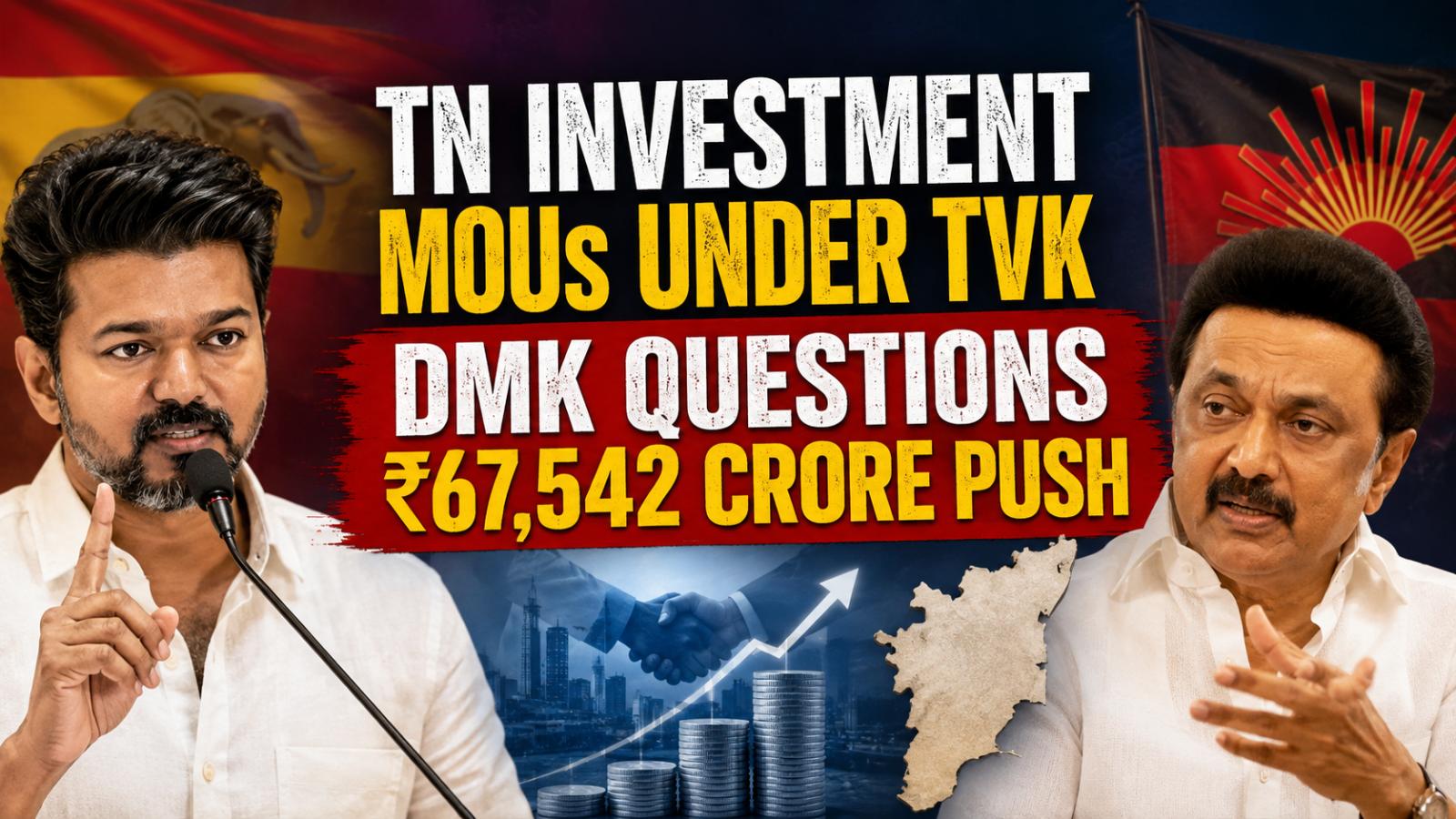
Tamil Nadu’s ₹67,542 crore investment announcement has triggered a political debate, with the DMK questioning how many TN investment MoUs under TVK represent fresh projects. Former Industries Minister TRB Rajaa also raised concerns over airports, jobs and the state’s investment branding strategy.
The Tamil Nadu government has announced investment commitments worth ₹67,542 crore across 97 projects at the Vettri Tamil Nadu Investment Conclave 2026. According to details announced by the state government, the proposed projects have the potential to create more than one lakh jobs across automobiles, electronics, renewable energy, life sciences, data centres and research and development.
The conclave marks one of the first major investment-focused programmes of Chief Minister Vijay’s TVK-led government. While the administration has presented the agreements as a sign of continuing investor confidence, the principal opposition DMK has challenged the government over the origin of several proposed investments.
TRB Rajaa Questions Fresh Investments
Former Tamil Nadu Industries Minister TRB Rajaa alleged that nearly 75 per cent of the MoUs announced at the conclave were connected to negotiations or groundwork undertaken during the previous DMK government led by MK Stalin.
Rajaa asked why the TVK government had not attracted more major new projects during its opening months. The 75 per cent figure is an allegation made by the DMK leader and has not been independently established through publicly available project-by-project data.
He also compared Tamil Nadu’s approach with investment promotion efforts in Andhra Pradesh and argued that the state government should focus on bringing additional projects rather than claiming credit for investments initiated earlier.
DMK Raises Investment Continuity Claim
The DMK argues that investment negotiations often take months or years before companies sign formal agreements or begin construction. Its criticism has therefore focused on whether projects announced by the Vijay government were developed after it assumed office or inherited from the previous administration.
The TVK government, on the other hand, can ultimately be judged by how effectively the signed MoUs move from commitments to actual investment, construction and employment. The number of factories that become operational and jobs that materialise will provide a clearer measure of the conclave’s economic impact.
Parandur and Hosur Projects in Focus
Rajaa also sought clarity on the proposed Parandur airport near Chennai and the Hosur airport project. He argued that major infrastructure projects are critical for supporting industrial expansion and attracting companies looking for strong transport and logistics networks.
The opposition wants the TVK administration to clarify whether it intends to continue these projects and how they fit into its wider industrial policy. Infrastructure decisions surrounding Chennai and Hosur could influence future investment planning, particularly in manufacturing and technology-driven industries.
TN Brand Strategy Sparks Debate
Rajaa also objected to changes surrounding the previous government’s “Bullish on TN” investment campaign. He maintained that the campaign represented Tamil Nadu rather than the DMK and said an established state investment brand should not automatically be discarded after a change of government.
His remarks have opened a wider debate over continuity in Tamil Nadu’s investment promotion strategy. Political administrations may change, but investors often value consistent policies, infrastructure plans and clear long-term industrial priorities.
The ₹67,542 crore investment announcement gives the Vijay government a significant early opportunity, but MoU values alone will not determine its success. Project implementation, fresh capital inflows, infrastructure development and the creation of promised jobs will ultimately show whether the investment push delivers lasting economic gains for Tamil Nadu.