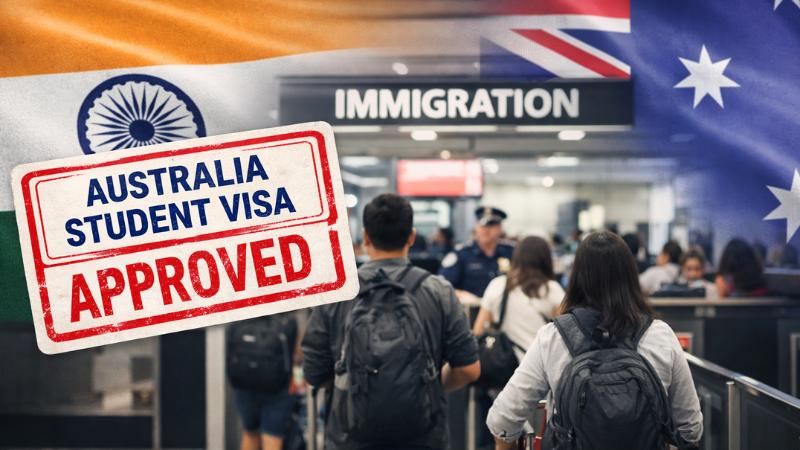
Australia has moved India into its highest-risk category for student visa applicants, a decision that will result in stricter scrutiny and longer processing timelines for thousands of prospective students. The change, implemented under Australia’s Simplified Student Visa Framework, takes effect from January 8, 2026, and represents an out-of-cycle reclassification driven by concerns over emerging integrity risks in the student visa system.
Under the revised framework, India has been shifted from Evidence Level 2 to Evidence Level 3, placing it alongside Nepal, Bangladesh and Bhutan. The re-rating was carried out outside the routine assessment schedule, signalling heightened concern within the Australian administration about the quality and credibility of applications from these countries. Authorities stated that the move is intended to strengthen oversight while continuing to support genuine students seeking education opportunities in Australia.
The Australian government has indicated that the revised classification will allow officials to better manage integrity-related challenges within the Student Visa Program. At the same time, it said the objective remains to ensure that international students have confidence they are investing in a high-quality education and that the visa system maintains the appropriate safeguards to protect its credibility.
For Indian students, the shift to the highest-risk category is expected to bring noticeable changes to the application process. Visa officers will subject applications to more detailed examination, which may include requests for additional financial and academic documentation. Background checks are expected to become more thorough, with manual verification of bank statements and closer assessment of an applicant’s financial capacity.
Applicants may also be required to submit further proof of English language proficiency, even in cases where previous requirements had been met. In addition, visa officials will have expanded authority to directly contact educational institutions, sponsors and referees to verify information provided in applications. These measures are likely to increase the overall time taken to process student visas.
Processing timelines, which currently average around three weeks for many applicants, are expected to extend significantly under the new classification. In some cases, processing could take up to eight weeks, potentially affecting students planning to meet enrolment deadlines for upcoming academic intakes.
While Australian authorities have not cited a single factor behind India’s reclassification, the move follows recent international attention on cases involving fraudulent academic credentials originating from the country. Such incidents have raised concerns among destination countries about the authenticity of documents submitted by some student visa applicants.
India remains Australia’s second-largest source of international students, with nearly 140,000 Indian nationals enrolled out of an estimated 650,000 overseas students. Along with Nepal, Bangladesh and Bhutan, these countries collectively account for close to one-third of Australia’s international student population in 2025, making the re-rating significant for the country’s education sector.
Industry observers note that the tighter stance also reflects broader global trends in international education. As major destinations such as the United States, the United Kingdom and Canada have introduced stricter limits on foreign student intakes, Australia has emerged as a key alternative for many applicants. This shift has been accompanied by an increase in applications, including a rise in cases involving questionable financial and academic documentation.
Education sector experts say placing certain countries in the highest risk category strengthens the screening process and helps ensure that student visas are granted primarily to applicants with genuine study intentions. While the measures may pose additional hurdles for legitimate students, Australian authorities maintain that the changes are necessary to safeguard the long-term integrity and sustainability of the international education system.