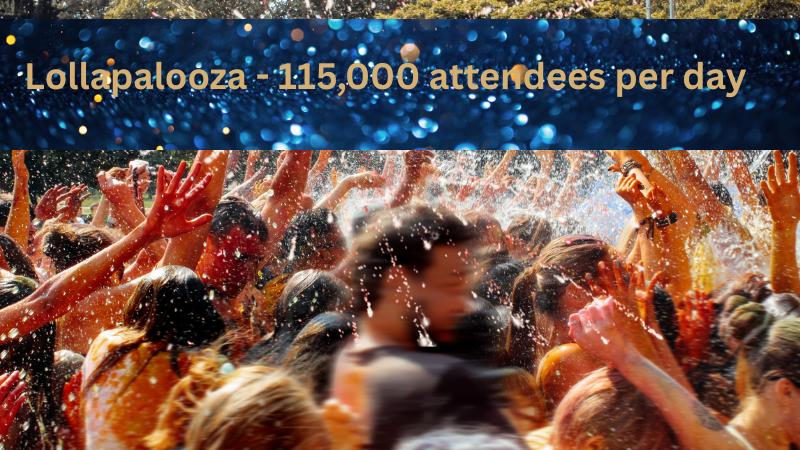
With cleanup crews hard at work and major streets reopening, another year of Lollapalooza has officially wrapped in Chicago. The four-day festival drew approximately 115,000 attendees per day, offering a wide range of music, food, and entertainment in Grant Park while maintaining a relatively calm public safety profile.
Preliminary figures released by event organizers show that despite the massive turnout, only 12 arrests were made throughout the duration of the festival. This arrest count aligns with trends from recent years, reflecting effective planning, security presence, and crowd control strategies. For comparison, arrest totals in previous years included 9 in 2024, 14 in 2023, 15 in 2022, 19 in 2021, and 31 in 2019.
In addition to the arrests, 42 individuals required ambulance transport during the festival. Notably, there were no violations, citations, or tickets reported. The low numbers suggest that despite the sheer scale of the event, most attendees acted responsibly, and the infrastructure in place helped to prevent more serious incidents.
Cleanup efforts began early Monday morning, just hours after the final performances concluded. Workers were seen gathering and hauling away trash, a task that often takes several days to complete given the volume of waste generated. In past years, restoring Grant Park after Lollapalooza has cost hundreds of thousands of dollars. The process includes not just trash removal, but resodding grassy areas, laying new mulch, watering stressed vegetation, and planting fresh greenery to return the park to public-ready condition.
Street reopenings around Grant Park are happening in stages. As of Monday, several major roads were made accessible again, including:
Balbo Drive from Michigan Avenue to Columbus Drive
Jackson Drive from Michigan Avenue to Columbus Drive
Columbus Drive from Monroe Street to Roosevelt Road
Monroe Street from Michigan Avenue to DuSable Lake Shore Drive
Two additional sections remain temporarily closed but are expected to reopen later in the week. Jackson Drive from Columbus Drive to DuSable Lake Shore Drive is scheduled to reopen on Saturday, while Balbo Drive from Columbus Drive to DuSable Lake Shore Drive is expected to be accessible again by Sunday.
The phased reopening plan helps reduce congestion and ensures that crews have adequate time to safely remove temporary fencing, lighting, stages, and other festival infrastructure.
Lollapalooza has become one of the largest and most influential music festivals in the country, known not only for its major performances but also for the logistical complexity it brings to Chicago each summer. Organizers continue to refine how they manage large crowds, transportation, emergency access, and sanitation. The 2025 edition of the event appears to have benefitted from lessons learned in years past, showing an ability to scale without significantly increasing public safety issues.
The combination of high attendance and low arrest numbers suggests that both city departments and festival organizers are finding a working balance between safety, accessibility, and enjoyment. As the post-event restoration continues and Grant Park returns to its usual condition, attention will shift toward planning for future large-scale events.
For now, residents and city officials can reflect on a successful festival weekend that brought hundreds of thousands of visitors to the heart of the city and wrapped with minimal disruption.
Preliminary figures released by event organizers show that despite the massive turnout, only 12 arrests were made throughout the duration of the festival. This arrest count aligns with trends from recent years, reflecting effective planning, security presence, and crowd control strategies. For comparison, arrest totals in previous years included 9 in 2024, 14 in 2023, 15 in 2022, 19 in 2021, and 31 in 2019.
In addition to the arrests, 42 individuals required ambulance transport during the festival. Notably, there were no violations, citations, or tickets reported. The low numbers suggest that despite the sheer scale of the event, most attendees acted responsibly, and the infrastructure in place helped to prevent more serious incidents.
Cleanup efforts began early Monday morning, just hours after the final performances concluded. Workers were seen gathering and hauling away trash, a task that often takes several days to complete given the volume of waste generated. In past years, restoring Grant Park after Lollapalooza has cost hundreds of thousands of dollars. The process includes not just trash removal, but resodding grassy areas, laying new mulch, watering stressed vegetation, and planting fresh greenery to return the park to public-ready condition.
Street reopenings around Grant Park are happening in stages. As of Monday, several major roads were made accessible again, including:
Balbo Drive from Michigan Avenue to Columbus Drive
Jackson Drive from Michigan Avenue to Columbus Drive
Columbus Drive from Monroe Street to Roosevelt Road
Monroe Street from Michigan Avenue to DuSable Lake Shore Drive
Two additional sections remain temporarily closed but are expected to reopen later in the week. Jackson Drive from Columbus Drive to DuSable Lake Shore Drive is scheduled to reopen on Saturday, while Balbo Drive from Columbus Drive to DuSable Lake Shore Drive is expected to be accessible again by Sunday.
The phased reopening plan helps reduce congestion and ensures that crews have adequate time to safely remove temporary fencing, lighting, stages, and other festival infrastructure.
Lollapalooza has become one of the largest and most influential music festivals in the country, known not only for its major performances but also for the logistical complexity it brings to Chicago each summer. Organizers continue to refine how they manage large crowds, transportation, emergency access, and sanitation. The 2025 edition of the event appears to have benefitted from lessons learned in years past, showing an ability to scale without significantly increasing public safety issues.
The combination of high attendance and low arrest numbers suggests that both city departments and festival organizers are finding a working balance between safety, accessibility, and enjoyment. As the post-event restoration continues and Grant Park returns to its usual condition, attention will shift toward planning for future large-scale events.
For now, residents and city officials can reflect on a successful festival weekend that brought hundreds of thousands of visitors to the heart of the city and wrapped with minimal disruption.