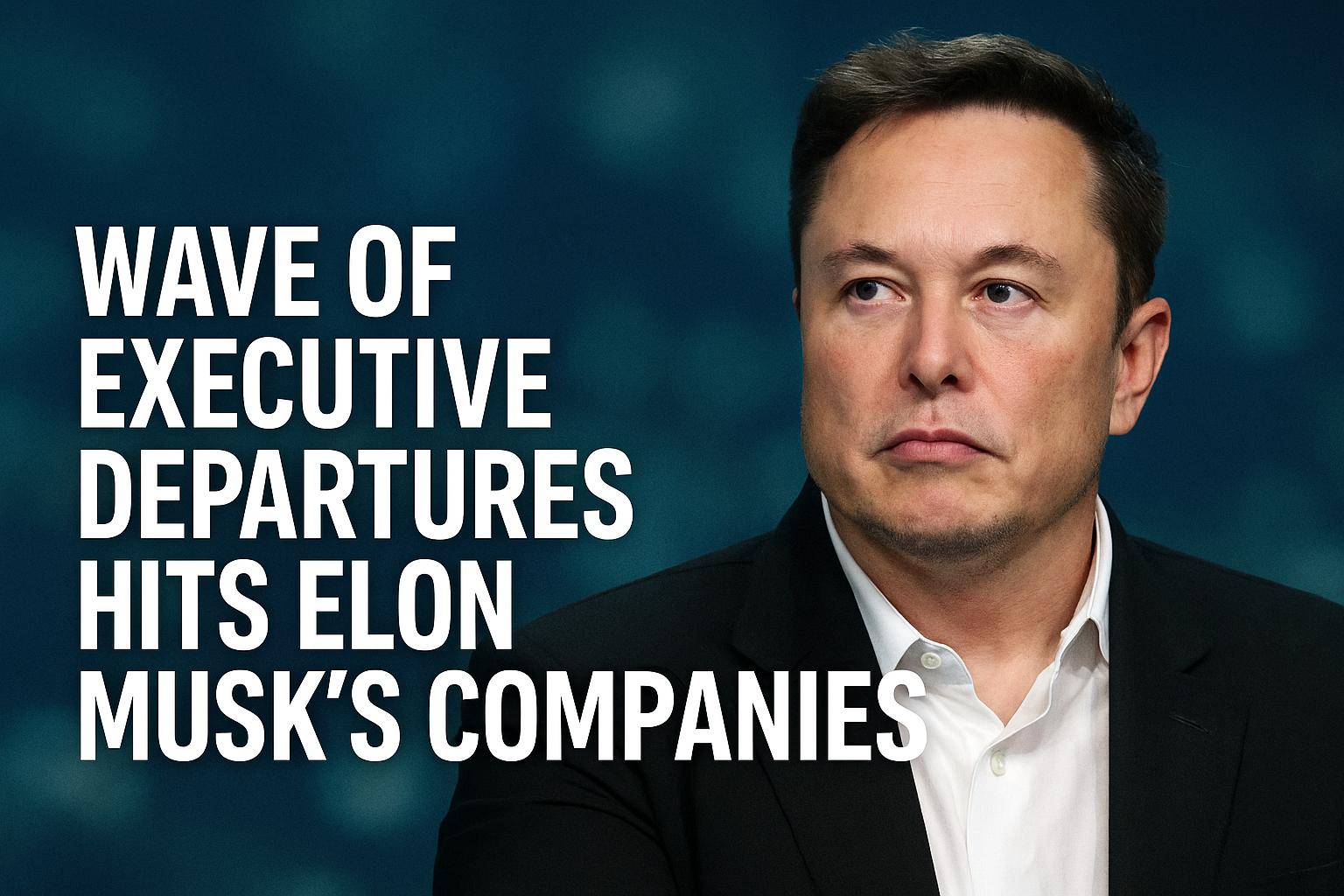
Elon Musk’s business empire is facing a wave of senior-level departures across Tesla, X and xAI as his relentless management style, shifting strategies and personal rivalries continue to drive churn at the top. Over the past year, several of the billionaire’s closest lieutenants and senior executives have chosen to walk away, leaving behind questions about the stability of leadership inside some of the world’s most closely watched companies.
Tesla, once considered the most stable part of Musk’s corporate group, has lost multiple senior leaders from its United States sales unit, its energy division and its powertrain group. The company even saw its chief information officer depart, alongside engineers and robotics specialists who were seen as critical to Tesla’s long-term technology vision. The departures came as Tesla laid off more than 14,000 workers in April 2024, a move that insiders say created frustration and uncertainty. Tensions escalated further when Musk abruptly cancelled a long-planned affordable electric vehicle priced at $25,000, choosing instead to pivot resources toward robotics, artificial intelligence and a bold vision of self-driving taxis. The decision triggered discontent across divisions, with Daniel Ho, who led the low-cost EV project, leaving to join Google’s Waymo. Senior leaders Drew Baglino, Rebecca Tinucci and David Zhang also departed during this period, weakening Tesla’s once strong management bench.
The turbulence has not been limited to Tesla. Musk’s artificial intelligence start-up xAI, founded only two years ago and later merged with his social media platform X, has experienced an even faster rate of turnover. Within days of each other, the company’s chief financial officer and its general counsel both resigned. Mike Liberatore, who lasted just over three months as finance chief, publicly remarked on working more than 120 hours a week and seven days in the office, while general counsel Robert Keele ended his time at the company by posting an AI-generated video of a lawyer shoveling molten coal, a striking metaphor for his burnout.
At the same time, Musk’s rivalry with OpenAI and its leader Sam Altman has intensified. Former colleagues say Musk spends nearly every waking moment trying to outpace Altman and the success of ChatGPT, pushing xAI employees under constant pressure. The rivalry spilled into the public spotlight when xAI accused OpenAI of poaching talent and misusing trade secrets. OpenAI dismissed the accusations, but the episode underscored the escalating battle between two of Silicon Valley’s most ambitious AI leaders.
Musk’s social media platform X has also been deeply affected by executive churn. Linda Yaccarino, who was brought in as chief executive with the hope of stabilizing the company’s advertising base and professionalizing its operations, resigned in July. Insiders say she grew frustrated with Musk’s unilateral decisions and lack of consultation. Soon after her departure, Igor Babuschkin, a co-founder of xAI, left to start his own AI safety venture. Public affairs leaders Dave Heinzinger and John Stoll also quit after only a few months, returning to their previous employers. Several engineers considered close to Musk walked away as well, creating a sense of instability across X at a time when the platform continues to face revenue and reputation challenges.
While some executives explain their departures as opportunities to start new ventures or take personal breaks after long stints, others cite exhaustion from the extreme demands of Musk’s leadership style. Insiders describe an environment of mass layoffs, shifting goals and sudden pivots that leave even senior managers uncertain of their futures. A former Tesla executive characterized Musk as “the boss, the alpha” and said that anyone who does not show constant deference eventually finds themselves pushed out or sidelined.
The constant turnover raises questions about the long-term direction of Musk’s companies. Tesla remains under pressure to maintain its lead in the electric vehicle market amid rising competition from traditional automakers and Chinese manufacturers. Its shift toward robotics and AI-driven taxis is bold but unproven, and the loss of seasoned leaders could slow progress. X continues to wrestle with declining advertiser trust and user engagement, while xAI faces an uphill battle to compete against more established players in the AI sector.
For now, Musk continues to command extraordinary influence over each company, dictating priorities and demanding extreme performance from those who remain. Yet the growing list of departures signals a deeper challenge: sustaining innovation and stability in organizations led by one of the most relentless, and polarizing, figures in global business.