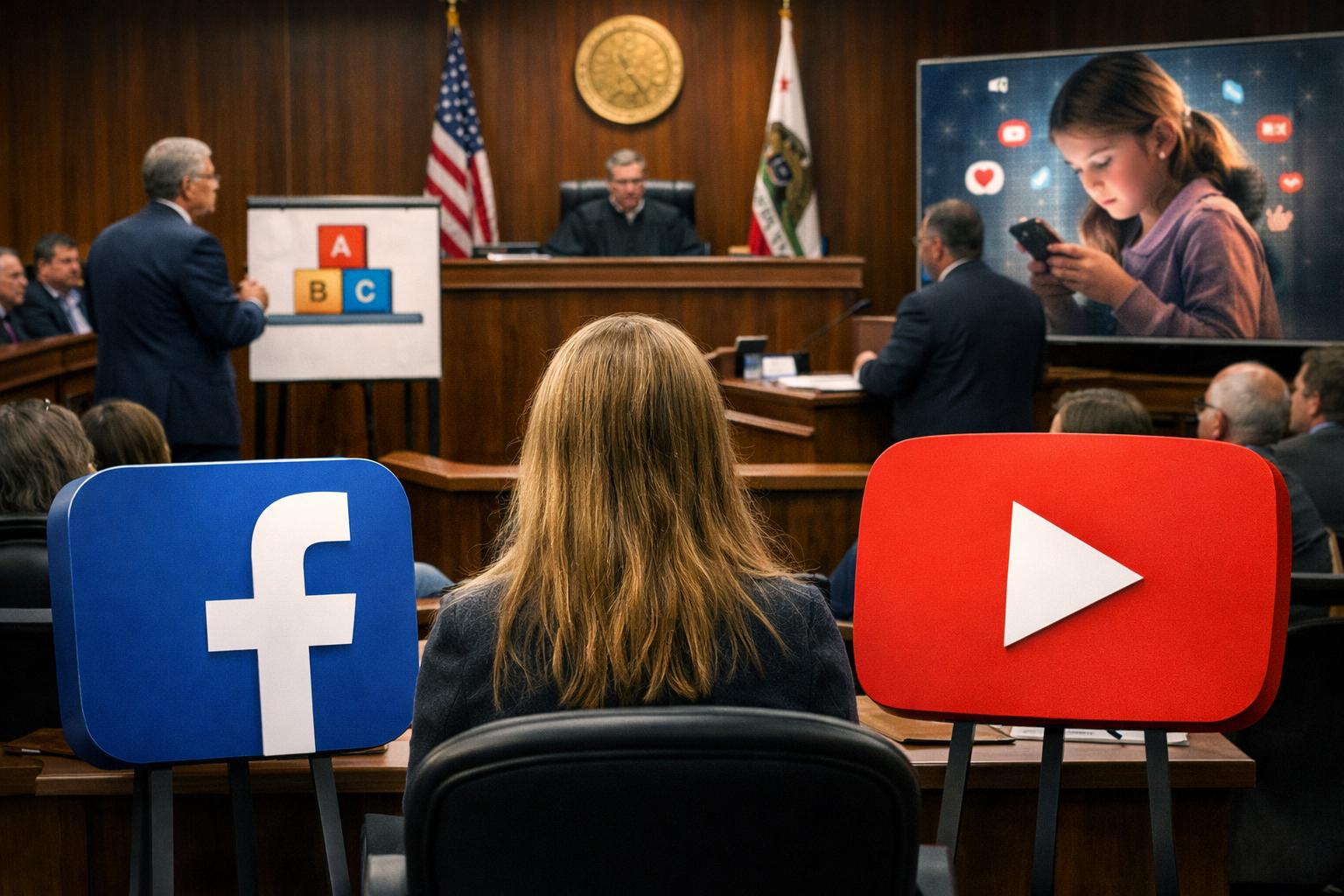
Meta, the parent company of Facebook and Instagram, and Google-owned YouTube are facing serious allegations in a closely watched trial that began Monday in California, with plaintiffs accusing the companies of deliberately designing social media platforms to be addictive for children. The case marks one of the first times a jury has been asked to directly assess whether major technology companies can be held legally responsible for the mental health consequences their products may have on young users.
The proceedings are unfolding before a jury in Los Angeles and are being closely monitored by legal experts, policymakers, and the technology industry. The outcome could establish a significant legal benchmark, as the trial has been designated a bellwether case, meaning its verdict may shape the direction of hundreds of similar lawsuits currently filed across the United States. These cases broadly argue that social media companies prioritised user engagement and profit over the wellbeing of children and adolescents.
At the centre of the lawsuit is a 20-year-old woman identified in court documents as Kaley G.M., who alleges that she suffered severe psychological harm after developing an early dependence on social media platforms. According to the plaintiffs, her exposure began in early childhood and escalated as algorithm-driven content increasingly dominated her online experience. The lawsuit contends that neither Kaley nor her family were adequately warned about the potential risks associated with prolonged and repeated exposure to such systems.
During opening arguments, plaintiffs’ attorney Mark Lanier accused the companies of intentionally creating digital environments designed to keep young users engaged for extended periods. He told jurors that the case revolves around what he described as the systematic development of addiction in children’s brains through carefully engineered features. Using a visual demonstration, Lanier argued that the alleged strategy could be broken down into addicting design, vulnerable developing brains, and the targeting of children, all of which he said formed the foundation of the companies’ business models.
Lanier compared certain platform features to mechanisms commonly associated with gambling, arguing that unpredictable rewards, endless content feeds, and algorithmic recommendations were used to reinforce compulsive behaviour. He claimed these elements were not accidental but were deliberately incorporated to maximise user engagement, particularly among younger audiences. According to the plaintiffs, Kaley began using YouTube at around six years old, long before she could fully understand how recommendation systems worked or how extended use might affect her mental health.
The defence has strongly rejected these claims. Lawyers representing Meta argued that social media use should not be viewed as the primary cause of Kaley’s struggles, suggesting instead that a range of personal and environmental factors played a more significant role. Meta’s defence attorney Paul Schmidt asked jurors to consider whether removing social media from Kaley’s life would have fundamentally changed her circumstances, pointing to issues such as bullying and family-related challenges as contributing factors to her mental health difficulties.
YouTube has also denied the allegations, stating that the claims misrepresent the company’s practices and intentions. A spokesperson for the platform said the accusations were inaccurate and emphasised that YouTube has introduced various safety measures aimed at protecting younger users. These include parental controls, content restrictions, and tools designed to limit exposure to potentially harmful material.
As the trial continues, it is expected to delve deeper into internal company documents, expert testimony on child psychology, and the role of algorithms in shaping user behaviour. Legal observers say the case could influence future regulation of digital platforms and redefine the scope of corporate responsibility in the technology sector, particularly when it comes to protecting minors in online environments.