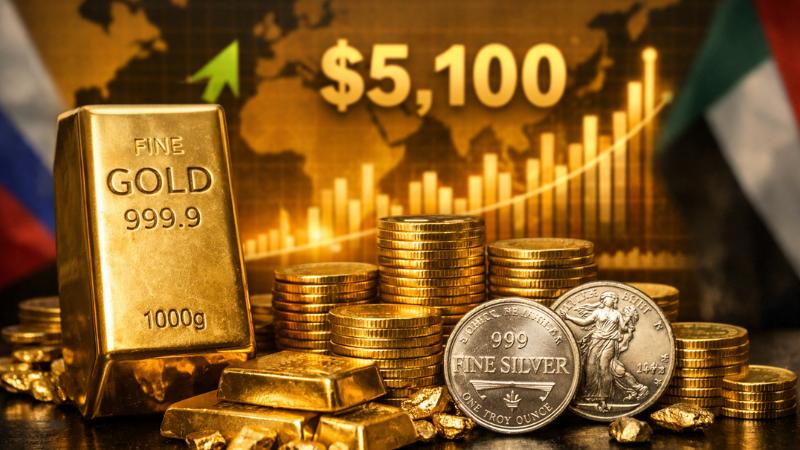
Gold prices surged to a fresh all-time high on Monday, crossing the $5,100 per ounce mark as investors increasingly turned to the precious metal for safety amid escalating geopolitical tensions and growing concerns over global fiscal stability. The rally extended gold’s record-breaking run, reinforcing its role as a preferred hedge during periods of uncertainty in financial markets.
Spot gold climbed as much as 2.4 percent to trade near $5,102 per ounce, equivalent to approximately ₹4,23,300 per ounce, before easing slightly to around $5,086, or ₹4,22,000, in later trading. U.S. gold futures for February delivery also advanced sharply, rising 2.1 percent to about $5,087 per ounce, reflecting strong investor appetite across both physical and derivative markets.
Market participants attributed the surge largely to heightened geopolitical risk, with recent flashpoints spanning multiple regions, including developments linked to Greenland, Venezuela, and ongoing instability in the Middle East. These factors have reinforced demand for gold as a reliable store of value during periods of geopolitical stress and macroeconomic uncertainty.
Analysts noted that broader geoeconomic considerations have played a key role in the latest leg higher for precious metals. Ongoing concerns around trade, strategic resources, and regional power dynamics have encouraged investors to increase exposure to assets perceived as resilient to political and economic shocks.
Silver prices also posted a strong rally, benefiting from both safe-haven demand and industrial usage. Spot silver jumped nearly 5 percent to around $107.9 per ounce, or roughly ₹8,955 per ounce, marking one of its strongest daily gains in recent months. The metal’s dual role as an investment asset and an industrial input has supported prices amid expectations of sustained demand.
Investment demand for gold has remained robust across both institutional and retail segments. Analysts pointed to steady buying interest that has persisted even as prices reached historic highs, suggesting confidence in gold’s longer-term outlook. Forecasts from major financial institutions indicate expectations for further gains, supported by strong fundamentals and continued risk aversion.
A notable driver of the rally has been the expansion of gold demand beyond traditional channels. Holdings in Western gold exchange-traded funds have risen significantly since the start of 2025, while physical purchases by high-net-worth individuals and families have become an increasingly important source of support. These buyers are using gold as a hedge against macroeconomic and policy-related risks, adding depth to the market’s demand base.
Central banks have also continued to play a pivotal role in supporting prices. Monthly gold purchases by central banks are estimated to be well above historical averages, with emerging market economies in particular continuing to diversify reserves away from currencies and toward bullion. This sustained official-sector buying has helped underpin prices even during periods of market volatility.
Looking ahead, analysts expect that concerns around fiscal sustainability, inflation, and global economic resilience will keep demand for gold elevated. Unlike short-term hedges tied to political events, many of the current drivers of demand are viewed as structural and likely to persist through 2026, providing a firm foundation for prices.
As global investors navigate an environment marked by rising geopolitical risks and uncertain economic prospects, gold’s performance underscores its enduring appeal as a hedge against instability, with market participants increasingly confident that the precious metal’s role in diversified portfolios remains as relevant as ever.