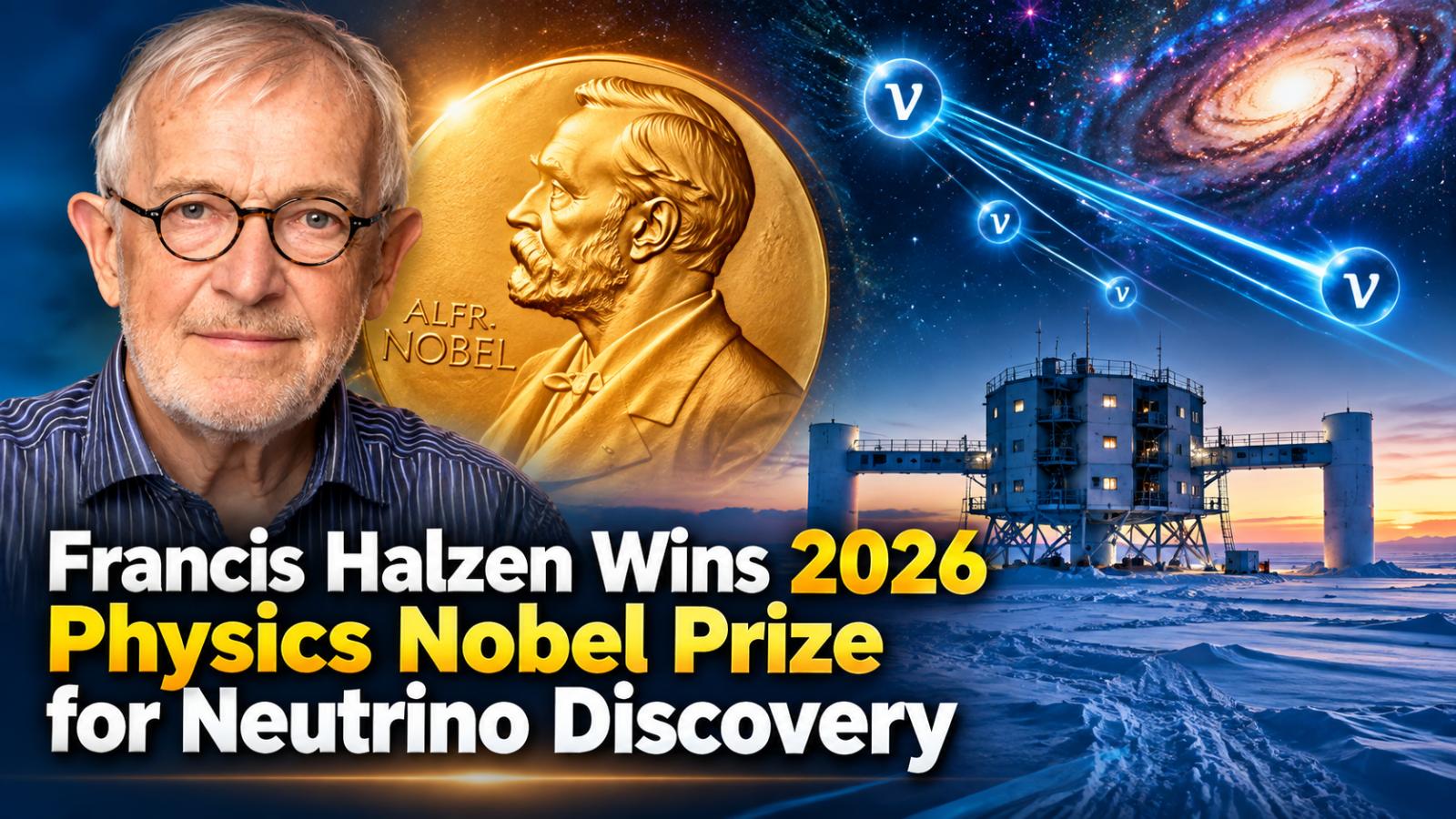
Francis Halzen of the University of Wisconsin–Madison has been awarded the 2026 Nobel Prize in Physics for his pioneering work on the IceCube Neutrino Observatory and the discovery of high-energy neutrinos arriving from some of the most extreme environments in the universe.
The Royal Swedish Academy of Sciences recognised Halzen for helping transform Antarctic ice into a massive particle detector, opening an entirely new way for scientists to study the cosmos.
Why Neutrinos Matter
Neutrinos are among the most abundant particles in nature, but detecting them is extremely difficult. They carry no electric charge and interact only very weakly with matter, allowing enormous numbers of them to pass through Earth — and even through the human body — without leaving a noticeable trace.
That same property makes them extremely useful to astronomers. Unlike charged particles, which can be redirected by magnetic fields, high-energy neutrinos can travel vast cosmic distances in almost straight lines.
By tracing their direction, scientists can investigate some of the most powerful and violent processes taking place across the universe.
Turning Antarctic Ice Into a Giant Detector
Halzen proposed an ambitious idea decades ago: using the vast, transparent ice beneath the South Pole as a detector for these elusive particles.
When a high-energy neutrino occasionally interacts with an atomic nucleus inside the ice, the collision can produce particles that generate tiny flashes of light. IceCube detects these flashes using thousands of sensitive optical sensors installed deep beneath the Antarctic surface.
Scientists then analyse the signals to estimate the neutrino's energy and determine the direction from which it travelled.
IceCube Completed in 2011
Constructing the IceCube Neutrino Observatory required years of engineering and international scientific collaboration. The detector was completed in 2011 and occupies roughly one cubic kilometre of Antarctic ice.
The South Pole provides a particularly useful environment for the experiment because the enormous volume of clear ice acts as the detecting medium while also helping shield the instruments from unwanted background signals.
Not long after becoming operational, IceCube began detecting unusually energetic neutrinos.
Discovery Opens New Window Into Universe
Further observations showed that some of the detected high-energy neutrinos originated well beyond the Solar System.
The finding helped establish neutrino astronomy, allowing scientists to study the universe using particles rather than relying only on electromagnetic radiation such as visible light, radio waves, X-rays or gamma rays.
This approach can provide information about cosmic environments that may otherwise remain difficult to observe.
Search for Powerful Cosmic Accelerators
Scientists have long believed that the universe contains natural particle accelerators capable of producing particles at energies far beyond those reached by even the world's most powerful human-built accelerators.
Identifying those sources, however, has remained a major scientific challenge.
High-energy neutrinos can potentially point researchers toward objects and events capable of producing such extreme energies, including some of the most violent phenomena in the cosmos.
Nobel Committee Praises Halzen's Scientific Vision
The Nobel Committee highlighted Halzen's role in leading an international team of scientists and engineers responsible for creating IceCube.
His vision helped turn what once appeared to be an extraordinary experimental idea into one of modern astronomy's most important tools for studying high-energy cosmic phenomena.
IceCube Continues Its Search
IceCube remains active today, continuously recording neutrino interactions beneath the Antarctic ice.
As its dataset grows, researchers hope to identify more of the cosmic sources responsible for producing high-energy neutrinos and gain a better understanding of the physical processes occurring in some of the universe's most extreme environments.
The 2026 Physics Nobel therefore recognises more than the detection of mysterious particles from deep space. It honours the development of a new way of observing the universe — using nearly invisible particles as messengers carrying information across enormous cosmic distances.