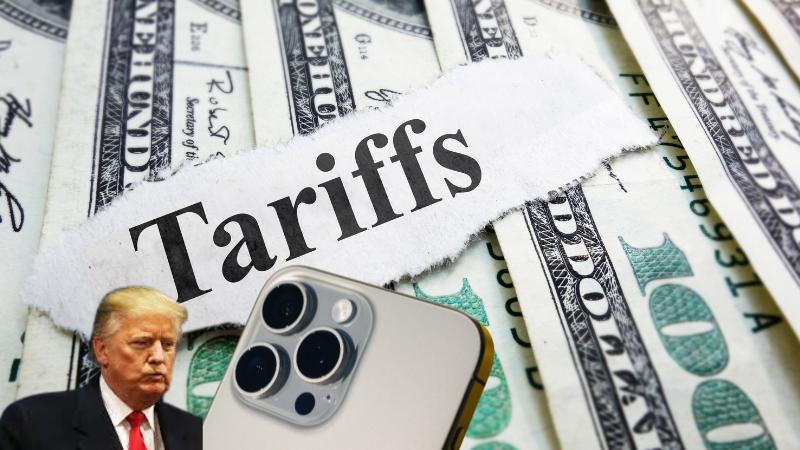
In a series of statements that have stirred global business conversations, U.S. President Donald Trump has issued a stark warning to Apple, insisting that the tech giant must manufacture iPhones within the United States if it intends to sell them in the American market. Speaking from the Oval Office while signing multiple executive orders aimed at strengthening the U.S. nuclear power sector, Trump said it is acceptable for Apple to go to India to build plants, but under no circumstances would they be allowed to sell their products in America without incurring significant tariffs. He reiterated that if Apple chooses to manufacture abroad, particularly in India, then a tariff of at least 25% will be imposed on its products entering the U.S.
Addressing the matter publicly on Friday, May 23, 2025, Trump disclosed his conversation with Apple CEO Tim Cook. He emphasized that there had been an understanding between them about keeping Apple’s manufacturing operations in the United States. "He said he's going to India to build plants. I said, ‘That's okay to go to India, but you're not going to sell into here without tariffs.’ And that's the way it is,” Trump stated. He made it clear that his main concern was the iPhone and that if the device is to be sold in America, it must also be built on American soil.
Earlier the same day, Trump used social media to express his dissatisfaction with Apple's overseas production. In a strongly worded post, he stated that Apple’s iPhones sold in the U.S. must be manufactured domestically. If not, a 25% tariff would be enforced. “I have long ago informed Tim Cook of Apple that I expect their iPhones that will be sold in the United States of America will be manufactured and built in the United States, not India, or anyplace else. If that is not the case, a Tariff of at least 25% must be paid by Apple to the U.S. Thank you for your attention to this matter!” he wrote.
Just a week earlier, during a visit to Doha, Trump had again expressed his frustration regarding Apple’s increasing manufacturing footprint in India. Addressing business executives, Trump recounted a discussion with Tim Cook, saying, “Tim, you’re my friend. I treated you very good. You’re coming here with $500 billion, but now I hear you’re building all over India. I don’t want you building in India. You can build in India if you want to take care of India because India is one of the highest tariff nations in the world. It’s very hard to sell into India. And they’ve offered us a deal where they’re willing to literally charge us no tariff.”
Meanwhile, Apple CEO Tim Cook, during the Q2 2025 earnings call earlier this month, provided insights into the company’s global production strategy. He noted that the majority of iPhones sold in the United States during the upcoming June quarter would originate from India. Additionally, Vietnam would serve as the country of origin for most iPads, Macs, Apple Watches, and AirPods being shipped to the U.S.
Responding to Trump’s statements, analysts and market experts weighed in on the potential ramifications. Tarun Pathak, Research Director at Counterpoint Research, said Trump’s remarks were consistent with his longstanding approach of pressuring American companies to localize production. He emphasized that establishing a fully functional manufacturing ecosystem in the U.S. is not a task that can be accomplished overnight. Building iPhones domestically would significantly increase production costs compared to assembling them in India, where labor and logistical expenses are substantially lower.
Neil Shah, Vice President at Counterpoint Research, echoed similar sentiments. He pointed out that Apple has already laid a strong foundation in India to cater to U.S. iPhone demand, and that capacity in India is growing steadily. According to him, while India could potentially meet the full U.S. demand for iPhones in the future, further expansion and ecosystem development are necessary. He predicted that in 2025, iPhones made in India would represent approximately 25% to 30% of global iPhone shipments, a considerable jump from 18% in 2024.
This evolving situation highlights the complexities of global manufacturing, trade policy, and international business strategy. While Trump’s push for domestic production reflects a broader political agenda to revitalize American industry, Apple’s global supply chain decisions are driven by cost-efficiency, scalability, and geopolitical dynamics. With U.S.-China trade relations still sensitive and India emerging as a preferred alternative manufacturing hub, Apple’s shift toward Indian production facilities appears economically prudent, even if it clashes with political expectations in the United States.
The tension between political directives and corporate strategy is evident, and the final outcome may hinge on a combination of government policy shifts, Apple’s cost-benefit analysis, and consumer response to potential price increases if tariffs are enacted. For now, Apple must navigate these challenges while continuing to fulfill market demands across continents, keeping a close watch on how policy developments in Washington may influence its future decisions.