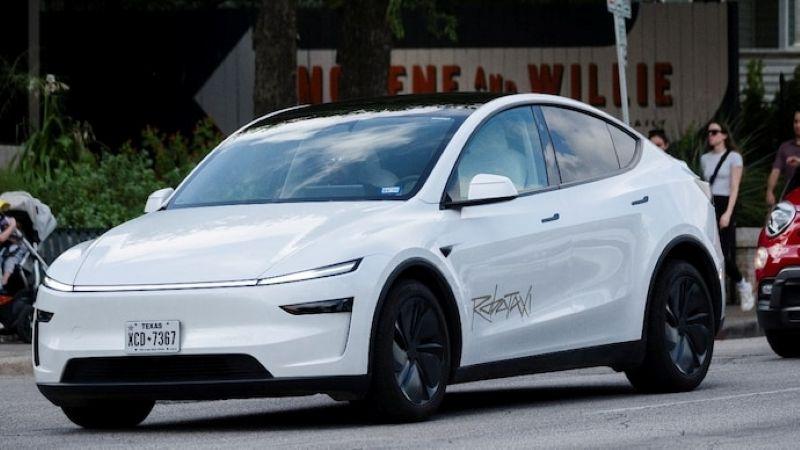
After years of hype, shifting timelines, and skepticism, Tesla has officially launched its fully driverless Robotaxi service marking a historic moment in the company’s journey toward autonomous transportation. The pilot service, which began on June 22 in Austin, Texas, offers paid rides to the public using Tesla Model Y vehicles with no one behind the wheel.
A Limited Yet Landmark Rollout
The initial deployment is small and tightly controlled. Tesla is using just 10 specially equipped Model Y vehicles for this pilot. These cars operate only within a limited area of South Austin, specifically around South Congress Avenue. Each vehicle has a Tesla safety monitor in the front passenger seat not to drive, but to oversee the journey and step in only if absolutely necessary.
The Robotaxi service is currently available from 6 AM to midnight, and each ride costs a flat $4.20, a number that cheekily references Elon Musk’s fondness for meme culture. Users must be over 18 years old to ride, and minors are currently not permitted due to safety protocols.
Tesla has not yet introduced its much-publicized Cybercab the futuristic concept vehicle it showcased in 2024. Instead, the company is using its more familiar Model Y, upgraded with a new version of its Full Self-Driving (FSD) software, now labeled “unsupervised.” Notably, Tesla's approach continues to reject radar and lidar, relying solely on vision-based AI systems powered by neural networks.
A Decade in the Making
Elon Musk has promised self-driving Tesla vehicles since 2014. After multiple delays and regulatory hurdles, the June 2025 launch is the first tangible realization of those claims. In a post on X, Musk hailed the milestone as “the culmination of a decade of hard work,” praising Tesla’s in-house AI and chip development teams.
While Tesla did not officially announce the launch beforehand, several tech influencers were invited to test the system and share videos of their rides online. Some clips showed the Robotaxi driving smoothly, while others revealed it hesitating near emergency vehicles and making abrupt stops suggesting the technology, while impressive, is still evolving.
New Laws Pave the Way
The Robotaxi rollout coincides with new autonomous vehicle legislation in Texas, which took effect in September 2024. The law requires companies operating driverless vehicles to meet Level 4 autonomy standards meaning the car can drive itself under defined conditions without human input and to obtain a state permit.
Crucially, the law shifts oversight from local governments to the Texas Department of Motor Vehicles (TxDMV), streamlining the process for AV deployment while retaining emergency powers to suspend dangerous services. Tesla reportedly received its permit in early June.
The law also mandates that AV companies provide detailed instructions to first responders on how to handle emergencies involving autonomous vehicles. While Tesla has not disclosed these protocols publicly, officials say the company submitted the required documentation to the state.
Privacy, Safety, and the Road Ahead
Although labeled “driverless,” Tesla’s Robotaxis are not without safety concerns. Each ride is monitored by a Tesla employee in the passenger seat, and the cars are equipped with internal cameras. Tesla has said it will not monitor in-cabin activity by default, but will review footage if a rider files a complaint or breaks the rules.
Riders who smoke, drink alcohol, attempt to tamper with vehicle systems, or use the Robotaxi for illegal purposes may be banned from the service. In addition, Tesla reserves the right to remove passengers who film or share videos that showcase policy violations.
Despite the milestone, experts caution that this is only the beginning. Philip Koopman, an autonomous driving researcher at Carnegie Mellon University, called it “the end of the beginning,” emphasizing the difficulty of scaling such systems citywide. Unlike companies such as Waymo or Cruise, Tesla is notably secretive rarely sharing detailed safety metrics, disengagement data, or technical specifications.
Tesla’s Robotaxi launch is currently limited to a small part of Austin, but expansion plans are expected. The company hopes to use its in-house Full Self-Driving system to deploy fleets across the U.S. without needing major infrastructure or sensor overhauls. In the short term, Tesla is gathering performance data, analyzing rider behavior, and testing the limits of its technology. But industry analysts warn that success in one neighborhood doesn't automatically translate to national readiness. Issues such as weather variability, complex road conditions, pedestrian unpredictability, and legal liability remain unresolved.
For now, Tesla’s Robotaxi fleet offers a glimpse into the future Musk has long envisioned: a world where cars drive themselves, mobility is accessible on-demand, and transportation is powered by artificial intelligence. But that future still faces many roadblocks before it can go mainstream.