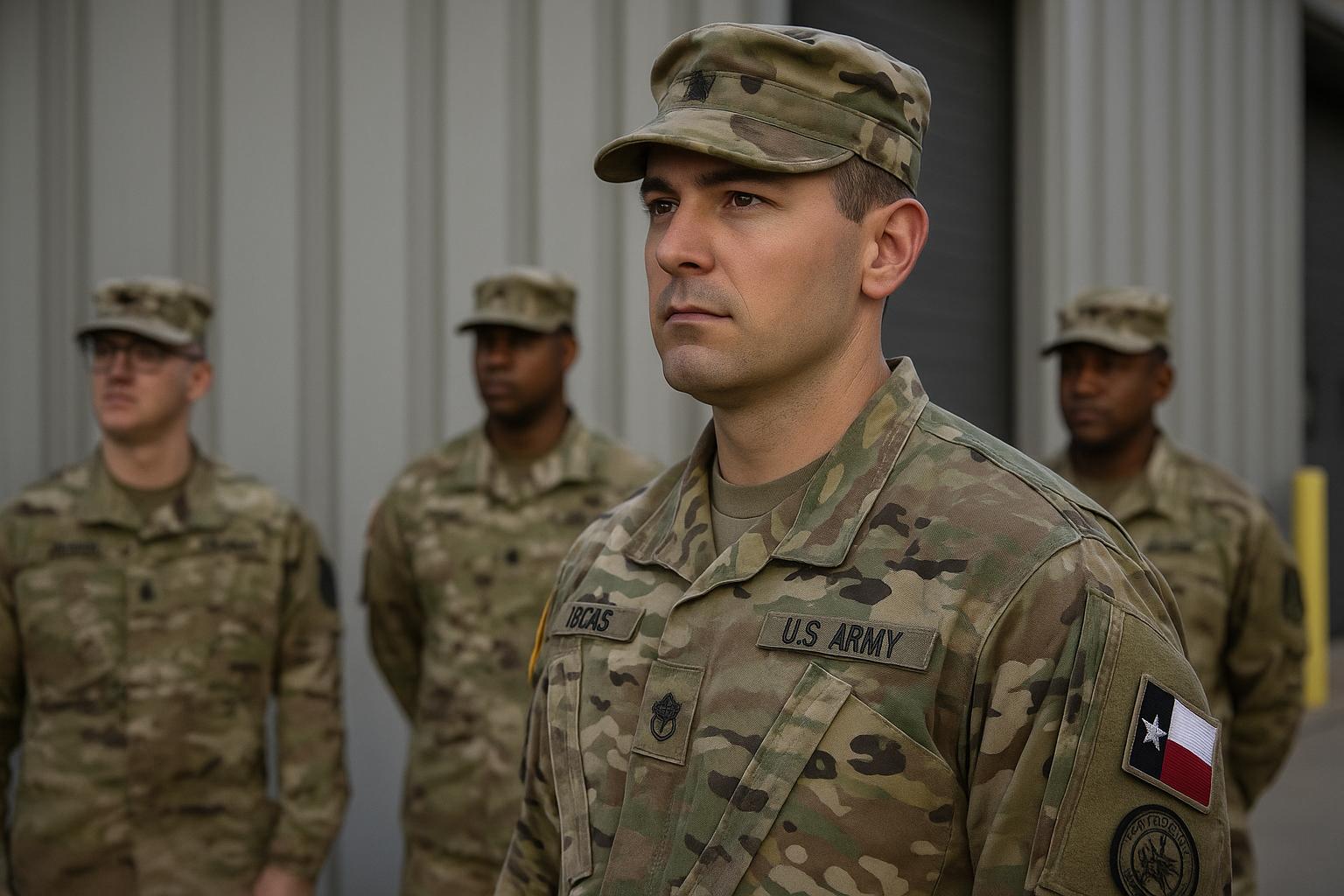
National Guard troops from Texas were seen on Tuesday at a U.S. Army training facility in Illinois, marking the most visible step yet in the Trump administration’s controversial plan to deploy military personnel to the Chicago area. The move has ignited a wave of political opposition and legal challenges from state and city officials who argue that the action is unconstitutional and politically motivated.
Military personnel wearing uniforms with the Texas National Guard insignia were spotted at the U.S. Army Reserve Center in Elwood, a village located about 55 miles southwest of Chicago. The sighting came a day after Texas Governor Greg Abbott shared a photo online showing members of his state’s National Guard boarding a plane, though he did not reveal their destination.
Illinois Governor JB Pritzker has been openly critical of the federal plan, warning that the deployment could escalate tensions rather than improve security. The Democratic governor previously suggested that Illinois National Guard troops might also be activated alongside roughly 400 troops from Texas. He accused President Donald Trump of using the military for political theater, calling the troops “props” and “pawns” in a wider campaign to project toughness on crime and immigration.
Chicago Mayor Brandon Johnson voiced similar frustration, saying the federal government has provided little transparency about its operations. “That is what is so difficult about this moment,” Johnson said on Tuesday. “You have an administration that is refusing to cooperate with local authorities.”
The state of Illinois and the city of Chicago filed a joint lawsuit against the Trump administration on Monday, seeking to block the deployment. A federal judge has given the administration two days to respond, with a hearing scheduled for Thursday. The lawsuit describes the move as part of “President Trump’s long-declared ‘War’ on Chicago and Illinois,” arguing that such deployments violate state sovereignty and threaten public safety.
The legal challenge in Illinois mirrors similar resistance from other states. Over the weekend, a judge in Oregon blocked the deployment of National Guard troops to Portland, citing concerns that federal involvement could intensify unrest. Trump’s broader effort to send troops to major urban centers has prompted criticism from several Democratic governors, who accuse the administration of overreach and disregard for state authority.
Trump has defended his actions, claiming that federal intervention is necessary to combat violent crime and illegal immigration in what he describes as “lawless” cities. He said he would consider invoking the Insurrection Act, a rarely used federal law that allows the president to deploy active-duty troops if states are unable to restore order. “If I had to enact it, I’d do that,” Trump said Monday. “If people were being killed, and courts or governors were holding us up, I’d take action.”
In Chicago, the federal presence has already stirred anxiety. Reports of armed Border Patrol agents operating near major landmarks have alarmed residents, particularly in immigrant-heavy neighborhoods. The city’s leadership has condemned the operations, arguing that they undermine trust and create fear in communities already unsettled by immigration crackdowns.
Mayor Johnson signed an executive order this week prohibiting federal immigration agents from using city-owned spaces—such as parking lots, garages, and vacant lots—for enforcement activities. The move is part of a broader effort to limit the federal government’s ability to conduct large-scale operations within city boundaries.
Meanwhile, the American Civil Liberties Union of Illinois has filed a separate lawsuit against the federal government, alleging that federal agents used excessive force against protesters and journalists near a U.S. Immigration and Customs Enforcement (ICE) facility in suburban Broadview. The Department of Homeland Security responded by asserting that the First Amendment does not protect “rioting.”
Similar tensions have unfolded in Portland, Oregon, where protests near an ICE facility have persisted for months. While earlier demonstrations had dwindled to small groups, crowds swelled again over the weekend following news of the troop deployment. Federal agents reportedly used tear gas to disperse protesters, reigniting public debate over the limits of federal authority.
Despite the administration’s claims of rising crime, official data indicates that violent crime has declined in many U.S. cities. In Portland, homicides dropped by 51 percent during the first half of 2025 compared with the same period last year. Chicago police reported a 31 percent decline in homicides through August.
Since the start of his second term, President Trump has sent or proposed sending troops to at least ten U.S. cities, including Baltimore, Memphis, Washington, D.C., New Orleans, and several in California. A federal judge ruled in September that the administration “willfully” violated federal law by deploying guard troops to Los Angeles during immigration-related protests.
The expanding use of federal forces within U.S. cities has deepened the divide between the White House and state governments, setting the stage for a larger constitutional battle over executive power and local autonomy. As the court hearings in Illinois approach, the debate over the legality and necessity of Trump’s troop deployments continues to intensify, with implications that could reshape the balance between state and federal authority for years to come.