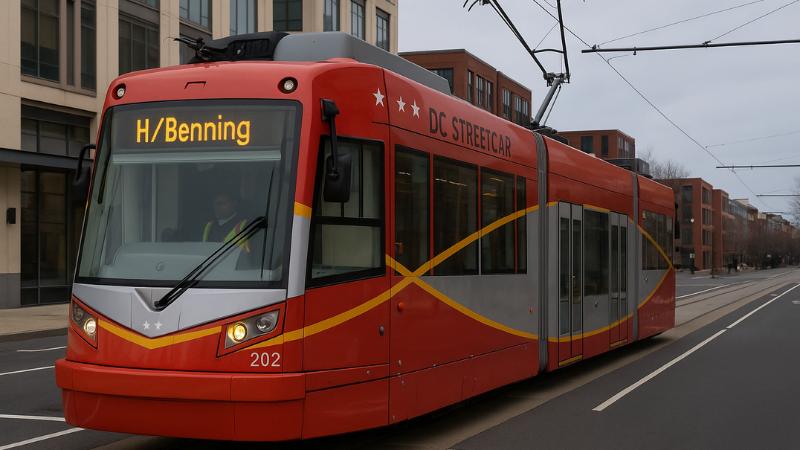
The District of Columbia is preparing to close the DC Streetcar after years of delays, significant investment, and ridership levels that never returned to pre-pandemic levels. City officials confirmed that the streetcar, which operates along H Street NE and Benning Road NE from Union Station to Oklahoma Avenue NE, will end service on March 31 due to budget pressures and consistently low demand. The announcement marks a major shift in Washington’s transit strategy, coming nearly a decade after the system’s launch and following more than $200 million invested in its development.
Ahead of the full shutdown, the city will begin scaling back the service in early January. The Department of Transportation stated that starting January 4, the streetcar will no longer run on Sundays, and weekday frequency will shift to 20 minutes. The revised schedule will run from 6 a.m. to 10 p.m. Monday through Friday and from 8 a.m. to 10 p.m. on Saturdays. The change represents a significant cut from the current 12-minute intervals and reflects the city’s effort to reduce operational expenses as the system winds down.
For many riders, the discontinuation is more than an inconvenience. Longtime residents who rely on the free service say they worry about losing a reliable transit option. Denis Hill, who frequently boards the streetcar for errands and shopping, said the closure will affect seniors who depend on short, accessible trips within their neighborhood. She explained that the route provides essential mobility for older residents who may not have other means of travel.
Transit officials are encouraging riders to shift to WMATA bus routes, including the D2X, D20, and C57, which cover portions of the same corridor. Some riders, like Betty Fluker, say they already prefer the bus network because of familiarity and social connections. Others say they find the streetcar route difficult to navigate or rarely used.
Earlier this year, Mayor Muriel Bowser announced plans to replace the streetcar with an electric bus system that would utilize existing infrastructure, including overhead power lines. However, details remain unresolved. During a recent virtual meeting dedicated to the upcoming service reductions, DDOT staff told residents that timelines for the electric bus conversion and the future of streetcar tracks are still under review. The meeting, scheduled for one hour but lasting less than 30 minutes, allowed residents to raise questions about long-term plans, contractor obligations, and operator employment.
Officials acknowledged that the city is still evaluating whether discontinuing the system will trigger penalties under its contract with the service operator, which costs approximately $10 million annually. Questions regarding the fate of streetcar employees were not addressed, with DDOT stating it could not comment on personnel matters.
As the shutdown approaches, residents and transit advocates continue to seek clarity on the transition to electric buses and the fate of infrastructure that has shaped the H Street corridor for years. DDOT has not yet provided further comment on the next phase of the project.