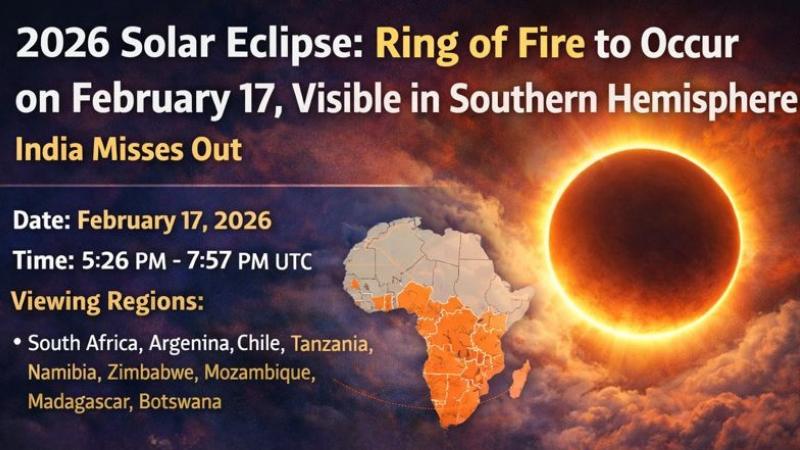
The 2026 Solar Eclipse will occur on February 17, and it is set to be a remarkable celestial event. This eclipse will be an annular solar eclipse, often referred to as the Ring of Fire eclipse. Here's everything you need to know about this rare event:
Eclipse Type: The eclipse will be an annular solar eclipse. In this type of eclipse, the Moon will cover about 96% of the Sun, but due to the Moon being farther from Earth, it will appear slightly smaller than the Sun. As a result, the outer edges of the Sun will remain visible, forming a bright circular ring around the Moon, which is known as the Ring of Fire.Duration: The eclipse will last for over two hours in total, with the Ring of Fire visible for a brief yet striking moment.
Eclipse begins: 5:26 PM UTC
Eclipse ends: 7:57 PM UTC
Maximum duration of Ring of Fire: Approximately 2 minutes and 20 seconds.
Visibility:
- India: Unfortunately, India will not be able to see the 2026 solar eclipse.
- Other regions: The eclipse will be primarily visible across parts of the Southern Hemisphere.
- Countries where the eclipse will be visible include:
- South Africa
- Argentina
- Chile
- Tanzania
- Namibia
- Zimbabwe
- Mozambique
- Madagascar
- Botswana
Significance:
- The eclipse will coincide with the Chinese Lunar New Year, adding cultural and astronomical significance to the date.
- The Ring of Fire will be visible in the Southern Hemisphere, providing a spectacular view to astronomy enthusiasts in those regions.
- Though the eclipse will not be visible in India, skywatchers in India can still follow live streams and scientific coverage from space agencies and observatories around the world.
- An annular eclipse like this one offers scientists and space enthusiasts a chance to study the Sun’s outer atmosphere, also known as the corona, which is typically hidden by the Sun’s bright light.
- It’s an exciting event for astronomers, highlighting the beauty of celestial movements and precision in our solar system.
- An annular solar eclipse occurs when the Moon passes between the Earth and the Sun. However, because the Moon is farther from the Earth, it appears smaller and cannot fully block the Sun.
- This results in the Ring of Fire, a glowing ring around the dark shadow of the Moon. Annular eclipses are rare and always draw attention due to their stunning visual effects.