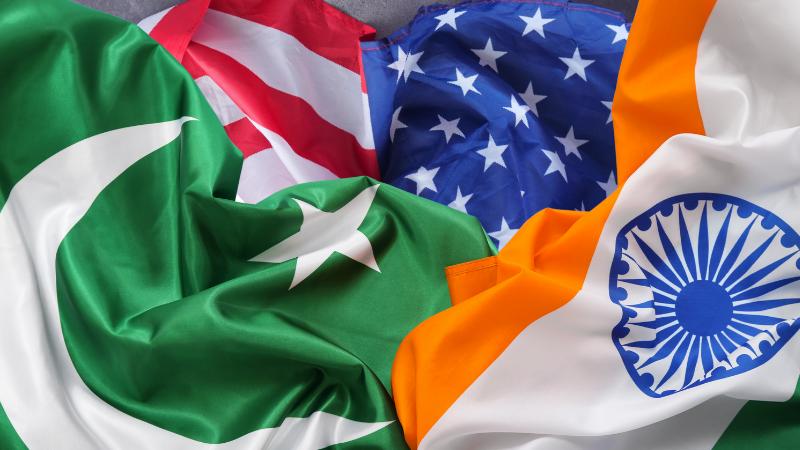
President Trump, now in his second term, has so far refrained from overtly siding with either nation. While acknowledging his closeness to both India and Pakistan, Trump remarked that the two countries would find a resolution “one way or the other.” His avoidance of strong language or condemnation was a noticeable shift from his earlier tenure when he openly criticized Pakistan for harboring terrorists. Despite this, Trump has continued to maintain ties with Islamabad. Even with a formal freeze on foreign aid, his administration has approved $5.3 billion in security-related exemptions for Pakistan and allowed nearly $400 million to support the maintenance of its F-16 fighter jets.
Interestingly, during Trump’s first term, he slashed $1.3 billion in military aid to Pakistan and openly labeled the country a safe haven for terrorists. This dual approach of financial leverage and political ambiguity seems to reflect the United States’ desire to retain influence in a complex region without becoming deeply entangled in the ongoing conflict between its two major allies.
Amidst this backdrop, several top US officials have reached out to Indian counterparts in an effort to calm the waters. Secretary of State Marco Rubio and Vice President JD Vance both emphasized the need for restraint and de-escalation. Vance, who was visiting India with his family when the Pahalgam attack occurred, made a public appeal urging India to avoid actions that might spark a wider regional conflict. At the same time, he pressed Pakistan to acknowledge any responsibility and cooperate with India in bringing the perpetrators to justice. Vance expressed hope that Pakistan would help ensure that terrorist groups operating within its borders are brought to account, signaling cautious but significant concern over Islamabad's role.
Rubio, in separate conversations with Indian External Affairs Minister S. Jaishankar and Pakistani Prime Minister Shehbaz Sharif, reinforced the need for dialogue and calm. While his tone was largely diplomatic, the fact that he directly engaged with Pakistan’s Prime Minister, bypassing its foreign minister, underscores the seriousness with which Washington views the situation. With Jaishankar, Rubio reaffirmed US-India cooperation against terrorism, while urging Sharif to publicly condemn the Pahalgam attack and contribute to the investigation. Such measured dual diplomacy highlights the United States’ desire to avoid taking sides publicly while still acknowledging India’s concerns.
On the other hand, some voices within the US establishment have expressed far stronger support for India. Secretary of Defence Pete Hegseth, in his call with Defence Minister Rajnath Singh, declared that the United States stands firmly with India and supports its right to defend itself. His statement is being viewed as the most unambiguous endorsement of India's stance, potentially signaling internal divergence in the US administration’s messaging.
Adding to this more assertive narrative, Director of National Intelligence Tulsi Gabbard went a step further. In her remarks, Gabbard not only condemned the Pahalgam attack in the strongest terms but specifically identified the victims as Hindus and blamed Islamist terrorists for targeting them. Her statement clearly aligns with India’s position, emphasizing that the attack was not just a terrorist incident but one aimed at a particular religious group. Gabbard tweeted that the US stood in solidarity with India and backed efforts to hunt down those responsible for what she called a heinous act.
These varied responses from the United States reflect the geopolitical complexities it faces in the region. With growing concerns over China’s assertiveness in the Indo-Pacific, Washington sees a stable South Asia as essential to its broader strategic interests. While Pakistan’s strategic importance has arguably diminished in recent years, it still occupies a significant place in US calculations, especially with regard to Afghanistan and broader counterterrorism efforts.
India, on the other hand, is increasingly viewed as a critical partner for the US in its Indo-Pacific vision. With deepening economic ties, defense collaborations, and shared democratic values, New Delhi occupies a central place in America’s long-term regional strategy. This makes balancing relations with both India and Pakistan not just a diplomatic challenge, but a necessity for the US.
However, the rising public support for India among certain US officials also reflects shifting sentiments in Washington. The overt nature of statements by figures like Gabbard and Hegseth suggests growing American impatience with Pakistan’s handling of extremist elements on its soil. It also demonstrates how the Indian diaspora’s influence in American politics, particularly among lawmakers, is beginning to shape foreign policy perceptions.
Meanwhile, inflammatory statements by Pakistani ministers following the attack have done little to ease tensions. Their reluctance to acknowledge the terror strike, coupled with provocative rhetoric, has drawn criticism not just in India but among international observers who see such posturing as detrimental to peace efforts. In this environment, the United States’ calls for calm, even if balanced, may have limited impact unless accompanied by firmer diplomatic pressure behind closed doors.
As the situation evolves, the coming weeks will be crucial in determining whether restraint prevails or whether the region slides closer to confrontation. For now, the United States continues to juggle its interests and alliances in a region where old rivalries and modern geopolitics are colliding with renewed intensity.