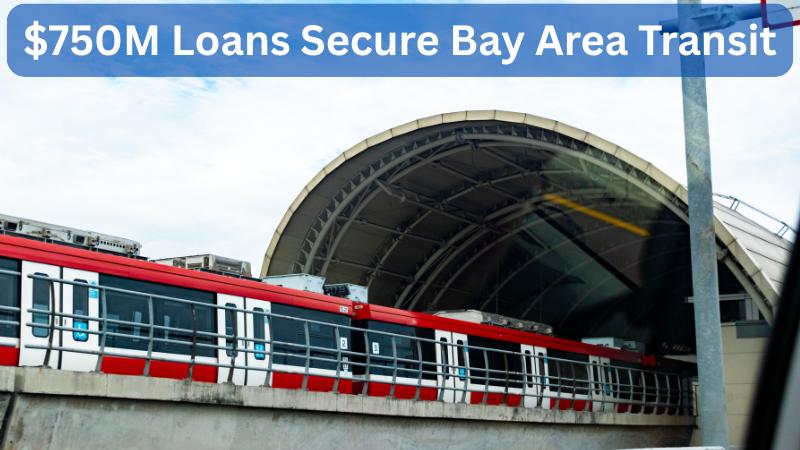
California Governor Gavin Newsom announced that $750 million in state loans for Bay Area transit agencies will be finalized before the end of the legislative session, delivering a much-needed financial lifeline to struggling transportation systems. The announcement comes after weeks of uncertainty, when a budget agreement reached in June appeared to be unraveling as state officials hesitated to release the promised funding.
The loans are intended to provide temporary relief to transit operators grappling with steep ridership declines and financial instability that began during the COVID-19 pandemic. Agencies including BART, San Francisco Municipal Transportation Agency, Alameda-Contra Costa Transit, and Caltrain were all counting on the funds to avoid immediate service cuts and layoffs. With the confirmation of the loans, these agencies can now move forward with greater stability while longer-term solutions are sought.
Ridership across Bay Area transit networks has failed to fully recover to pre-pandemic levels, leaving major gaps in revenue streams that were once sustained by ticket sales. The situation prompted state lawmakers, led by prominent Bay Area leaders, to advocate for bridge financing until a regional ballot measure can be considered in November 2026. That measure, if approved by voters, would provide ongoing funding starting in 2027 through a dedicated regional sales tax.
Earlier this month, the state Department of Finance indicated it would not finalize the loans by the close of the legislative session, raising concerns for transit operators who were preparing contingency plans for service cuts. However, Newsom stepped in and announced that an agreement had been reached to ensure the loans are delivered in time. He emphasized the state’s commitment to supporting public transportation, calling it essential to the lives of millions of Californians and crucial to building sustainable urban infrastructure.
“Transit is a lifeline to millions of Californians — and after billions in state investment, we’re continuing to back Bay Area agencies with ongoing support tailored to their needs,” Newsom said. He noted that the loans are part of a broader strategy to align financial resources with agency timelines while working toward a rider-first approach to public transit.
The financial challenges facing Bay Area transit agencies remain significant despite the loan support. AC Transit, which already used $41.5 million from its reserves to balance the current fiscal year’s budget, faces a projected $72 million deficit next year and a staggering four-year shortfall of $238 million. Caltrain’s projections show annual deficits of $75 million from 2027 through 2034, underscoring the severity of the financial cliff ahead.
BART, one of the region’s most heavily relied upon systems, is staring at annual shortfalls of $375 million starting in 2027 unless additional funding streams are established. Similarly, the San Francisco Municipal Transportation Agency (SFMTA) is bracing for annual deficits surpassing $300 million beginning in the 2026-27 fiscal year.
The loans provide a crucial buffer but do not resolve the long-term structural funding problems. Leaders across the Bay Area continue to argue that sustainable funding solutions are needed to ensure reliable public transit service for the future. Without voter approval of a regional ballot measure, agencies may again face drastic service cuts, fare increases, or layoffs.
For now, the finalized loans represent a reprieve for riders who depend on Bay Area transit services every day. Advocates stress that preserving reliable public transportation is not only about economic stability but also about environmental responsibility and equitable access to mobility across diverse communities.
As California prepares for the 2026 ballot measure, the debate over how to build a sustainable and modern transit network is expected to intensify. For now, however, the state’s intervention offers transit agencies the opportunity to stabilize and continue serving millions of residents without immediate cuts.