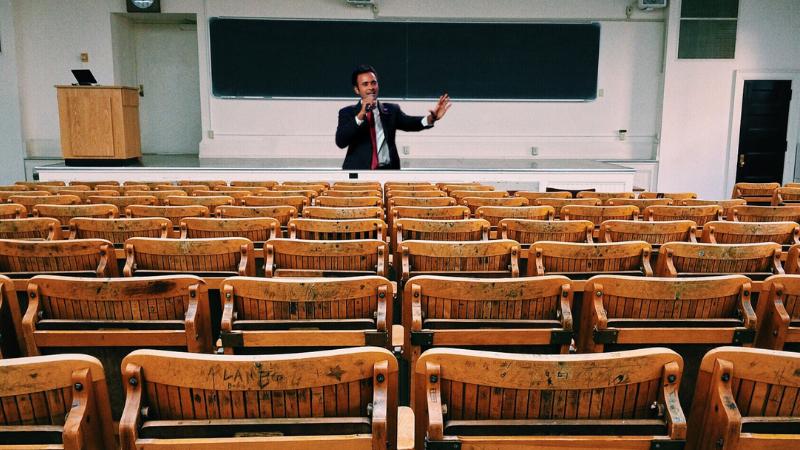
Ohio gubernatorial candidate Vivek Ramaswamy presented his vision for the future of education in the state during a campaign event in Hilliard on Wednesday night. The Republican candidate spoke to supporters about what he sees as a critical need for reform in Ohio’s schools, putting forth a series of proposals that immediately drew both strong support and vocal opposition. His agenda focused heavily on eliminating teachers’ unions, creating a system of merit-based pay for educators, and expanding access to school choice programs.
Ramaswamy pointed to what he called alarming statistics in Ohio’s largest public school districts as justification for urgent change. He cited data showing that the state’s eight largest public school systems, known as the Ohio 8, have less than 45 percent of students achieving reading proficiency by the end of third grade and the start of fourth grade. He stressed that such numbers are not acceptable and reflect a deeper systemic problem within public education. According to him, only bold reforms could bring meaningful improvements, and those reforms would need to focus on empowering families, holding schools accountable, and rewarding teachers who perform well.
One of the central pieces of Ramaswamy’s vision is school choice. He argued that by allowing families to use state-funded scholarships or vouchers to enroll their children in private schools, the competition would ultimately raise standards in public schools as well. He pointed to examples where areas with school choice policies showed improvement not only in private institutions but also in the surrounding public schools, which he claimed perform better once they face the pressure of competition. In his remarks, Ramaswamy emphasized that school choice is not just a matter of policy but a matter of principle, aligning it with his broader conservative belief in freedom and individual rights.
His proposal to eliminate teachers’ unions and replace traditional pay structures with merit-based systems also drew significant attention. He argued that unions often block meaningful reform and protect ineffective practices, while merit pay would incentivize high-quality teaching and reward educators who go above and beyond in helping students succeed. By removing what he views as institutional obstacles, he believes Ohio can rebuild a stronger, more effective educational system that better serves both students and communities.
While Ramaswamy’s remarks received applause from his supporters inside the venue, the event also sparked protests outside. Critics gathered to voice concerns that his agenda would undermine public education and leave many families behind. Christina Collins from Honesty for Ohio Education said that public schools provide far more than just academic instruction, noting their role as central hubs for community support and resources. She argued that proposals like eliminating unions and shifting toward privatization overlook the broader responsibilities of public schools and the real needs of families who depend on them for stability, meals, and social programs in addition to classroom learning.
Other protesters, including members of advocacy groups, highlighted the pressures and challenges that educators already face. Rachel Coyle of Ohioans Against Extremism argued that teachers and professors are under attack and that their struggles directly affect students. She noted that when educators are weakened, students inevitably pay the price, and she called on candidates and leaders to consider the well-being of both groups when shaping policy.
Despite the criticism, Ramaswamy stayed focused on his platform and made it clear that his campaign will continue to emphasize education reform as one of its key pillars. He framed the issue as foundational to Ohio’s long-term success, arguing that fixing the state’s educational achievement crisis is essential not only for improving schools but also for securing a stronger future for the entire state. He urged supporters to see education not as a partisan issue but as a defining factor in whether Ohio will decline or rise in the years ahead.
As the event concluded, it was clear that Ramaswamy’s proposals had struck a chord with both supporters and opponents, setting the stage for education policy to become a major debate in the upcoming gubernatorial race. While some see his ideas as bold steps toward necessary change, others view them as dangerous moves that could weaken public schools and marginalize vulnerable communities. With protests, impassioned speeches, and growing public attention, Ohio’s education system has become a focal point of the campaign, ensuring that the conversation around schools, teachers, and students will remain central in the months ahead.