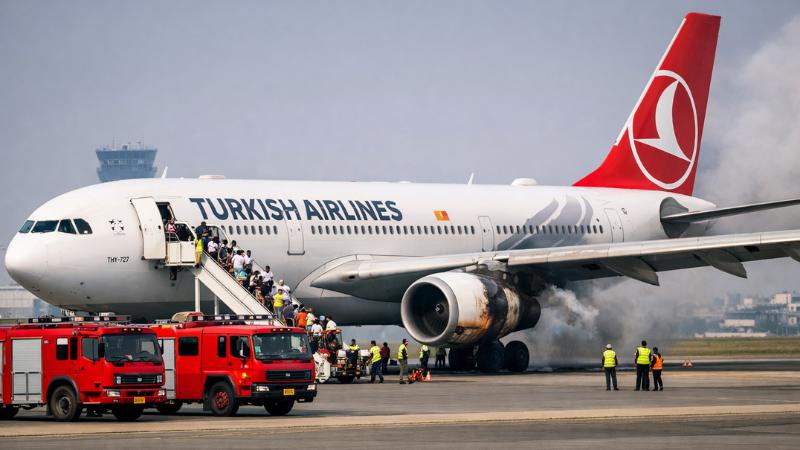
A Turkish Airlines passenger aircraft carrying 236 people was forced to divert and make an emergency landing on Wednesday afternoon after its right engine caught fire shortly after takeoff from Tribhuvan International Airport in Kathmandu, officials confirmed. The incident triggered a brief operational halt at the airport and prompted swift coordination between air traffic control and emergency services to ensure the safety of everyone onboard.
The wide-body Airbus A330-303, operating flight number THY-727 and bound for Istanbul, departed the Nepali capital at approximately 1:28 pm local time. Within minutes of becoming airborne, the crew detected signs of a fire in the aircraft’s right engine. Airport authorities said the situation developed roughly four minutes after takeoff, leading the pilots to initiate emergency procedures while maintaining control of the aircraft.
According to airport officials, the crew immediately shut down the affected engine and diverted the aircraft west of Kathmandu airspace to assess the situation. The pilots held the plane in the air for nearly 10 minutes while communicating with air traffic controllers and evaluating systems before deciding to proceed with a diversion. The aircraft was carrying 225 passengers and 11 crew members at the time of the incident.
Following reports of the engine fire, Tribhuvan International Airport temporarily suspended operations for around 15 minutes as a precaution. Emergency response teams were placed on standby, and coordination began with regional authorities to prepare for a potential emergency landing.
The flight ultimately diverted to Netaji Subhash Chandra Bose International Airport in Kolkata, where a full emergency landing protocol was activated. The captain informed Kolkata air traffic control of a possible fire in the right engine, prompting ground crews and firefighting units to be positioned along the runway. The aircraft touched down safely at approximately 2:49 pm local time.
All passengers and crew disembarked without reported injuries, officials said. The aircraft was subsequently moved to a designated inspection area, where technical teams began examining the engine and associated systems to determine the cause of the incident. Aviation safety authorities are expected to conduct a detailed review, including maintenance records and cockpit data, as part of standard procedures.
Airline and airport officials emphasized that the crew’s quick response and adherence to established safety protocols were critical in preventing further risk. The incident highlights the importance of emergency preparedness and coordinated action in commercial aviation, where rapid decision-making and system redundancies help protect passengers during unforeseen events.
Operations at both Kathmandu and Kolkata airports returned to normal shortly after the landing, while the aircraft remains under inspection pending clearance for further service.