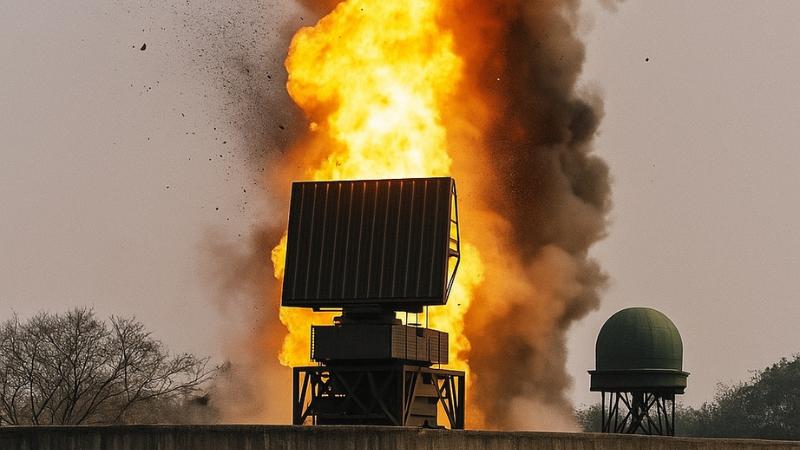
The Indian government stated that these attacks were countered in real-time by India’s advanced air defence network. Indian forces responded "in the same domain and with the same intensity," directly targeting radar and anti-air systems in Pakistan used to initiate the attacks. Cities reportedly targeted by Pakistan included Srinagar, Pathankot, Amritsar, Ludhiana, and Chandigarh. According to officials, all of Pakistan’s launched drones and missiles were successfully intercepted. Debris recovered from these attacks will be used as additional evidence in India’s ongoing campaign to expose Pakistan’s role in cross-border terrorism, especially in light of financial and military support provided to terror outfits.
This escalation attempt occurred just 24 hours after India carried out Operation Sindoor, a swift 25-minute precision strike on nine terror camps four in Pakistan and five in Pakistan-occupied Kashmir (PoK). The Indian Air Force used advanced munitions including SCALP missiles and HAMMER bombs to destroy terror group headquarters and training centers, specifically those operated by Lashkar-e-Taiba and Jaish-e-Mohammed. These strikes were a direct retaliation to the April 22 Pahalgam terror attack, in which four Lashkar proxies from The Resistance Front killed 26 civilians in Jammu & Kashmir’s Baisaran Valley. The Indian military stressed that its strikes were focused and non-escalatory, targeting only terrorist infrastructure based on credible intelligence, and not Pakistani military establishments.
Among the key sites hit during Operation Sindoor was Muridke, a city in Pakistan’s Punjab province known to house Lashkar’s main HQ. Jaish training centers, also implicated in the 2019 Pulwama suicide bombing that killed 40 Indian soldiers, were destroyed in similar precision strikes. Since the Pahalgam attack, Pakistan has intensified cross-border shelling, targeting Indian positions in Kupwara, Baramulla, Uri, Poonch, Mendhar, and Rajouri sectors. Heavy artillery and mortar fire have resulted in the deaths of 16 civilians, including three women and five children, and injured several others. One Indian soldier was also killed in the shelling.
India has reiterated its policy of proportional retaliation, stating that the military remains committed to non-escalation, provided Pakistan refrains from further provocations. Defence Minister Rajnath Singh briefed opposition leaders during an all-party meeting on Thursday, reaffirming that Operation Sindoor is ongoing and any attack on Indian assets will be met with further military responses.
India's use of advanced air and ground-based countermeasures underscores the preparedness of its armed forces in responding to both conventional threats and asymmetric warfare tactics. The focus remains on preventing further civilian casualties and safeguarding national security infrastructure, while also maintaining strategic restraint.
As tensions remain high across the border, global attention is once again turning toward South Asia. India is expected to use recovered drone and missile debris to present its case on international platforms, reinforcing its position that Pakistan continues to harbor and assist terror groups despite mounting diplomatic pressure.