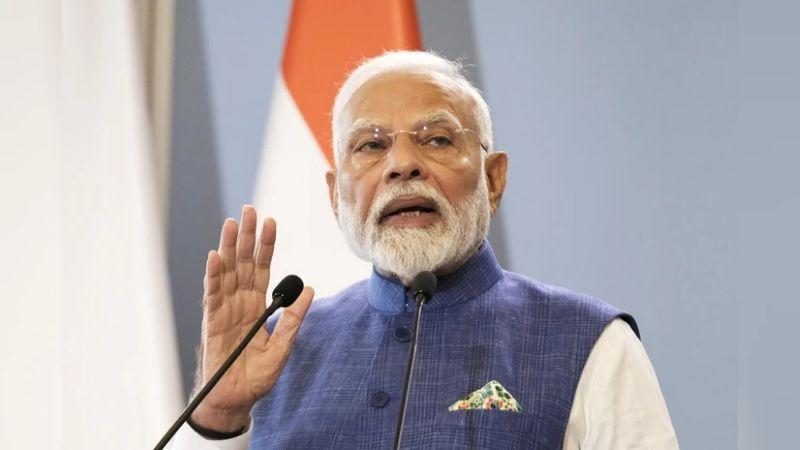
In a strong and emotionally charged message, Prime Minister Narendra Modi today declared his unwavering support for India's farmers and fishermen in response to US President Donald Trump's announcement of an additional 25% tariff on Indian exports. Speaking at the MS Swaminathan Centenary International Conference in New Delhi, PM Modi made it clear that India would not compromise its agricultural interests under international pressure.
This was Modi’s first public response to the latest escalation in the India-US tariff tensions, triggered by Washington’s decision to penalize India over its continued import of Russian crude oil. "The interest of farmers is our top priority. India will never compromise with the interests of its farmers, livestock holders, and fishermen. I know I will have to pay a huge price personally, but I am ready," the Prime Minister declared.
The US administration, led by President Trump, had already imposed 25% tariffs on July 20. The recent announcement brings the total tariffs on Indian exports to 50%, a move that has sparked sharp responses from Indian authorities. The Ministry of External Affairs condemned the tariff hike as “unfair, unjustified, and unreasonable,” asserting that India’s oil imports are based on market logic and national energy security needs.
India’s agricultural exports, a key component of trade with the US, are expected to be heavily impacted by this decision. PM Modi used his platform at the conference to reiterate that India’s commitment to its food producers would remain firm. He also honored MS Swaminathan, the father of India’s Green Revolution, calling on the nation to now move toward a mission of "nutritional security."
This latest move by the US is seen not only as economic retaliation but also as part of larger political tensions. India and the US have experienced strained relations in the aftermath of Operation Sindoor, India’s military retaliation following the Pahalgam terror attack. While Trump has claimed to have mediated a ceasefire between India and Pakistan, the Modi government has firmly denied such claims, stating in Parliament that no foreign leader influenced the nation's decision-making.
The tariff increases also come amid a freeze in India-US trade deal negotiations. Washington had been pressuring New Delhi for greater access to India’s agricultural sector, which India resisted in order to protect domestic farmers. PM Modi’s latest speech reaffirms that stance. As the diplomatic rift deepens, all eyes are on how both nations will navigate the widening trade and geopolitical divide. With a determined tone, PM Modi’s message to the US is clear: India is prepared to bear the cost but not at the expense of its people.