Pakistan Army Chief Calls Kashmir 'Jugular Vein', Defends Two-Nation Theory in Diaspora Address
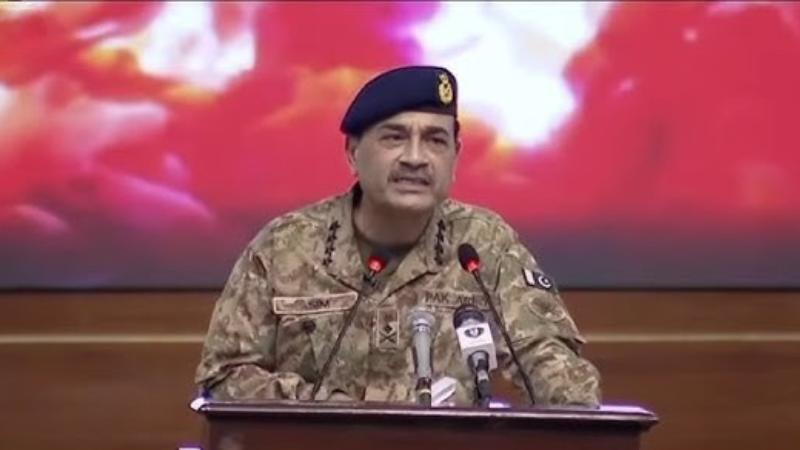
In a speech that is expected to provoke strong responses from India, Pakistan’s Army Chief General Asim Munir reiterated the long-standing claim that Kashmir is Pakistan's “jugular vein” and reaffirmed his support for the two-nation theory, which served as the foundation for the 1947 Partition of India. Addressing a gathering of Pakistanis abroad, General Munir delivered a message that blended national pride, historical justification, and a clear stance on the country’s strategic and ideological positioning.
His remarks were delivered to members of the Pakistani diaspora, whom he described as ambassadors of the nation, encouraging them to preserve and promote Pakistan’s identity and values across generations. “You should definitely tell Pakistan's story to your children,” he said, emphasizing that the two-nation theory is not only a historical principle but a continuing ideological compass for Pakistan. “Our forefathers thought that we are different from the Hindus in every aspect of life. Our religions, our customs, traditions, thoughts and ambitions are different.” The two-nation theory, which asserts that Muslims and Hindus constitute distinct nations, was a central pillar of the movement for the creation of Pakistan led by Muhammad Ali Jinnah. General Munir’s endorsement of this theory reasserts the ideological divide that has fueled tensions between India and Pakistan since their independence.
Statements Reinforce Pakistan’s Stance on Kashmir and Internal Security
In one of the most politically charged moments of his speech, General Munir doubled down on Pakistan’s position on Kashmir, saying, “Our stance is absolutely clear. It was our jugular vein, it will be our jugular vein, we will not forget it.” He described the people of Kashmir as engaged in a “heroic struggle” and assured that Pakistan would not abandon their cause. This rhetoric reaffirms Islamabad’s continued focus on Kashmir as central to its national and regional agenda. General Munir also addressed concerns regarding Pakistan’s internal security and global perception. Responding to fears that terrorism and instability are deterring foreign investment, he expressed confidence in Pakistan’s resilience. “The 1.3 million-strong Indian Army, with all its wherewithal, if they cannot intimidate us, do you think these terrorists can subdue the armed forces of Pakistan?” he asked.
Furthermore, the Pakistan Army chief delivered a strong warning to separatist movements in Balochistan, declaring that such efforts to divide the country would fail. “Balochistan is Pakistan's pride,” he said. “You will just take it away so easily? You won't be able to take it in 10 generations. Inshallah, we will defeat these terrorists very soon. Pakistan will not fall.” His speech underlined the role of the military as the ultimate guardian of Pakistan’s territorial and ideological integrity. While defending the nation's Islamic identity, General Munir positioned the army as a stabilizing force capable of countering both domestic insurgencies and external threats.
The Indian government has not yet responded to General Munir’s remarks, but given their nature and the context in which they were made, a formal response is expected. His comments come at a time when diplomatic relations between India and Pakistan remain strained, with no formal talks underway and tensions continuing over cross-border incidents, terrorism allegations, and the status of Jammu and Kashmir. For a country where the military plays a dominant role in political and foreign affairs, General Munir’s statements provide insight into Pakistan’s current stance on key issues, including its national identity, defense policy, and regional posture. The speech also appears to be a message to both domestic and international audiences—reassuring Pakistanis at home and abroad of the army’s control, while signaling to adversaries that the country’s military leadership remains firmly committed to traditional narratives and security doctrines.
By invoking the two-nation theory and asserting that the ideological divide between Hindus and Muslims remains relevant, General Munir’s speech reinforces a hardened position that may hinder prospects for dialogue with India. His firm words on Kashmir and Balochistan reflect a defense-first mindset that continues to shape Pakistan’s policy direction under military influence. As regional dynamics evolve with shifting alliances and changing economic priorities, such speeches are more than symbolic—they are strategic signals. Whether General Munir’s remarks will escalate tensions or prompt diplomatic exchanges remains to be seen. What is clear, however, is that the army chief has made Pakistan’s ideological and territorial claims loud and clear, reaffirming a path that leaves little room for immediate rapprochement with India.