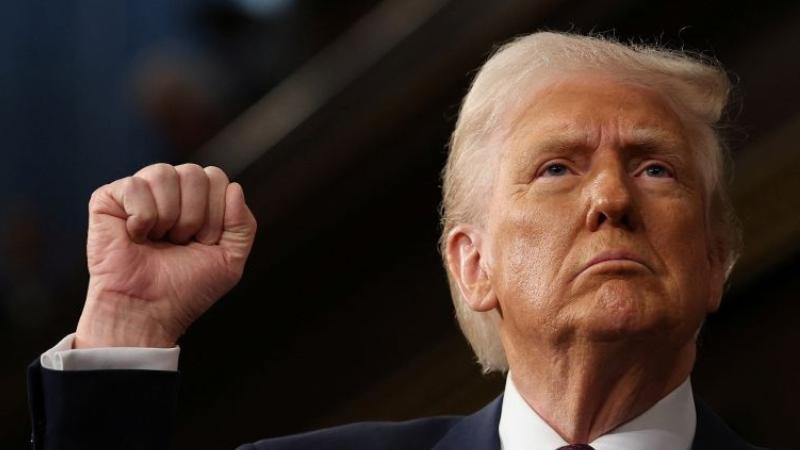
President Donald Trump returned to Washington in the early hours of Tuesday, following an abrupt departure from the Group of Seven (G7) summit in Canada. The move came as tensions continue to escalate between Israel and Iran. Trump, who had initially planned to remain for the summit’s entirety, decided to leave after dinner with other world leaders, citing the urgency of the Middle East situation.
Speaking to reporters aboard Air Force One from Calgary, Trump dismissed French President Emmanuel Macron's earlier remarks suggesting he left to broker a truce between Israel and Iran. Instead, Trump insisted he is aiming for more than a temporary ceasefire. "We’re looking at better than a ceasefire," Trump said, emphasizing his desire for a permanent resolution. "A real end. Not a ceasefire, an end," he added. He also explained that his recent statement urging Tehran’s 10 million residents to evacuate was not a threat, but a concern for public safety, reiterating that Iran must never possess a nuclear weapon.
After landing in Washington, Trump posted on Truth Social, stating that he had not initiated peace talks with Iran. "If they want to talk, they know how to reach me," he wrote. He further criticized Tehran for not accepting a prior deal to limit its nuclear program, saying doing so could have prevented the ongoing Israeli attacks. According to administration officials, Trump had instructed the National Security Council to prepare for immediate consultations in the Situation Room upon his return.
White House press secretary Karoline Leavitt confirmed Trump’s decision to leave the summit early in a post on X, noting that although he missed part of the G7 agenda, significant progress was made, particularly on trade negotiations with British Prime Minister Keir Starmer. The discussions led to an agreement to adjust certain tariffs, though the 25% duty on British steel imports remains in place for now.
The gravity of the conflict between Israel and Iran was underscored as both countries engaged in fresh rounds of airstrikes. The U.S. State Department announced the temporary closure of its embassy in Jerusalem and its branch in Tel Aviv due to the ongoing hostilities. Israeli Finance Minister Bezalel Smotrich reported that thousands of civilians in Israel had been evacuated in response to Iranian retaliation. Iranian state media stated that at least 224 people had died in Iran since the initial Israeli offensive began, including several individuals close to Supreme Leader Ali Khamenei. In return, Iranian strikes have killed at least 24 people in Israel, according to local officials.
During the G7 summit, leaders released a joint statement supporting Israel’s right to defend itself and labeling Iran as the primary source of instability in the Middle East. The statement reaffirmed the collective stance that Iran must never acquire nuclear weapons. Although Trump supported this view, a White House source said he declined to formally sign the joint statement.
Secretary of State Marco Rubio, who accompanied Trump during the summit, also returned to Washington to assist in high-level consultations. The administration has remained tight-lipped about any further strategic responses but maintains that preparations are underway for all possible scenarios. The situation has drawn international attention, raising concerns about a wider regional conflict if diplomatic avenues fail to materialize.
As the situation continues to develop, Trump’s administration appears poised to intensify its involvement in the Middle East conflict. His recent remarks and swift departure from the G7 signal a shift in focus from multilateral diplomacy toward direct crisis management. Observers note that the coming days will be crucial in determining whether the conflict escalates further or opens a window for de-escalation through negotiations.