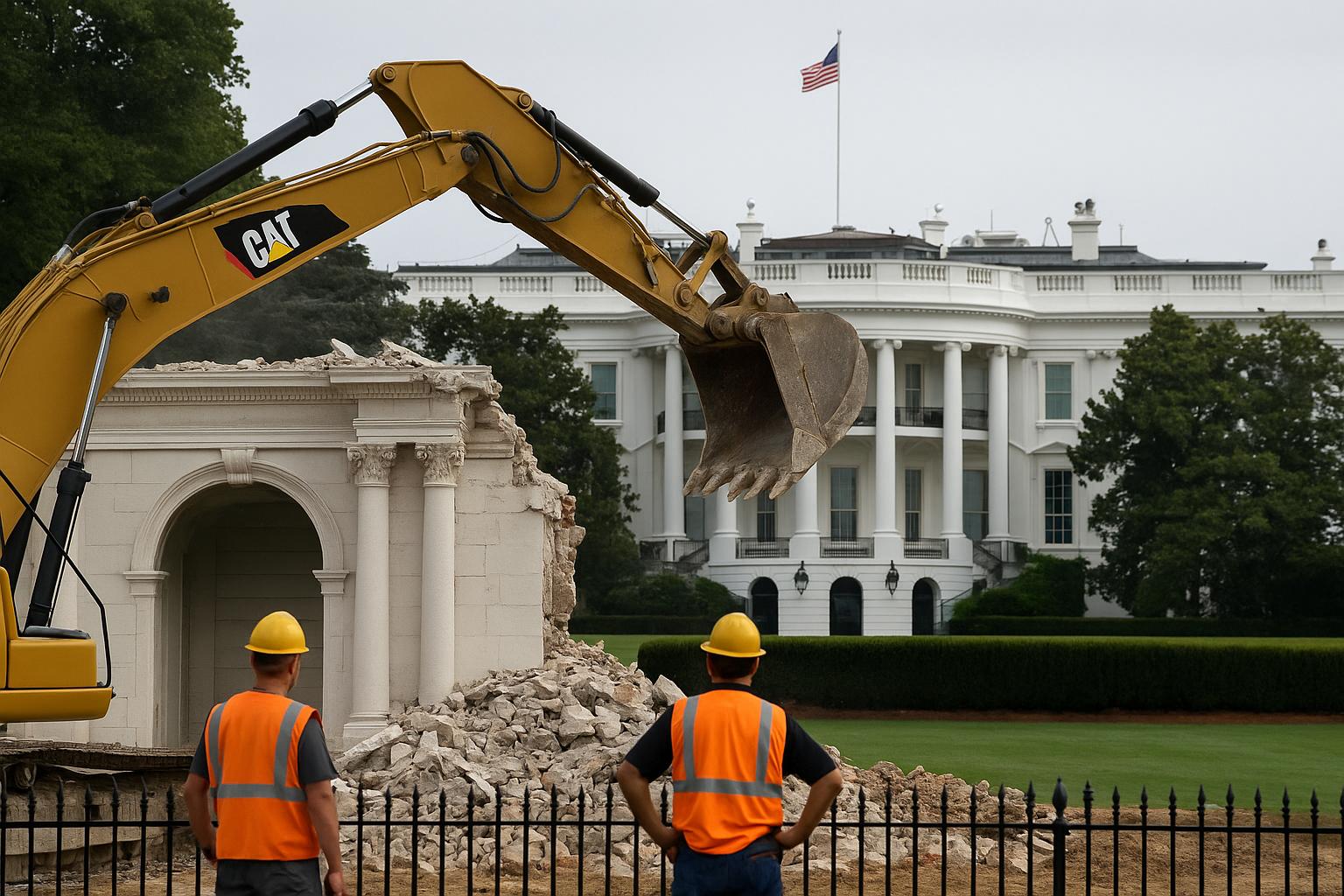
The White House has become the center of national debate following the announcement that its East Wing will be demolished to make way for President Donald Trump’s proposed new ballroom. The decision, confirmed earlier this month, has sparked outrage among historians, architects, and preservationists who consider the East Wing an integral part of America’s architectural and political heritage.
For over a century, the East Wing has served as both a ceremonial entrance and the official domain of the First Lady. Since the era of Eleanor Roosevelt, it has been a space associated with influence, culture, and the personal side of presidential life. The demolition of the two-story structure, which began this week, immediately drew criticism after photos of bulldozers tearing through the wing’s facade went viral online. Even former First Lady and Secretary of State Hillary Clinton voiced her disapproval, calling the move “a loss of history and heart.”
The National Trust for Historic Preservation, a nonprofit organization based in Washington, D.C., expressed “deep concern” in an open letter to federal authorities, urging the administration to halt the demolition until proper public and regulatory reviews were conducted. The organization appealed to the National Capital Planning Commission and the National Park Service to pause the process and allow the American public to weigh in on the proposed construction. The letter, dated October 1, emphasized the need for transparency and preservation of a building that has played a crucial role in shaping the identity of the White House complex.
The East Wing, in its current form, traces its origins back to 1902 under President Theodore Roosevelt, who transformed what was then known as the East Terrace. It was later reconstructed during Franklin D. Roosevelt’s presidency in the 1940s, partly to conceal the construction of a secret underground bunker known as the Presidential Emergency Operations Center. The bunker, first designed for use during World War II, gained renewed attention in modern times. It was used during the September 11, 2001 terrorist attacks to shelter Vice President Dick Cheney and, more recently, by President Trump himself during the 2020 protests near the White House.
Above the bunker sits the president’s private theater and the East Colonnade, a covered walkway connecting the wing to the main residence. The colonnade, along with the Jacqueline Kennedy Garden to its south, symbolizes the blend of function and elegance that defines the White House grounds. The garden, named after the former First Lady, has hosted numerous outdoor events and receptions through the decades.
The East Wing’s history has long been intertwined with controversy. When Franklin D. Roosevelt expanded the wing in 1942 to accommodate additional staff, critics accused him of extravagance during wartime. Republican opponents at the time called the renovations wasteful and politically motivated. Yet, despite initial criticism, the expansion became essential to supporting the growing administrative demands of the presidency.
The roots of the East Wing, however, date back even further. President Thomas Jefferson first envisioned colonnades on both sides of the White House to provide practical walkways and architectural balance. While Jefferson’s additions were initially criticized by Federalists for reflecting “aristocratic tendencies,” they laid the foundation for what would eventually become the modern East Wing. Over the years, the structure evolved from a simple architectural extension into a hub of political and social activity.
By the 1930s, First Lady Eleanor Roosevelt had transformed the space into a professional base for her growing staff as she redefined the public role of the president’s spouse. Her successor, Jacqueline Kennedy, brought refinement and media attention to the wing, hiring a press secretary and formalizing the First Lady’s office. It wasn’t until 1977, during Rosalynn Carter’s tenure, that the East Wing became the official headquarters of the First Lady’s staff. Betty Ford once described its symbolic importance, saying, “If the West Wing is the mind of the nation, the East Wing is the heart.”
Architectural historians fear that the demolition will erase these layers of history. Lorenzo Winslow, the White House architect during the 1930s, oversaw much of the original East Wing’s reconstruction, integrating it with the bunker and theater below. His work helped shape the White House’s current form, balancing presidential security and architectural dignity. It remains unclear how Trump’s proposed ballroom project will affect these historic elements, including the subterranean structures beneath.
As the Trump administration moves ahead, preservationists argue that the loss extends beyond architecture. The East Wing has long embodied the evolution of America’s first ladies and the nation’s social history. Its walls have witnessed suffragist protests, wartime decision-making, and cultural transformation.
With demolition underway, critics fear that one of the White House’s most symbolic and human spaces will vanish in favor of a modern addition that may not reflect its historical legacy. Supporters of the plan, however, claim the new ballroom will modernize the White House’s event facilities and create new opportunities for state functions.
As construction begins, the debate continues over how the nation balances modernization with preservation. The East Wing’s story — from its humble colonnade beginnings to its transformation into the heart of the First Lady’s office — stands as a reminder that history, once destroyed, can rarely be rebuilt.