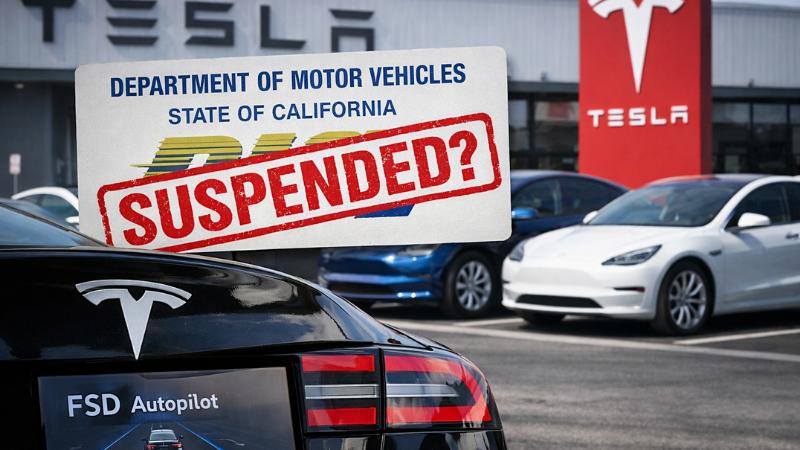
California regulators have warned Tesla that its license to sell electric vehicles in the state could be temporarily suspended early next year unless the automaker revises how it markets its self-driving technology. The warning follows a legal decision concluding that Tesla misled consumers for years by overstating the capabilities of its driver assistance systems, particularly through the use of the terms Autopilot and Full Self-Driving.
In a decision released late Tuesday, an administrative law judge recommended that the California Department of Motor Vehicles impose a 30-day suspension of Tesla’s license to sell vehicles in the state. The proposed penalty stems from findings that Tesla’s marketing created unrealistic expectations among consumers about the level of autonomy its vehicles can achieve. After five days of hearings held in Oakland in July, the judge determined that Tesla’s advertising failed to adequately convey that its systems require active human supervision at all times.
The ruling also suggested suspending Tesla’s manufacturing license for its Fremont, California, factory. State regulators, however, indicated they do not intend to pursue that portion of the recommendation. Instead, the focus remains on Tesla’s sales practices and how it communicates the limitations of its self-driving technology to buyers.
Tesla has been given a 90-day window to make additional changes to its marketing language in order to avoid the suspension of its California sales license. The company has already taken steps in that direction since regulators filed their action in 2023, including adding clearer disclaimers that Full Self-Driving requires constant driver oversight. California officials have said further adjustments could resolve the issue without disrupting vehicle sales.
State regulators maintain that the matter is about consumer protection rather than technological innovation. Officials argue that Tesla can comply by aligning its messaging with standards already followed by other autonomous vehicle developers and automakers. They say the goal is to ensure drivers clearly understand that current systems are advanced driver assistance features, not fully autonomous technology.
Tesla has publicly dismissed the decision as excessive. In a post on Elon Musk’s social media platform, the company said the ruling was focused solely on terminology and noted that no individual customer testified to having been harmed by the marketing. Tesla insisted that vehicle sales in California would continue without interruption and reiterated that user manuals clearly state the need for driver supervision.
The regulatory threat arrives at a challenging time for Tesla’s core auto business. The company has faced a global slowdown in demand amid intensifying competition in the electric vehicle market and a lineup that critics say is aging. Sales have also been affected by political controversy surrounding Musk’s former role in a federal government efficiency initiative under President Donald Trump, a tenure that ended in a public split. Tesla’s vehicle deliveries declined by about 9 percent from 2024 through the first nine months of this year, despite updates to the Model Y and the introduction of lower-priced variants.
Even so, Tesla’s stock briefly reached a record high in early Wednesday trading before retreating later in the session. The resilience of the share price, despite weakening vehicle sales and regulatory pressure, reflects investor confidence in Tesla’s longer-term ambitions, particularly its investments in artificial intelligence, humanoid robotics, and autonomous transportation.
Much of that optimism centers on Musk’s long-promised robotaxi vision. Tesla has begun limited testing of autonomous ride-hailing vehicles in Austin, initially with human supervisors behind the wheel. Musk recently disclosed that some tests are now being conducted without a safety monitor in the vehicle, a move that has drawn both attention and skepticism from regulators and safety advocates.
Criticism of Tesla’s self-driving claims is not new. Regulators, safety experts, and plaintiffs in multiple lawsuits have argued that the company’s marketing exaggerates the capabilities of its technology and may encourage drivers to place too much trust in automated systems. A video released in 2020 showing a Tesla driving itself was cited as evidence in the California case and remained publicly available for several years.
Tesla has faced numerous legal challenges related to crashes involving Autopilot, with mixed outcomes. While the company has prevailed or settled in several cases, a jury in Miami earlier this year found Tesla partially liable for a fatal crash in Florida and ordered it to pay more than $240 million in damages. The verdict intensified scrutiny of how the automaker presents its technology to the public.
As California regulators weigh their final decision, the case underscores the growing tension between rapid technological development and the need for clear, accurate communication with consumers. The outcome could shape how autonomous features are marketed not only by Tesla, but across the broader electric vehicle and self-driving industry.