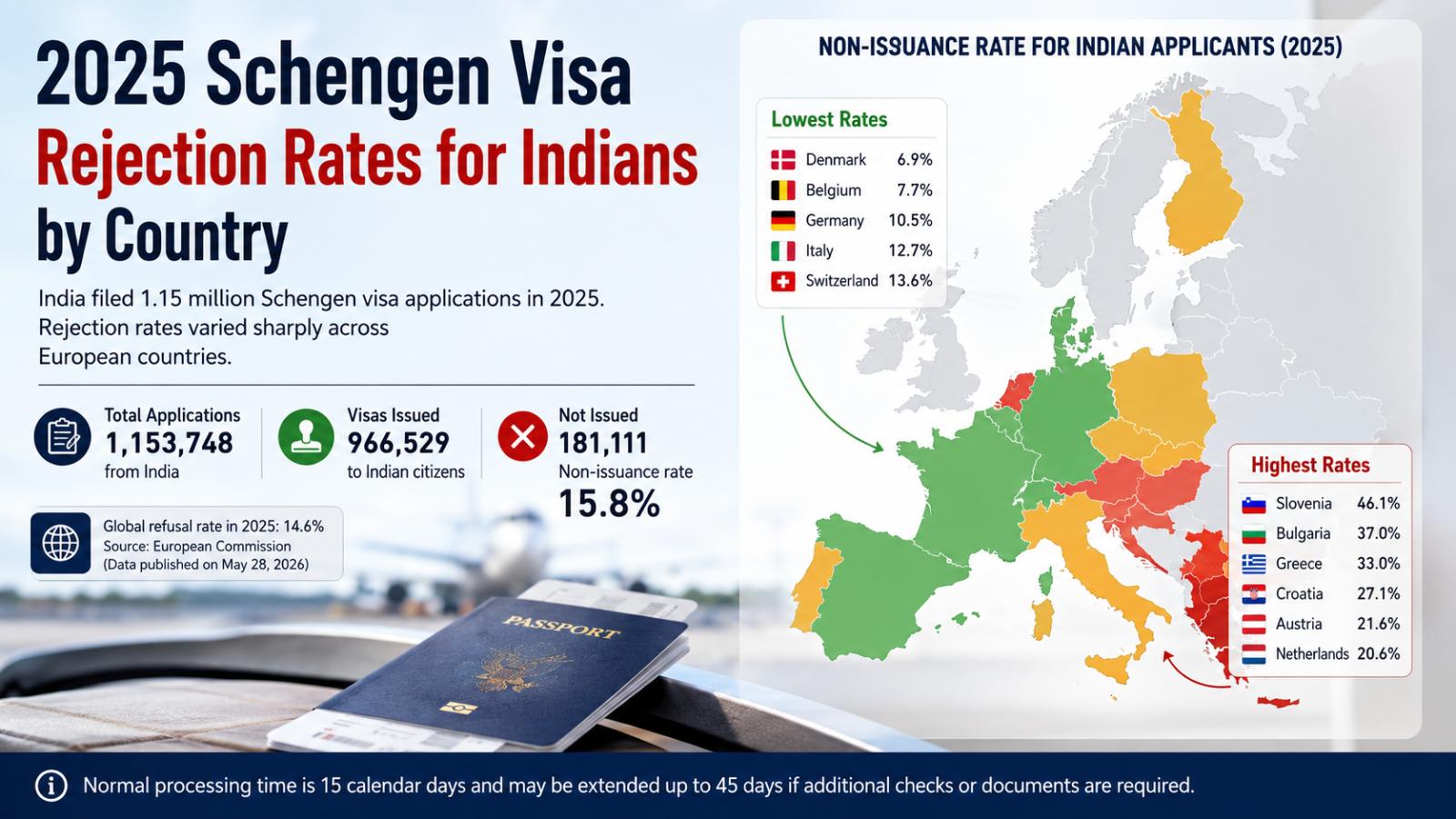
Indian residents filed 1,153,748 Schengen short-stay visa applications in 2025, and 181,111 did not result in a uniform visa, according to European Commission data published on Thursday, May 28, 2026. Under the Commission’s methodology, India’s non-issuance rate was 15.8%, compared with a global refusal rate of 14.6%.
India was the world’s third-largest source of Schengen visa applications, behind China and Türkiye. A total of 966,529 uniform visas were issued to applicants filing from India.
Schengen visa rejection rates for Indians by country in 2025
Country-level outcomes varied sharply. When non-issued applications are compared with total applications, Slovenia recorded the highest rate at 46.1%, followed by Bulgaria at 37.0% and Greece at 33.0%. Austria stood at 21.6%, while the Netherlands recorded 20.6%.
At the lower end, Denmark recorded a 6.9% non-issuance rate, Belgium 7.7% and Germany 10.5%. Italy’s rate was 12.7%, while Switzerland—India’s largest Schengen destination by application volume—recorded 13.6%.
The comparison requires caution. Smaller destinations can show large percentage swings because they process far fewer applications. The European Commission dataset also uses the term “not issued,” which should not automatically be treated as identical to a formal refusal in every case.
What Indian travelers should know before applying
Applicants must apply through the country that is their main destination or where they will spend the longest period—not simply the country with the lowest historical rate. For equal-length stays, the application should go to the country of first entry.
European Union guidance lists a normal processing period of 15 calendar days. It may be extended to 45 days when additional review or documents are required. Applicants may be asked for proof of their travel purpose, financial means, accommodation and intention to return home.
The 2025 data matters because it shows that outcomes differed substantially across consulates, even within the shared Schengen framework. Travelers should use the figures as context, not as a shortcut, and apply to the correct destination with complete and consistent documentation.