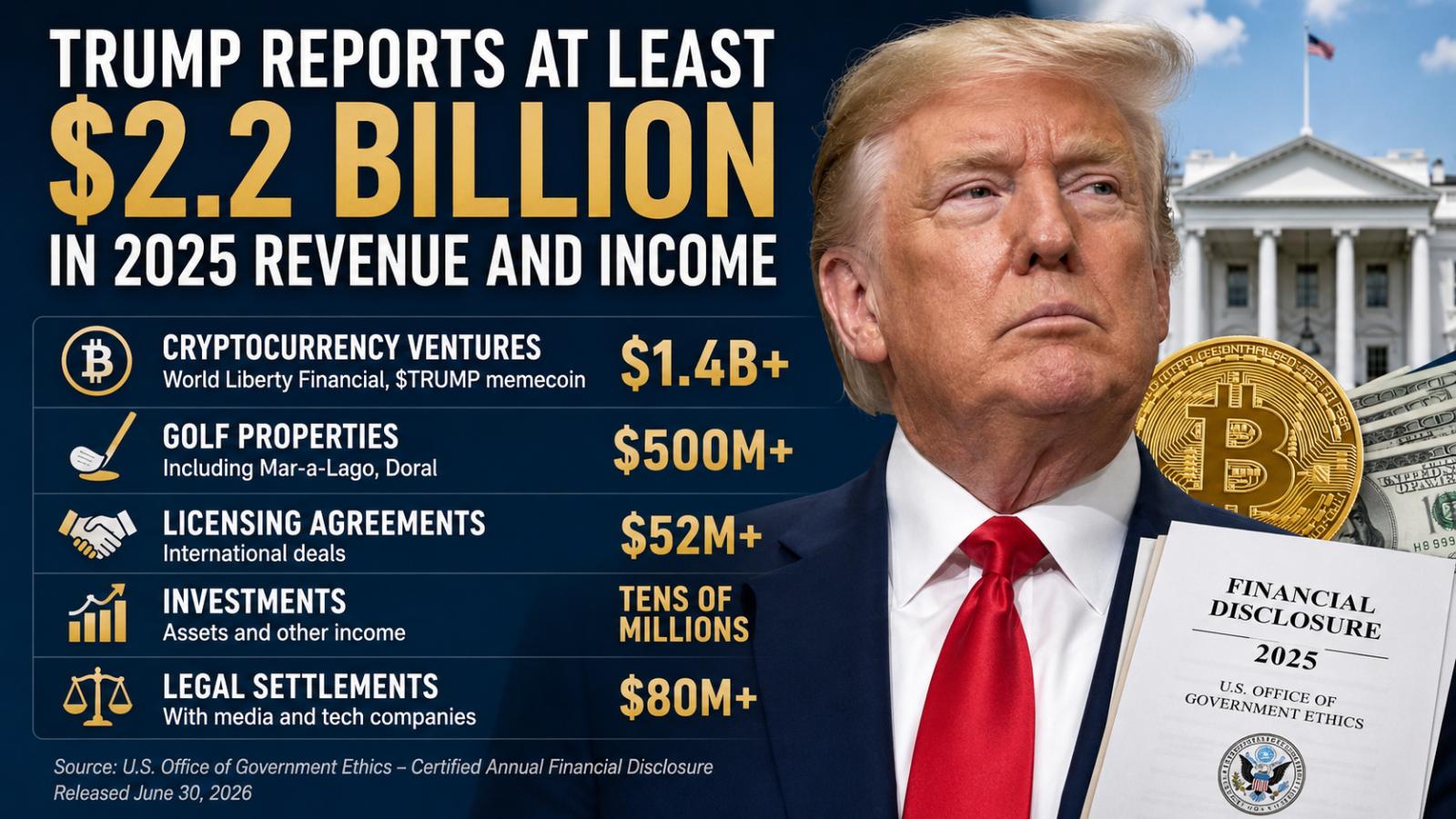
President Donald Trump’s 2025 financial disclosure shows more than $2.2 billion in reported revenue and income from cryptocurrency ventures, golf properties, licensing agreements, investments and legal settlements.
The U.S. Office of Government Ethics released Trump’s certified annual financial disclosure on Tuesday, June 30, 2026. The nearly 1,000-page filing provides an extensive but incomplete picture of his businesses, assets and income because some entries are reported in ranges and business revenue does not represent profit.
Trump Crypto Income Exceeds $1.4 Billion
Cryptocurrency was the largest reported source of income.
Trump’s companies received almost $800 million from World Liberty Financial, the digital-asset venture he co-founded with his sons. That included more than $520 million from token sales and more than $250 million from the sale of business interests.
Trump also reported $635 million from the sale of Trump-branded memecoins. Together with other digital-asset activity, his family’s crypto ventures produced more than $1.4 billion in reported income during 2025.
The figures are attracting renewed scrutiny because Trump’s administration has pursued policies welcomed by the cryptocurrency industry. The White House rejected allegations of conflicts of interest and said the president’s actions were taken in the public interest. Trump’s business interests are overseen by his children, although he remains a beneficiary of the trust receiving the income.
Golf, Licensing and Settlements Add Millions
Trump’s golf courses and resorts reported slightly more than $500 million in 2025 revenue, an increase of about 15%. Mar-a-Lago generated $77 million, up from $50 million during the previous year.
Overseas property licensing produced approximately $52 million, driven largely by agreements involving Middle Eastern developers. Trump also reported more than $80 million from settlements involving media and technology companies.
The disclosure illustrates how cryptocurrency has become a central part of Trump’s business finances during the first year of his second presidency. It also adds to questions about how presidential policymaking should be separated from privately owned businesses that may benefit from government decisions.