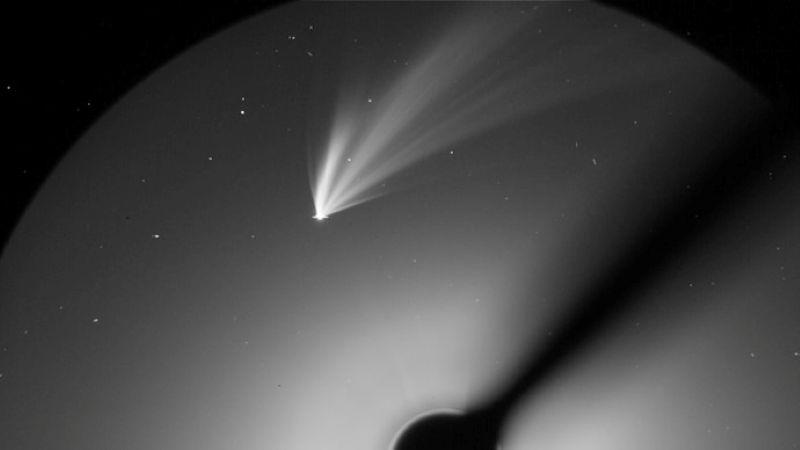
Astronomers have confirmed the passage of a rare interstellar visitor comet 3I/ATLAS through our solar system. First detected on July 1, 2025, by NASA’s ATLAS telescope in Chile, it is only the third such object ever observed, following Oumuamua in 2017 and 2I/Borisov in 2019. Traveling at an astonishing 208,800 km/h, 3I/ATLAS is expected to make its closest approach to the Sun on October 30 at a distance of 1.4 AU, just inside Mars’ orbit.
Despite its high speed and mysterious origin from the direction of the Sagittarius constellation, 3I/ATLAS poses no danger to Earth. NASA confirms that it will stay at a safe distance of 1.6 AU about 150 million miles from our planet. Although faint and fast-moving, astronomers believe it could brighten to magnitude +11 in October, possibly becoming visible to amateur astronomers with mid-sized telescopes.
What makes 3I/ATLAS truly significant is not the threat it poses, but the scientific potential it carries. As a visitor from beyond our solar system, the comet offers a rare chance to study materials from distant planetary systems. By observing its brightness, behavior, and composition, scientists hope to uncover clues about how worlds form in other parts of the galaxy. In essence, 3I/ATLAS is a harmless but fascinating reminder that our solar system is not isolated and that the universe still holds many cosmic surprises.