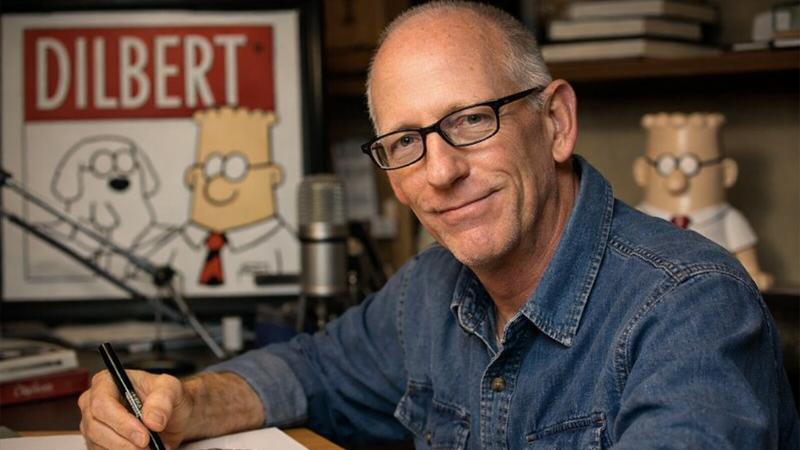
Scott Adams, the cartoonist whose comic strip “Dilbert” became a defining satire of modern corporate life before his career unraveled amid controversy, has died at the age of 68. His death was announced Tuesday by his former wife, Shelly Miles, during a livestream posted on Adams’ social media accounts. She said he died at his home in Northern California, where he had been receiving hospice care.
Adams had revealed in 2025 that he was suffering from prostate cancer that had metastasized to his bones. In a statement shared near the end of his life, he reflected on his career and personal journey, writing that he had lived “an amazing life” and had given it everything he had.
At its peak, “Dilbert” was one of the most widely distributed comic strips in the world, appearing in approximately 2,000 newspapers across more than 70 countries and translated into at least 25 languages. Featuring a bespectacled, mouthless engineer navigating a maze of corporate absurdities, the strip struck a nerve with white-collar workers who saw their own frustrations mirrored in its panels. Its depiction of pointless meetings, vague performance metrics, and incompetent management became a shared language of workplace cynicism.
Adams’ success was formally recognized in 1997 when he received the National Cartoonist Society’s Reuben Award, the profession’s highest honor. That same year, “Dilbert” achieved a rare cultural milestone when its title character was named to a major magazine’s list of the most influential Americans, underscoring how deeply the strip had penetrated office culture. The comic’s popularity fueled a broader empire that included bestselling books, licensed merchandise, advertising campaigns, and an animated television series.
The origins of “Dilbert” traced back to Adams’ own experiences in corporate America. A graduate of Hartwick College with an MBA from the University of California, Berkeley, Adams worked at Pacific Bell during the 1980s. He initially shared his cartoons with colleagues, drawing humor from daily office routines before submitting his work to syndicators. The first “Dilbert” strip was published in April 1989, years before workplace comedies became a dominant genre in film and television.
Over time, Adams expanded the strip’s mythology, introducing characters such as the pointy-haired boss, the perpetually disengaged Wally, the idealistic intern Asok, and the volatile engineer Alice. The strip also popularized the so-called “Dilbert Principle,” a satirical observation suggesting that incompetent employees are often promoted into management to minimize the damage they cause. Adams maintained an unusually direct relationship with readers, becoming one of the first syndicated cartoonists to include his email address in his strip, which he said provided a steady stream of ideas.
Despite its enduring popularity, the “Dilbert” brand collapsed rapidly in 2023 after Adams made repeated racist remarks, including referring to Black people as a “hate group” and stating he would no longer support Black Americans. Although he later claimed his comments were exaggerated for effect, he continued to defend them. Newspapers swiftly dropped the strip, and his longtime distributor severed its relationship with him. Planned publishing projects were canceled, and the comic effectively disappeared from mainstream media.
Adams responded by relaunching the strip online under the name “Dilbert Reborn” and shifting much of his commentary to alternative platforms, where he discussed political and social issues and framed his professional downfall as a free speech issue. In public statements, he portrayed himself as a victim of ideological intolerance rather than professional accountability.
In retrospect, critics noted that Adams’ controversial views had surfaced years earlier through blog posts, interviews, and increasingly political themes in his work. Observers pointed to a gradual shift in tone, with strips and commentary reflecting grievances about race, gender, and social change that diverged sharply from the workplace satire that had originally defined his career.
Scott Adams leaves behind a complicated legacy. For decades, “Dilbert” articulated the quiet frustrations of office workers around the world and helped shape how corporate culture was lampooned in popular media. At the same time, his later remarks and actions overshadowed much of that work, prompting debates about the separation of art from artist and the consequences of public speech. His death closes the chapter on a figure who was, for better or worse, a significant and polarizing presence in American cultural life.