Plot:
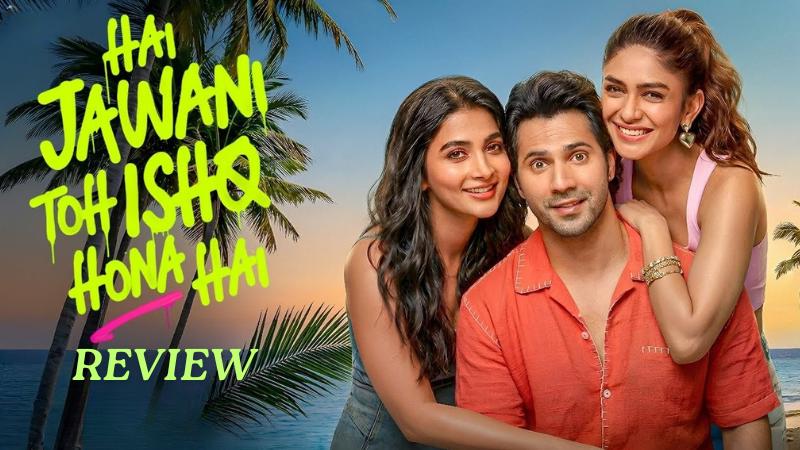
Hai Jawani Toh Ishq Hona Hai follows Jas, played by Varun Dhawan, and his wife Bani, played by Mrunal Thakur, whose marriage reaches the edge of divorce because of conflicting life priorities. Jas wants to become a father immediately, while Bani wants to focus on her career before starting a family. Instead of treating this conflict with emotional depth, the story shifts into a chaotic comedy setup when Jas travels to London and meets Preet, played by Pooja Hegde. What follows is a messy web of misunderstandings, mistaken emotions, two women, pregnancy confusion and loud comic situations built in classic David Dhawan style.
Overview:
David Dhawan returns to his familiar comedy formula with mistaken identities, exaggerated characters, colourful visuals and over-the-top situations. The film tries to recreate the flavour of 90s Bollywood comedy, but the problem is that the humour feels outdated in 2026. What once worked as harmless madness now feels stretched, repetitive and disconnected from today’s audience expectations. The film has nostalgia, glamour and a few comic moments, but it struggles to feel fresh.
Performances:
Varun Dhawan gives a highly energetic performance, but his act often feels forced rather than effortless. His body language and dialogue delivery appear heavily inspired by old-school Salman Khan and Govinda-style heroes, but the imitation becomes tiring after a point. Mrunal Thakur and Pooja Hegde look graceful but are given limited scope. Their characters mostly react to Jas’s confusion instead of driving the story. Johnny Lever, Rajpal Yadav, Manoj Pahwa, Jimmy Shergill, Rakesh Bedi, Mouni Roy and Chunky Panday provide some genuinely enjoyable moments and understand the comic tone better than the lead track.
Technical Aspects:
The film looks glossy and expensive. The London locations are captured attractively, and the cinematography gives the movie a bright, polished look. However, the visuals feel too artificial at times, with every frame looking overly clean and airbrushed. The production design supports the colourful comedy mood, but the writing does not match the visual polish.
Music:
The music works mainly because of nostalgia. Familiar David Dhawan-style songs and recreated tunes such as Chunari Chunari and Mujhse Shaadi Karogi bring energy to a few scenes. However, the songs also remind viewers of better and more entertaining films from the past. The soundtrack adds colour, but it does not fully rescue the weak screenplay.
Editing:
The editing keeps the film moving, but the pacing is uneven. The first half tries too hard to generate laughs, while the second half works slightly better because the audience adjusts to the film’s tone. Some scenes feel stretched beyond their comic value, and tighter editing could have reduced the fatigue.
Positives:
The film has glossy visuals, attractive London locations and a colourful presentation. The supporting comedy cast brings a few fun moments. Nostalgic music helps lift some portions. David Dhawan’s ability to create chaos with multiple characters still appears in flashes.
Negatives:
The humour feels outdated. The screenplay depends too much on old tricks, body-shaming jokes, gender stereotypes and forced confusion. Varun Dhawan’s performance becomes too loud in several scenes. Mrunal Thakur and Pooja Hegde do not get strong character arcs. The emotional conflict between career, marriage and parenthood is underwritten. The comedy often mistakes noise for humour.
Analysis:
Hai Jawani Toh Ishq Hona Hai does not fail because it is loud or unrealistic. David Dhawan’s cinema has always been loud, unrealistic and chaotic. The real issue is that the film behaves as if audience taste has not changed in the last three decades. Modern viewers are used to sharper writing, better relationship dynamics and comedy that does not depend only on confusion and exaggeration. The film wants to be a nostalgic celebration of Dhawan’s old style, but it ends up exposing why that style needs reinvention.
There are moments where the old David Dhawan spark appears, mostly through the supporting comedians. But those moments are not enough to carry a film built on a dated premise. The central marital conflict had potential, but instead of exploring it with wit or emotion, the screenplay turns it into a chaotic triangle that feels more tiring than funny. For fans of 90s Bollywood comedy, the film may offer brief nostalgia. For others, it may feel like an old formula trying too hard to remain relevant.
Bottomline: Formula Expired
Rating: 2.5/5