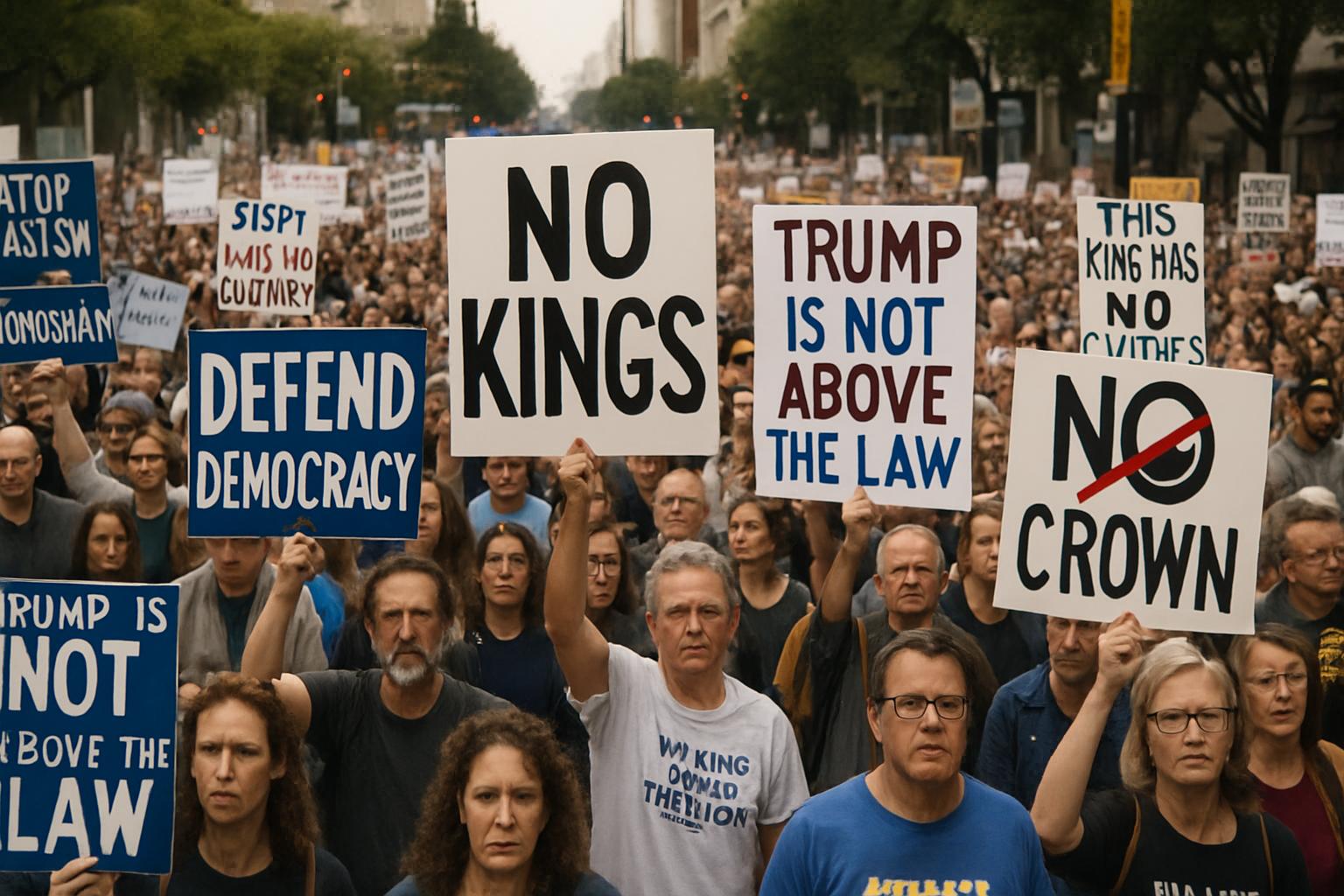
Mass demonstrations are expected across the United States on Saturday as protesters gather in thousands of cities and towns for the second “No Kings” protest of the year. The coordinated events are being organized in opposition to what participants describe as increasingly authoritarian actions by President Donald Trump and his administration.
The “No Kings” movement, which has been active since early 2025, is centered on defending democratic institutions, civil liberties, and the right to peaceful assembly. Organizers expect turnout to exceed the previous wave of demonstrations held in June, with more than 2,500 gatherings planned nationwide — from major cities like New York and Chicago to small communities such as East Glacier Ridge, Montana.
Ezra Levin, co-executive director of the nonprofit Indivisible and a lead organizer of Saturday’s events, said the protests are a direct response to what he called a “crackdown on First Amendment rights.” Levin pointed to recent federal actions — including restrictions on press freedom, aggressive immigration enforcement, and efforts by the president to influence midterm elections — as evidence of executive overreach. “We believe this moment calls for Americans to stand up peacefully but firmly for the principles that define our democracy,” Levin said.
While most demonstrations are expected to be peaceful, security measures are being heightened nationwide. Some conservative politicians have criticized the gatherings, referring to them as “Hate America rallies,” while supporters say they represent a patriotic defense of the Constitution.
In the Bay Area, several large “No Kings” marches are scheduled. In San Francisco, protesters will gather at Embarcadero Plaza and Sue Bierman Park at 1:30 p.m. before marching along Market Street to Civic Center Plaza for a rally at 3:30 p.m. Smaller demonstrations will take place earlier in the day at Ocean Beach, where participants plan to form a human banner at 11 a.m. In Palo Alto, organizers will hold a parade beginning at 11:30 a.m., leading to a democracy fair at Rinconada Park. Additional rallies are scheduled in Oakland, San Jose, and Santa Rosa, each emphasizing local community involvement and voter engagement.
In Chicago, tens of thousands of demonstrators are expected to fill a Lake Michigan park before marching downtown. The city has seen a rise in federal immigration enforcement activity, with more than 1,000 arrests since September. Protests there have intensified in recent weeks, particularly near a suburban federal processing center. “People are angrier now,” said Denise Poloyac, an organizer with Indivisible Chicago. “It feels more immediate, more personal, and that’s why people are showing up.”
In Utah, organizers are focusing on healing and unity following a tragedy at the June protests, where a demonstrator was accidentally killed after a confrontation turned deadly. Jamie Carter, a Salt Lake Indivisible organizer, said safety volunteers this weekend will be unarmed and trained in de-escalation tactics. “We want this to be uplifting — a chance for the community to come together and replace painful memories with hope,” Carter said.
Officials in several states are preparing for large crowds. Texas Governor Greg Abbott announced the activation of the National Guard to assist local police in maintaining order, stating that anyone engaging in violence or property damage will be arrested. California Governor Gavin Newsom, meanwhile, encouraged peaceful participation, saying he hopes Californians “turn out in large numbers to show that democracy still matters.”
The “No Kings” coalition, which includes Indivisible and other civic organizations, has conducted virtual safety trainings ahead of the marches with the help of legal experts and civil rights groups. The sessions focused on protesters’ rights, de-escalation strategies, and state-specific rules regarding identification and masks. Organizers say each event has designated medics, safety officers, and emergency meeting points.
Saturday’s demonstrations come amid growing tension between federal law enforcement and protesters in several major cities. Trump’s decision to deploy National Guard troops to Washington, D.C., and Memphis drew sharp criticism, while similar efforts in Chicago and Portland have been temporarily blocked by the courts.
The last “No Kings” protest in June drew hundreds of thousands nationwide and remained mostly peaceful despite isolated confrontations in Los Angeles and Portland. Organizers hope this weekend’s turnout will send a renewed message that, even in a politically divided climate, citizens are still willing to defend democratic values.
As protests unfold from coast to coast, participants say the goal is not only to oppose specific policies but to inspire sustained civic engagement. “If people walk away from Saturday feeling more connected and more determined to protect their freedoms,” Levin said, “then we’ve succeeded.”