The fragile ceasefire between India and Pakistan remains intact as of now, following a tense night of missile and drone attacks by Pakistan across the Line of Control (LoC) and International Border (IB). This came just hours after both nations agreed to halt all military action following the high-impact Operation Sindoor, India’s counter-terror offensive launched in response to the April 22 Pahalgam terror attack. The ceasefire was officially acknowledged by both sides late Saturday, after US President Donald Trump announced the breakthrough in a social media post. Soon after, India’s Foreign Secretary Vikram Misri confirmed that a direct conversation between the Directors General of Military Operations (DGMOs) of both countries had resulted in an agreement to cease hostilities on land, air, and sea with immediate effect.
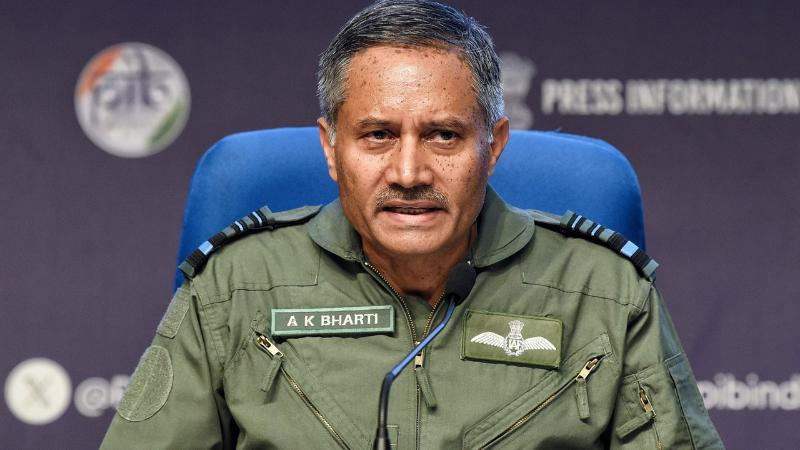
However, Pakistan violated the terms within hours, launching missile and drone attacks on Indian military installations and border areas in Jammu and Kashmir. Despite the provocation, Indian forces successfully intercepted several unmanned aerial vehicles using indigenous counter-drone systems. Speaking at a high-level briefing, Air Marshal AK Bharti, Director General Air Operations, stated that India’s military infrastructure remains fully functional. “Our bases are operational, our equipment is mission-ready, and we are prepared to respond decisively if the situation escalates again,” he said. He also praised the robust performance of India’s indigenous Akash air defence system in recent days.
Earlier in the day, Prime Minister Narendra Modi chaired a critical national security meeting with National Security Advisor Ajit Doval, Defence Minister Rajnath Singh, Chief of Defence Staff Gen. Anil Chauhan, and the tri-services chiefs. The group reviewed the security situation post-ceasefire and discussed next steps in case of renewed escalation. Operation Sindoor, launched by India on May 7, targeted multiple terror camps in mainland Pakistan and Pakistan-occupied Kashmir. The strike was a direct response to the brutal terrorist attack in Pahalgam that claimed the lives of 26 civilians, most of them tourists. According to Defence Ministry sources, over 100 terrorists were neutralized, and key infrastructure used by Lashkar-e-Taiba, Jaish-e-Mohammed, and Hizbul Mujahideen was destroyed.
The initial response from Pakistan, which involved missile and drone strikes in Punjab, Rajasthan, and Jammu & Kashmir, led to civilian injuries and temporary blackouts in cities like Chandigarh, Jaisalmer, and Pathankot. One government employee in Rajouri was killed, and multiple civilians were injured in Ferozepur, Punjab. Despite this, the situation along the LoC and IB is reportedly stable now, with no new incidents since Sunday afternoon. India has not retaliated further, choosing instead to observe Pakistan’s compliance with the ceasefire agreement while remaining combat-ready.
As the region returns to an uneasy calm, the spotlight is now on diplomatic backchannels and international mediation. Observers point out that this ceasefire might be a temporary pause unless deeper issues, particularly state-backed terrorism, are addressed. India has reiterated that any future violations will invite strong military response, and emphasized that the country retains full right to defend its sovereignty. The Defence Ministry has also confirmed that surveillance operations have been intensified across all vulnerable sectors. In the coming days, developments will be closely monitored as India remains vigilant and prepared for any shift in Pakistan’s stance. For now, the ceasefire holds but the atmosphere is far from relaxed.