Donald Trump Surprises Liberian President With English Compliment During Africa Summit Ask ChatGPT
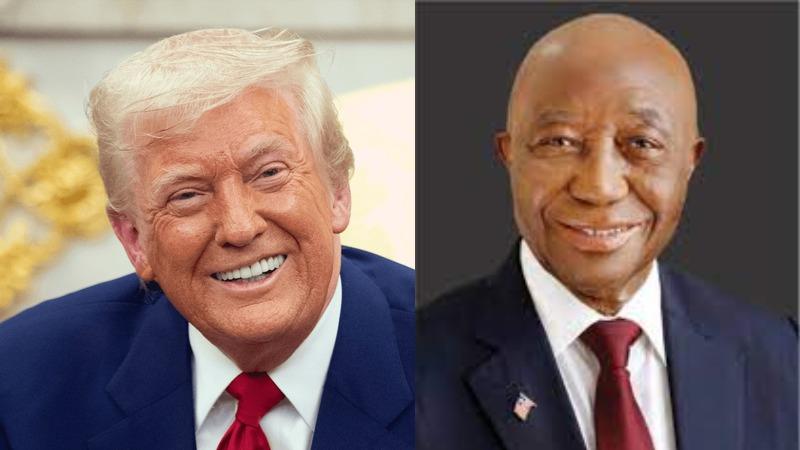
US President Donald Trump became the center of yet another viral moment after he praised the English-speaking skills of Liberian President Joseph Boakai during a White House summit with African leaders. The remark quickly drew attention online, given that English is the official language of Liberia. The incident took place during a formal meeting where several African heads of state had gathered to discuss trade, development, and diplomatic relations with the United States.
As the event unfolded, Liberian President Joseph Boakai took the microphone and addressed Trump in fluent English, expressing his support for the American administration's policies. “Liberia is a longtime friend of the United States, and we believe in your policy of making America great again,” Boakai said. He further thanked Trump for the opportunity to attend the meeting and urged American investment in Liberia.
In response to the Liberian president’s remarks, Trump appeared genuinely impressed. “Such good English, such beautiful…” he said, pausing before asking, “Where did you learn to speak so beautifully? Where were you educated?” Boakai, slightly amused by the question, smiled and replied, “Yes, sir, in Liberia.” Trump, apparently surprised, responded, “That’s very interesting, that’s beautiful English. I have people at this table who can’t speak nearly as well.” The interaction, though meant as a compliment, drew criticism and humor online, as many noted that Liberia has used English as its official language since its founding.
Liberia has a unique historical connection with the United States. It was established in 1822 as a settlement for freed Black Americans. The idea was backed by segments of white Americans who believed that the repatriation of freed slaves to Africa would solve potential racial conflicts in post-slavery America. As a result, Liberia adopted many American political institutions, cultural traits, and English as its official language. While multiple Indigenous languages are spoken across the country, English remains the primary medium in governance, education, and formal communication.
The viral exchange occurred during a meeting that included leaders from Gabon, Guinea-Bissau, Mauritania, Senegal, and Liberia. Trump used the occasion to emphasize a new strategic direction for US-Africa relations. He reiterated his administration’s focus on strengthening partnerships through trade rather than aid. “We’re shifting from aid to trade,” Trump stated during the meeting. “There’s great economic potential in Africa, like few other places. In many ways, in the long run, this will be far more effective and sustainable and beneficial than anything else that we can be doing together.”
Trump also sought to differentiate the United States from other global powers engaging with the continent, saying the US would be a more committed and transparent partner than countries like China. While several African leaders spoke in their native languages through interpreters, Boakai’s use of English led to the unexpected spotlight moment.
Despite the awkward exchange, the overall tone of the summit was one of mutual respect and optimism. African leaders applauded Trump’s role in promoting global peace deals and even suggested he should be considered for the Nobel Peace Prize. “We are not poor countries. We are rich countries when it comes to raw materials. But we need partners to support us and help us develop those resources,” said Gabon’s President Brice Clotaire Oligui Nguema. He invited American companies to invest in African economies, subtly warning that if the United States does not act, other nations would.
Trump also hinted at the possibility of visiting Africa in the near future. He underscored that his administration was committed to a more engaged and practical approach toward the continent. “There’s so much opportunity,” Trump said. “Africa can be one of the most important partners in the future, not only for the United States but for the world.”
While Trump's remark about Boakai's English may have raised eyebrows, it also brought renewed attention to Liberia’s deep historical ties with the US, and the broader conversation around cultural awareness in diplomacy. The moment may serve as a reminder that mutual understanding and historical knowledge are crucial when building global partnerships. At the same time, it reinforced the need for respectful communication, especially on the world stage where nuance is often magnified.
As the video of the exchange continues to circulate online, it has sparked both amusement and critique. Still, for many, the larger takeaway remains the importance of enhancing US-Africa relations through equal dialogue, economic cooperation, and acknowledgment of shared histories. Whether this incident becomes a footnote or a teaching moment depends on how such interactions are interpreted and learned from in future diplomatic engagements.