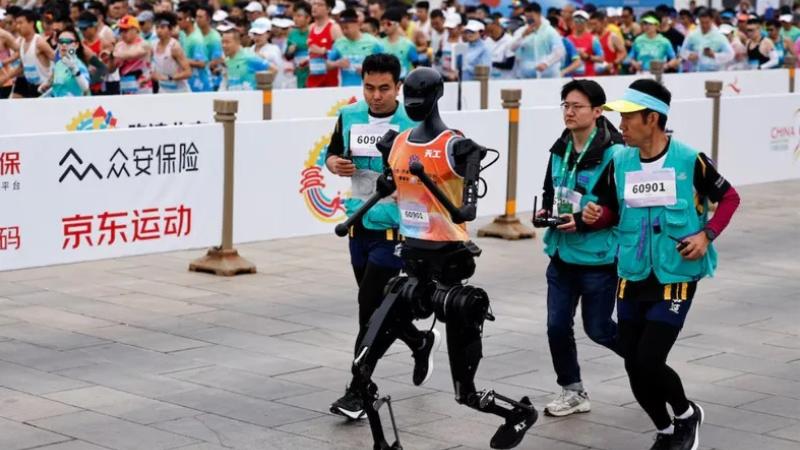
Humanoid robots, once confined to the realms of science fiction, are now becoming a reality with real-world applications. From lifting heavy loads in warehouses to assisting astronauts in space, these robots are designed not just to look human, but to move, act, and even think like one. Rapid advancements in AI, robotics, sensors, and actuators have led to an era where machines are no longer stationary units with limited functions. Instead, we are entering the age of humanoid robots that walk among us literally and figuratively.
With better AI chips, longer-lasting batteries, advanced mechanical engineering, and smart algorithms, robots are becoming increasingly capable. According to Nvidia, there is a looming global shortage of over 50 million workers, which is accelerating the push toward automation and AI-driven labor. Humanoid robots are being developed to operate in human environments: opening doors, climbing stairs, conversing, and performing multiple tasks traditionally done by people.
Nvidia CEO Jensen Huang declared the “age of generalist robotics” with the unveiling of the Nvidia Isaac GR00T N1 an open-source model for humanoid reasoning. In Amazon warehouses, robots already move packages and assist in logistics. Humanoids are now being programmed not only for industrial use but also for household and healthcare assistance. They’re becoming smarter and more mobile, built to complement and eventually augment the human workforce.
Tesla is a key player leading the humanoid charge. Its robot, Optimus, is designed as a general-purpose robotic assistant. Tesla CEO Elon Musk revealed plans to deploy 5,000 Optimus units in 2025 and scale up to 50,000 by 2026. Musk envisions a future where humanoid robots outnumber humans, performing repetitive, dangerous, or mundane tasks at home and work. Optimus has already been shown walking, sorting items, folding clothes, boiling eggs, doing yoga, and more all autonomously. The robot uses the same AI systems as Tesla’s autonomous cars, which helps it perceive and interact with the environment in real time.
Boston Dynamics, known for its robotic dog Spot, has developed Atlas, a humanoid robot known for its agility and fluid motion. The electric version of Atlas can now run, flip, and perform dynamic maneuvers with ease. Hyundai plans to deploy this robot in U.S. factories by 2025. Unlike many stiff-moving robots, Atlas glides with grace and precision, pushing the envelope of what humanoid mobility can look like in industrial settings.
Amazon is moving beyond conveyor belts and robotic arms with its Proteus robot. Its Lab126 division is working on more human-like robots, including those intended for use in homes. Amazon’s vision includes tabletop humanoids that assist with daily chores like cooking, fetching, and cleaning.
Meanwhile, companies like Nvidia, Google, and Microsoft are powering the "brains" behind these robots. Nvidia’s GR00T N1 model allows robots to reason and act intelligently in complex environments. Google’s DeepMind is working on AI models that help robots learn tasks like playing football or understanding human commands. Google’s Gemini Robotics platform focuses on embodied reasoning, where AI connects perception with physical action. Microsoft introduced Magma, an AI model that can generate action plans and execute them in the physical world, from manufacturing to healthcare environments.
Meta and Apple are also investing in humanoids, although their approach focuses more on AI companions and human-machine interaction. Meta is developing humanoid assistants integrated with its AR and VR platforms using its Llama models. Apple, though secretive, is reportedly working on a tabletop humanoid assistant integrated with smart home devices and iPads.
India is also entering the humanoid space through ISRO, which has developed Vyommitra a semi-autonomous female humanoid intended for space missions. As part of the Gaganyaan program, Vyommitra will be launched on an orbital test mission to assist astronauts, interact in Hindi and English, monitor spacecraft systems, and carry out safety checks. She represents the next step in merging AI, robotics, and space exploration.
Today’s humanoids excel in four major areas: mobility, dexterity, sensing, and interaction. Robots like Atlas and DeepMind’s models can run and balance thanks to AI-driven controls and actuators. Tesla’s Optimus and similar bots use articulated hands for grasping, packing, or performing delicate tasks. With advanced sensors and 3D vision, these machines navigate dynamic environments while avoiding obstacles. Language models and natural speech processing enable them to take voice commands, hold conversations, and learn from interaction.
As the next five to ten years unfold, humanoids may become commonplace. From assisting in elderly care and household tasks to becoming colleagues on the factory floor, their roles are expanding. With increasing investments from the biggest names in tech, humanoid robots are poised to reshape industries and redefine everyday life. While timelines remain flexible, the reality is clear: the age of humanoids has already begun. AI is no longer just in your phone or laptop it’s getting a body. And it’s here to stay.