

















The Indian Space Research Organisation experienced a tense morning on Tuesday after the Polar Satellite Launch Vehicle C62 lifted off from the Satish Dhawan Space Centre in Sriharikota at 10.18 am carrying a total of 16 satellites. The mission initially appeared to progress as planned, with scientists closely monitoring each phase of the flight. However, around 30 minutes after liftoff, ISRO confirmed that the mission had encountered an anomaly during the third stage of the launch sequence, r
India marked another defining moment in its space journey as the powerful Bahubali rocket successfully blasted off carrying the heaviest satellite ever launched by the country. The Launch Vehicle Mark-3 M6 mission lifted off from the second launch pad at the Satish Dhawan Space Centre in Sriharikota, Andhra Pradesh, showcasing India’s growing dominance in heavy-lift and commercial space missions. The 43.5-metre-tall LVM3 rocket, supported by two massive S200 solid boosters, took t
India’s space journey reached another landmark moment as Indian Space Research Organisation successfully launched the heaviest foreign satellite ever placed into orbit from Indian soil. The mission was carried out using the powerful LVM3 launch vehicle from the Satish Dhawan Space Centre in Sriharikota, reinforcing India’s growing reputation as a reliable and competitive space launch destination
In a remarkable achievement for Indian academia and space research, Assistant Professor Alok Sagar Gautam from the Department of Physics at Hemvati Nandan Bahuguna Garhwal University has been selected to join the Indian Space Research Organisation’s upcoming Venus Orbiter Mission, officially known as Shukrayaan-1. This marks a significant moment in India’s pursuit of interplanetary exploration, as the mission represents the nation’s first dedicated effort to study Venus, often referred
At the prestigious Semicon India 2025 conference, Prime Minister Narendra Modi was presented with India's first indigenously developed 32-bit microprocessor – the Vikram-32 chip. This groundbreaking achievement, showcased by Electronics and IT Minister Ashwini Vaishnaw, marks a monumental step in India's journey towards semiconductor self-reliance. Developed by the Indian Space Research Organisation&rsq
The Tokyo Skytree, the tallest tower in Japan and one of the most iconic landmarks of the country, was illuminated in the colours of the Indian national flag to mark the visit of Prime Minister Narendra Modi to Tokyo on Friday, August 29. The tricolour lighting served as a symbolic gesture reflecting the warmth of the relationship between India and Japan. Modi is in Japan for a two-day visit to participate in the 15th Annual India-Japan Summit, which was hosted
Asteroid 2025 QY4 is drawing the attention of both scientists and astronomy enthusiasts as it prepares to make a close approach to Earth this week. The asteroid, which belongs to the Aten group of space rocks known for orbiting across Earth’s path, measures nearly 180 feet in diameter and is travelling at an astonishing speed of more than 39,000 miles per hour. Its size and velocity make it an object worth monitoring, even though experts have already conf
India took a major step towards its long-term space ambitions as ISRO unveiled a model of the Bharatiya Antariksh Station (BAS) during National Space Day celebrations in New Delhi. The move signals India’s entry into the elite group of nations operating orbital laboratories, joining the ranks of the International Space Station (ISS) and China’s Tiangong station. The first BAS module, BAS-01
India has achieved a significant milestone in its space exploration and climate monitoring goals with the successful launch of the Nasa-Isro Synthetic Aperture Radar (Nisar) satellite. Launched on July 30, 2025, from the Satish Dhawan Space Centre in Sriharikota, the satellite is a $1.5 billion joint venture between the Indian Space Research Organisation (ISRO) and the United States’ National Aeronautics and Space Administration (Nasa). Weighing 2393 kil
India marked a major milestone in space collaboration today with the successful launch of the NISAR mission, a joint project between ISRO and NASA. Lifted into orbit aboard the GSLV-F16 from Sriharikota, NISAR is set to become the world’s most advanced Earth observation satellite. With a unique dual-frequency Synthetic Aperture Radar that combines NASA’s L-band and ISRO’s S-band systems, the satellite can penetrate clouds, forests, and even d
Indian astronaut Shubhanshu Shukla is set to return to Earth after a landmark mission aboard the International Space Station (ISS) as part of the Axiom-4 crew. The mission, which included extensive scientific research, marked several historic firsts for India. Shukla became the first Indian to visit the ISS and only the second Indian astronaut in space, following Wing Commander Rakesh Sharma's 1984 mission. His return, scheduled for July 14 via the Dragon spacecraft, is part of a well-
Indian astronaut Shubhanshu Shukla is set to make a historic communication from space with school students and scientists from the Indian Space Research Organisation (ISRO) on July 4, 2025. The interaction, which will take place via ham radio, is part of the ARISS (Amateur Radio on the International Space Station) programme, designed to connect astronauts aboard the ISS with students around the world, inspiring the next generation of space explorers.
Group Captain Shubhanshu Shukla, India’s first astronaut aboard the International Space Station (ISS), is conducting a critical space microalgae experiment for the Indian Space Research Organisation (ISRO). This study is aimed at exploring the role of microalgae in sustaining long-duration space missions like Gaganyaan, India’s ambitious human spaceflight program. As part of the experiment, Shukla deployed microalgae sample bags and captured images
The much-anticipated launch of Indian astronaut Shubhanshu Shukla aboard the Ax-4 mission has been delayed once again, marking the seventh postponement of this historic flight. Originally scheduled for May 29, 2025, the mission has faced a string of technical, operational, and weather-related issues. The latest delay, announced by NASA, cites concerns related to recent repairs on the International Space Station (ISS).
The launch of the highly anticipated Axiom-4 mission, which was set to send Indian Air Force Group Captain Shubhanshu Shukla to the International Space Station (ISS), has been postponed once again. This marks the fifth delay in the mission, originally scheduled for June 11, 2025. SpaceX, the aerospace company leading the rocket launch, cited a technical glitch in the Falcon 9 rocket's propulsion system specifically, a liquid oxygen (LOx) leak as the reason
In a forward-thinking move, the Government of Andhra Pradesh has entered into a strategic partnership with ISRO's Satish Dhawan Space Centre (SHAR), Sriharikota, to use space technology for real-time, citizen-focused governance. A Memorandum of Understanding (MoU) was signed on June 2 between the Real Time Governance Society (RTGS) and SHAR, marking a significant step towards integrating advanced satellite data into state governance.
India has officially confirmed the success of a high-precision military operation codenamed Operation Sindoor against terror-linked targets in Pakistan, revealing that the Indian Air Force (IAF) managed to jam Chinese-manufactured air defense systems deployed across the Line of Control and the international border. The mission, carried out in direct response to a recent terror attack in Jammu and Kashmir's Pahalgam that killed 26 Indian tourists, was completed in just 23 minutes and resul
The absence of the United States’ premier space agency, NASA, from the Global Space Exploration Conference (GLEX-2025) in Delhi has raised eyebrows within the international space community. Delegates from 37 countries gathered in the Indian capital to discuss the future of space exploration, yet NASA’s empty seats signaled a shift in U.S. space diplomacy under President Donald Trump’s second term. According to experts familiar with recent developments in Washington
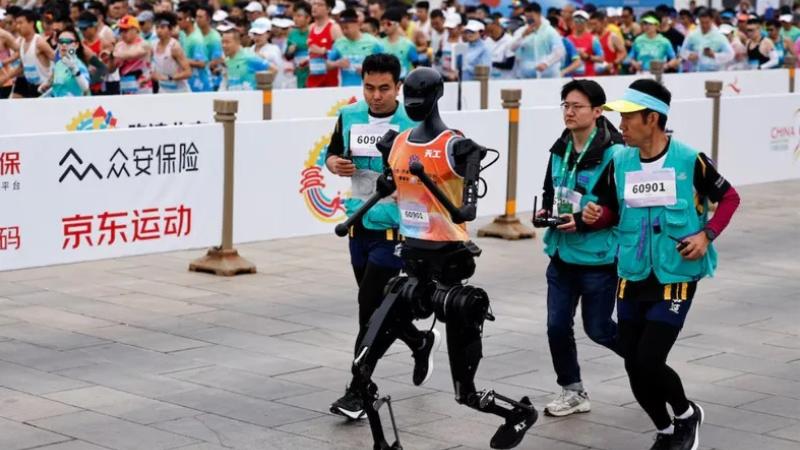
Humanoid robots, once confined to the realms of science fiction, are now becoming a reality with real-world applications. From lifting heavy loads in warehouses to assisting astronauts in space, these robots are designed not just to look human, but to move, act, and even think like one. Rapid advancements in AI, robotics, sensors, and actuators have led to an era where machines are no longer stationary units with limited functions. Instead, we are entering the age of humanoid robots that walk