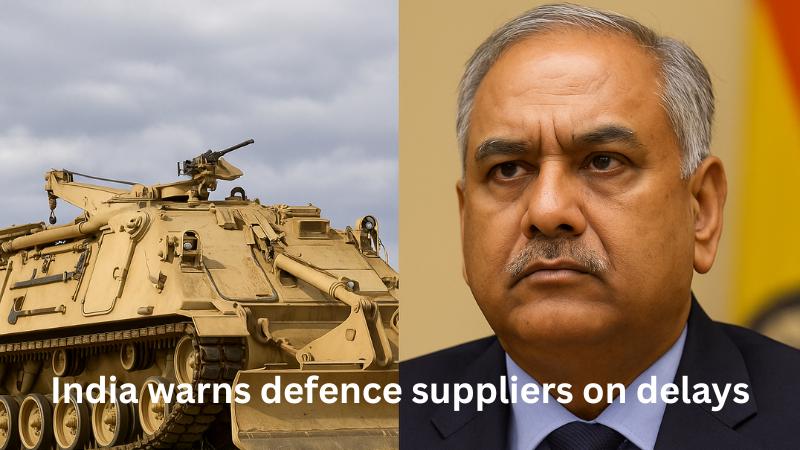
Defence Secretary Rajesh Kumar Singh has issued a clear warning to all companies supplying military platforms and equipment to India, stating that any vendor—domestic or international—will face termination of contracts if they fail to deliver within stipulated deadlines. The announcement comes as delays in defence procurement continue to impact operational planning for the armed forces, including setbacks flagged earlier by Air Force Chief Amar Preet Singh, who acknowledged that delivery timelines remain a persistent challenge for programmes such as the Tejas Mk1A fighter jet.
Speaking at the National Security Summit in New Delhi, the Defence Secretary emphasised that the ministry has adopted a firmer stance, particularly during the ongoing phase of emergency procurement. He noted that contracts will now be foreclosed if deliveries are not completed within one year, without exceptions based on company size, country of origin, or strategic partnerships. According to Singh, the objective is to bring stronger accountability and predictability into India’s defence acquisition process, an area that has faced repeated criticism for delays, procedural hurdles, and uneven supplier performance.
Singh also highlighted that the ministry is preparing to implement stricter liquidated damages for delayed deliveries, reinforcing the message that procurement milestones must be met with greater discipline. The emphasis on stricter enforcement reflects the government’s intention to streamline acquisition cycles as the armed forces continue to pursue modernisation across domains, including fighter aircraft, air defence systems, electronic warfare suites, and advanced engines.
The Defence Secretary pointed out that supply chain disruptions and delivery delays are increasingly a global trend rather than a problem isolated to India. He referenced multiple international setbacks, including delays in the supply of S-400 air defence systems, Israeli military equipment, and orders related to General Electric engines. Singh acknowledged that Indian manufacturers are not the sole contributors to delays, noting that a combination of global instability, production bottlenecks, and ambitious commitments has affected timelines worldwide. However, he cautioned that overpromising and underdelivering remain concerns that the ministry intends to address firmly.
In a significant development related to indigenous capability building, Singh revealed that India is in the final stages of concluding an agreement with a major international engine manufacturer for the joint development of a 120 kN fighter jet engine. The proposed collaboration aims for all manufacturing to be carried out in India, with full intellectual property rights retained domestically. This engine development effort is expected to span 10 to 12 years and aligns with India’s long-term plans for advanced combat aircraft, including the AMCA programme. Discussions on this front are progressing, with formal approval expected at the highest levels of government.
The Defence Secretary’s remarks underline the government’s intention to enforce clearer timelines, promote greater reliability among suppliers, and accelerate domestic defence manufacturing. As India continues to expand its strategic aviation, missile, and naval capabilities, timely delivery of critical systems is expected to play a decisive role in strengthening national defence preparedness in the coming decade.